FitnessGram Curl-Up Test Calculator
Quick Answer
This calculator evaluates your FitnessGram curl-up test performance against official Healthy Fitness Zone (HFZ) standards from The Cooper Institute. Enter your age, gender, and curl-up count to see if you meet the health-related fitness standards.
- Compares results to official FitnessGram standards for ages 5-17+
- Shows Healthy Fitness Zone (HFZ) thresholds by age and gender
- Based on The Cooper Institute's criterion-referenced standards
Good strength and endurance of the abdominal muscles are important in promoting correct posture and pelvic alignment. The curl-up abdominal fitness test requires the participants to perform as many curl-ups as possible following a cadence of one every three seconds. The following information describes the curl-up procedures as used in the FitnessGram Program and the Brockport Physical Fitness Test. There is also a similar Curl-Up test as part of the Connecticut Physical Fitness Test and a beep curl-up test used for the NHL testing. See the general guidelines for Abdominal Endurance Tests.
How to Use This Calculator
Follow these steps to evaluate curl-up test performance against FitnessGram standards:
- Select the student's age - Choose from ages 5 through 17+ from the dropdown menu
- Select gender - Male and female have different HFZ standards
- Enter curl-up count - Input the total number of correctly performed curl-ups (maximum 75)
- Click Calculate - View the Healthy Fitness Zone assessment and detailed results
The calculator automatically determines which measuring strip size should be used (3 inches for ages 5-9, 4.5 inches for ages 10+) and compares results to the appropriate age and gender-specific standards.
What is the FitnessGram Curl-Up Test?
test purpose: The curl-up test measures abdominal strength and endurance, which is important in back support and core stability.
Equipment required:
- A flat, clean, cushioned surface.
- PACER cd with curl-up cadence track. We have an online sit-up metronome that you can use. A sit up beep test mp3 which uses the same cadence is also available. If the cadence cd is not available, you can call out at the set cadence using a stopwatch, use a metronome, or create an audio track using the Team Beep Test software.
- 3.0" or 4.5" Curl-Up Measuring Strip. The 3.0 inch measuring strip is for 5-9 year olds, the 4.5" is used for students age 10 and up. If the manufactured measuring strips are not available, you can mark the floor with some tape, or use a piece of cardboard cut to the right dimensions (see make your own)
Pre-test: Explain the test procedures to the subject. Perform screening of health risks and obtain informed consent. Prepare forms and record basic information such as age, height, body weight, gender, test conditions. See more details of pre-test procedures.
Procedure: The student begins by lying on their back, knees bent at approximately 140 degrees, feet flat on the floor, legs slightly apart, arms straight and parallel to the trunk with palms of the hands resting on the mat. The fingers are stretched out and the head is in contact with the mat. The measuring strip is placed on the mat under the students legs so that their fingertips are just resting on the nearest edge of the measuring strip. The feet cannot be held or rest against an object. Keeping heels in contact with the mat, the student curls up slowly, sliding their fingers across the measuring strip until the fingertips reach the other side, then curls back down until their head touches the mat. Movement should be smooth and at the cadence of 20 curl-ups per minute (1 curl-up every 3 seconds).
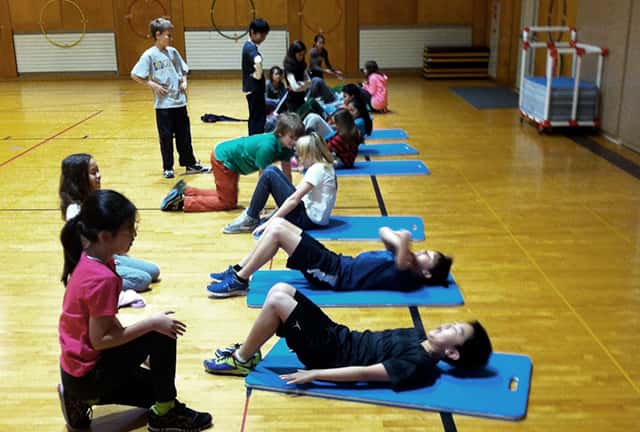
Curl-up testing in progress
Scoring: Record the total number of curl ups. The test is continued until exhaustion (e.g. the subject cannot maintain the set rhythm), or until they complete 75 curl-ups. The test is also stopped if the student has two technique warnings - if the heels come off the floor, the head does not return to the mat, or the fingertips do not reach the far side of the measuring strip.
FitnessGram Healthy Fitness Zone Standards
The following tables show the official FitnessGram Healthy Fitness Zone (HFZ) standards for curl-ups by age and gender. Students who score within this range are considered to have fitness levels associated with reduced health risks.
Boys Curl-Up Standards
| Age | HFZ Minimum | HFZ Maximum | Measuring Strip |
|---|---|---|---|
| 5 | 2 | 10 | 3.0" |
| 6 | 2 | 10 | 3.0" |
| 7 | 4 | 14 | 3.0" |
| 8 | 6 | 20 | 3.0" |
| 9 | 9 | 24 | 3.0" |
| 10 | 12 | 24 | 4.5" |
| 11 | 15 | 28 | 4.5" |
| 12 | 18 | 36 | 4.5" |
| 13 | 21 | 40 | 4.5" |
| 14 | 24 | 45 | 4.5" |
| 15 | 24 | 47 | 4.5" |
| 16 | 24 | 47 | 4.5" |
| 17+ | 24 | 47 | 4.5" |
Girls Curl-Up Standards
| Age | HFZ Minimum | HFZ Maximum | Measuring Strip |
|---|---|---|---|
| 5 | 2 | 10 | 3.0" |
| 6 | 2 | 10 | 3.0" |
| 7 | 4 | 14 | 3.0" |
| 8 | 6 | 20 | 3.0" |
| 9 | 9 | 22 | 3.0" |
| 10 | 12 | 26 | 4.5" |
| 11 | 15 | 29 | 4.5" |
| 12 | 18 | 32 | 4.5" |
| 13 | 18 | 32 | 4.5" |
| 14 | 18 | 32 | 4.5" |
| 15 | 18 | 35 | 4.5" |
| 16 | 18 | 35 | 4.5" |
| 17+ | 18 | 35 | 4.5" |
Understanding the Healthy Fitness Zone
FitnessGram uses criterion-referenced standards rather than percentile norms. This means students are evaluated against health-related fitness levels, not compared to their peers. The three fitness zones are:
- Healthy Fitness Zone (HFZ) - Students in this zone have achieved fitness levels associated with reduced health risks and good overall health
- Needs Improvement Zone - Students below the HFZ minimum should focus on increasing abdominal strength and endurance through regular core exercises
- Needs Improvement - Health Risk Zone - Students significantly below standards may face increased health risks and should prioritize fitness improvement
Sport-Specific Applications
Strong abdominal muscles are essential across virtually all sports. The curl-up test provides a baseline measure of core endurance that translates to athletic performance in multiple ways:
Running and Track Sports
Core stability helps maintain proper running form, especially during fatigue. Distance runners, sprinters, and hurdlers all benefit from strong abdominals that prevent excessive trunk rotation and pelvic tilt during high-intensity efforts.
Swimming
Swimmers rely heavily on core strength for body position and rotation. Strong abdominals help maintain a streamlined position and generate power during flip turns. Elite swimmers typically score well above HFZ minimums on curl-up tests.
Team Sports
Basketball, soccer, football, and hockey players need core endurance for quick direction changes, maintaining balance during contact, and generating power for throwing, kicking, and shooting. Athletes in these sports should aim for the upper ranges of the HFZ.
Gymnastics and Martial Arts
These sports demand exceptional core strength for holds, rotations, and controlled movements. Gymnasts and martial artists often exceed the maximum HFZ scores, reaching the 75 curl-up ceiling.
How to Improve Curl-Up Performance
If your results fall below the Healthy Fitness Zone, here are evidence-based strategies to improve abdominal strength and endurance:
Progressive Training
- Start with modified exercises - If you can't complete many curl-ups, begin with easier variations like partial crunches or planks
- Increase gradually - Add 2-3 curl-ups per week as you build strength
- Practice the test cadence - Train at the 20 per minute pace to build specific endurance
Complementary Exercises
- Planks - Build isometric core strength (start with 20 seconds, progress to 60+)
- Dead bugs - Improve coordination between upper and lower abdominals
- Bicycle crunches - Target obliques and improve rotational control
- Reverse crunches - Strengthen lower abdominals
Training Frequency
According to sports science research, training abdominals 3-4 times per week with adequate rest between sessions produces optimal improvements. Each session should include 2-3 exercises for 2-3 sets each.
Advantages: This test is simple and quick to perform requiring minimal equipment, and large groups may be tested all at once.
Disadvantages: A cd with the correct cadence or the measuring strip may not always available, although it is possible to conduct the test without these.
Comments:
- Ensure that the students do not hunch their shoulders before beginning test, as they may be able to get the fingertips to the other side of the testing strip by merely moving the arms and shoulders up and down.
- Students should not forcibly "reach" across the measuring strip with their hands, but simply let the hands passively move along the floor in response to the action of the trunk and shoulders.
- It is important that the correct technique is used as described for accurate comparison to the FitnessGram norms.
- The curl-up assessment used in FitnessGram is a safer and more effective test since it does not involve the assistance of the hip flexor muscles and minimizes compression in the spine, when compared to a full sit-up with the feet held.
Guidelines: Before conducting any fitness test, you should review each person's medical status to identify medical, orthopedic or other health problems that should be considered. Before starting, make sure the correct techniques for all tests are explained. (see the Fitness Testing Guidelines for more info)
Frequently Asked Questions
What is a good curl-up score for FitnessGram?
A good score falls within the Healthy Fitness Zone for your age and gender. For boys aged 12, this means completing 18-36 curl-ups. For girls aged 12, the HFZ range is 18-32 curl-ups. Scores above the HFZ maximum indicate excellent abdominal endurance, while scores below the minimum suggest a need for improvement.
How many curl-ups do you need to pass FitnessGram?
To achieve the Healthy Fitness Zone, you need to reach the minimum threshold for your age and gender. For 10-year-olds, this is 12 curl-ups. The requirements increase with age: 14-year-old boys need 24 curl-ups, while 14-year-old girls need 18. The maximum test score is capped at 75 regardless of age.
What is the cadence for FitnessGram curl-ups?
FitnessGram curl-ups are performed at a pace of 20 curl-ups per minute, which equals one complete curl-up every 3 seconds. Students curl up on the first beat and return down on the second, maintaining this rhythm throughout the test until they reach 75, cannot continue, or receive two form corrections.
What size measuring strip should I use for curl-ups?
Use a 3-inch (7.62 cm) measuring strip for students ages 5-9, and a 4.5-inch (11.43 cm) strip for students aged 10 and older. The strip is placed under the knees so fingertips rest on the near edge, and students must slide their fingers across to the far edge during each curl-up.
Why did my FitnessGram curl-up test stop?
The curl-up test stops for three reasons: completing 75 curl-ups (the maximum), being unable to maintain the required cadence, or receiving two form corrections. Form errors include heels lifting off the mat, head not returning to touch the mat, or fingertips not reaching the far side of the measuring strip.
Is the FitnessGram curl-up the same as a sit-up?
No, they are different exercises. The FitnessGram curl-up is a partial movement where only the shoulders lift off the mat, fingers slide across a measuring strip, and feet are not held. Traditional sit-ups involve raising the entire torso to the knees with feet anchored. The curl-up is safer because it minimizes hip flexor involvement and spinal compression.
Can I practice to improve my curl-up score?
Yes, practicing curl-ups 3-4 times per week with proper form can significantly improve your score. Research shows that students who train specifically for FitnessGram tests improve their scores substantially. Combine curl-up practice with complementary exercises like planks and bicycle crunches for best results.
References
- The Cooper Institute. (2017). FitnessGram Administration Manual, 5th Edition. Human Kinetics.
- Plowman, S.A., & Meredith, M.D. (2013). FitnessGram/ActivityGram Reference Guide. The Cooper Institute.
- Massicote, D.R. (1990). Partial curl-ups to assess abdominal endurance. CAHPER Journal, 56(4), 6-9.
- McGill, S.M. (2016). Low Back Disorders: Evidence-Based Prevention and Rehabilitation, 3rd Edition. Human Kinetics.
- Morrow, J.R., et al. (2009). Measurement and Evaluation in Human Performance. Human Kinetics.
- Welk, G.J., & Meredith, M.D. (2008). FitnessGram/ActivityGram Reference Guide. The Cooper Institute.
The Test in Action
- This curl-up is used in the FitnessGram Program
- The same test is part of the Brockport Physical Fitness Test.
Similar Tests
- The similar Curl Up test
- Beep curl up test used for the NHL testing.
- General Abdominal Endurance Test description.
- A simple sit-up test that you can do at home.
- Sit-up tests procedures for the US Army and US Marines and US Navy
Related Pages
- Purchase the sit-up test audio file
- About Abdominal Testing
- Online sit-up metronome where you can set your own pace.
- About the FitnessGram Program and the Brockport Test
- Videos of Sit Up Fitness Tests
- Sit up exercise at the beach or at home
- Sit Up World Records
 Any comments, suggestions, or corrections? Please let us know.