NHL Curl-Up Beep Test Calculator
Quick Answer
This calculator scores your curl-up beep test performance using the NHL Scouting Combine protocol (25 curl-ups per minute cadence). Enter your total completed curl-ups to see your rating compared to athletic standards.
- Calculates performance rating from beginner to elite based on curl-up count
- Based on NHL pre-draft combine testing protocol with 4-minute maximum (100 reps)
- Provides sport-specific interpretation for ice hockey and other athletic applications
The curl-up beep test requires the participants to perform as many curl-ups as possible following a set cadence. The following information describes the procedures for the curl-up test as used for the NHL pre-draft testing combine. There is a similar partial curl-up test at a different cadence and slightly different technique used for the Connecticut Physical Fitness Test. See the general guidelines for Abdominal Endurance Tests.
What Does the Curl-Up Beep Test Measure?
Test purpose: The curl-up test measures abdominal strength and endurance, which is important in back support and core stability. For ice hockey athletes, strong core muscles are essential for generating power during skating, shooting, and body checking while also protecting against lower back injuries common in the sport.
The curl-up beep test specifically assesses muscular endurance rather than maximum strength. By requiring athletes to maintain a consistent tempo over an extended period, the test evaluates the ability of the abdominal muscles to perform repeated contractions without fatigue—a quality critical for sustained athletic performance.
Equipment Required for the Curl-Up Beep Test
Equipment required: A flat, clean, cushioned surface, and a metronome. A sit-up beep test mp3 with the 1-in-3 sec cadence is also available for purchase. There is also an online sit-up metronome that you can use.
Pro Tip: For the NHL protocol, set your metronome at 50 beats per minute so there is a signal for both the up and down movement, resulting in 25 complete curl-ups per minute.
Pre-Test Procedures
Pre-test: Explain the test procedures to the subject. Perform screening of health risks and obtain informed consent. Prepare forms and record basic information such as age, height, body weight, gender, test conditions. See more details of pre-test procedures.
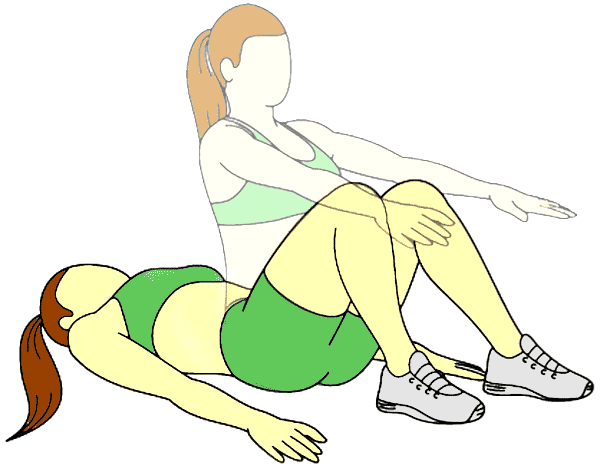
Proper curl-up exercise technique
NHL Curl-Up Beep Test Procedure
Procedure: Athletes are required to perform 25 curl-ups per minute (set the metronome at 50 so that there is a signal for both the up and down movement). The subject lies in a supine position on a mat, with the knees bent at 90°, heels in contact with the ground, and with the arms crossed over the chest with each hand on the opposite shoulder.
From the starting position, the athlete slowly curls up far enough so that the elbows make contact with the thighs. The heels must remain in contact with the floor and the feet may not be held. The athlete returns in a controlled manner so the shoulder blades touch the mat. An assistant should place one hand under the shoulders on the mat to verify contact.
Without pausing, the subject performs the maximum number of curl-up repetitions possible up to a limit of 100. The test is terminated if:
- The participant appears to be experiencing unusual discomfort
- They are unable to maintain the required cadence
- They are unable to maintain proper technique over two consecutive repetitions (e.g., heels come off the floor)
- 100 repetitions are performed (4 minutes has elapsed)
Curl-Up Beep Test Scoring and Norms
Scoring: Record the total number of curl-ups completed. The completion of one complete curl-up counts as one. Use the calculator above or the table below to determine your performance rating.
| Rating | Male Athletes | Female Athletes | NHL Combine Level |
|---|---|---|---|
| Excellent | 85-100 | 75-100 | Draft-Ready |
| Good | 65-84 | 55-74 | Above Average |
| Average | 45-64 | 35-54 | Acceptable |
| Below Average | 25-44 | 20-34 | Needs Improvement |
| Poor | <25 | <20 | Below Standard |
Note: These norms are based on athletic populations. NHL draft prospects typically achieve scores in the Good to Excellent range.
Advantages and Disadvantages
Advantages: This test is simple and quick to perform requiring minimal equipment, and large groups may be tested at once. The standardized cadence allows for fair comparison between athletes regardless of their natural speed preference.
Disadvantages: A metronome is not always available and creating a suitable audio tape is not easily done. It is difficult to control the amount of the curl-up, and some athletes may have difficulty synchronizing their movements with the beep cadence.
⚠️ Important: Before conducting any fitness test, you should review each person's medical status to identify medical, orthopedic, or other health problems that should be considered. Before starting, make sure the correct techniques for all tests are explained. See the Fitness Testing Guidelines for more information.
Sport-Specific Applications
The curl-up beep test has applications across multiple sports where core strength and endurance are critical for performance:
Ice Hockey
Core strength is essential for powerful skating strides, accurate shooting, and withstanding body contact. The curl-up test is part of the NHL pre-draft testing combine because strong abdominal muscles help players maintain balance during rapid direction changes and protect against lower back injuries common in the sport.
Combat Sports (Wrestling, MMA, Boxing)
Fighters require exceptional core endurance for grappling exchanges, maintaining defensive positions, and generating power through the kinetic chain during strikes and takedowns.
Team Sports (Football, Rugby, Soccer)
Core stability enables athletes to change direction quickly, resist contact, and transfer power from lower to upper body during throwing, kicking, and tackling movements.
Endurance Sports (Rowing, Cycling, Running)
Sustained core engagement maintains proper posture and efficient movement patterns over extended periods, reducing energy waste and injury risk.
How to Improve Your Curl-Up Beep Test Score
Improving your curl-up beep test performance requires a combination of strength building and endurance training:
Tempo Training
Practice curl-ups at the exact 25/minute cadence using a metronome or the online sit-up metronome. Start with shorter sessions (2 minutes) and gradually build to the full 4-minute test duration.
Core Strength Development
- Planks: Hold for 60-120 seconds, 3-4 sets
- Dead Bugs: 3 sets of 15-20 repetitions per side
- Cable Crunches: 3 sets of 15-20 repetitions with moderate resistance
- Hanging Leg Raises: 3 sets of 10-15 repetitions
Endurance Building
Incorporate high-repetition core circuits 2-3 times per week. A sample circuit might include: 30 seconds each of crunches, bicycle crunches, reverse crunches, and flutter kicks, repeated for 3-4 rounds with minimal rest.
Breathing Technique
Exhale during the curl-up phase and inhale during the return. Proper breathing prevents the Valsalva maneuver (breath holding) which can cause dizziness and early fatigue.
Frequently Asked Questions
What is a good score on the curl-up beep test?
For the NHL curl-up beep test (25 reps/min), completing 50+ curl-ups is considered good for male athletes, while 75+ is excellent. Elite NHL draft prospects typically achieve 80-100 curl-ups. Scores vary based on age, gender, and training background.
How is the NHL curl-up beep test different from other sit-up tests?
The NHL curl-up beep test uses a specific cadence of 25 curl-ups per minute with a maximum of 100 repetitions. Unlike timed sit-up tests that encourage speed, this protocol emphasizes controlled movement and sustained endurance, making it a more accurate measure of core muscular endurance.
What muscles does the curl-up beep test measure?
The test primarily measures the strength and endurance of the rectus abdominis, external and internal obliques, and transverse abdominis. Because feet are not held, it relies less on hip flexors than traditional sit-ups, making it a purer assessment of abdominal function.
Why is the curl-up beep test used in NHL combine testing?
Core strength and endurance are crucial for ice hockey performance, affecting skating power, shot velocity, body checking ability, and injury prevention. The standardized cadence allows fair comparison between all draft prospects regardless of their natural movement speed.
How can I practice for the curl-up beep test?
Use a metronome set to 50 BPM or the online sit-up metronome. Practice 2-3 times per week, starting with 2-minute sessions and building toward 4 minutes. Focus on maintaining perfect form—elbows touching thighs, shoulder blades touching mat—throughout every repetition.
Can I compare my curl-up score to other abdominal tests?
Direct comparison between different curl-up protocols is not recommended due to varying cadences, techniques, and maximum repetitions. The NHL protocol (25/min, max 100) differs from FitnessGram (20/min, max 75) and ACSM standards. Use normative data specific to the protocol you performed.
References
- NHL Scouting Combine. (2015). "NHL Scouting Combine Fitness Testing Summary." NHL.com.
- Gledhill, N. and Jamnik, V. (2007). "Detailed Assessment Protocols For NHL Entry Draft Players." York University, Toronto.
- Burr, J.F., Jamnik, R.K., Baker, J., Macpherson, A., Gledhill, N., and McGuire, E.J. (2008). "Relationship of Physical Fitness Test Results and Hockey Playing Potential in Elite-Level Ice Hockey Players." Journal of Strength and Conditioning Research, 22(5): 1535–1543.
- Cohen, J.N., Thompson, K.M.A., Jamnik, V.K., Gledhill, N., and Burr, J.F. (2022). "Relationship of Fitness Combine Results and National Hockey League Performance: A 25-Year Analysis." International Journal of Sports Physiology and Performance.
- American College of Sports Medicine. (2021). ACSM's Guidelines for Exercise Testing and Prescription, 11th Edition.
- Golding, L.A., Myers, C.R., and Sinning, W.E. (1989). Y's Way to Physical Fitness, 3rd Edition. Human Kinetics.
The Test in Action
- This test is part of the NHL pre-draft testing combine
- Results from previous combines are available on the NHL Scouting Combine Results page
Similar Tests
- General Abdominal Endurance Test description
- Partial curl-up test (Connecticut Physical Fitness Test)
- Simple sit-up test that you can do at home
Related Pages
- About Abdominal Testing
- Puchase the Sit-Up Test audio file
- The partial sit-up test is part of the Connecticut Physical Fitness Test.
- Online sit-up metronome where you can set your own pace.
- Videos of Sit-Up Fitness Tests
- Sit-Up World Records
 Any comments, suggestions, or corrections? Please let us know.