Navy PRT Curl-Up Calculator
Quick Answer
This calculator determines your US Navy Physical Readiness Test (PRT) curl-up score based on official Navy fitness standards. Enter your age and number of curl-ups completed in 2 minutes to instantly see your rating.
- Calculates scores using official Navy PRT standards
- Shows rating categories: Outstanding, Excellent, Good, Satisfactory, Probationary
- Compares your performance to age-specific requirements
The Curl-Up Test forms part of the Navy Physical Readiness Test (PRT), performed by US Navy personnel every six months. Participants are required to perform as many sit-ups as they can in two minutes. For the Navy this test is called the curl up, though others may call it a sit-up or crunch.
How to Use This Calculator
Follow these steps to calculate your Navy PRT curl-up score:
- Enter Your Age: Input your current age in years. The Navy PRT uses age groups to determine scoring thresholds, with separate standards for ages 17-19, 20-24, 25-29, and so on up to 65+.
- Enter Curl-Ups Completed: Input the total number of properly executed curl-ups you completed during your 2-minute test. Only count repetitions where your elbows touched your thighs and your shoulder blades returned to the floor.
- Click Calculate: The calculator will instantly display your score, rating category, points earned, and how your performance compares to Navy standards for your age group.
Pro Tip: For the most accurate score, ensure you only count curl-ups where your form was correct—elbows touching thighs on the way up and shoulder blades touching the floor on the way down.
Test Purpose and Procedure
Test Purpose: This test measures the endurance of the abdominal and hip-flexor muscles, which are critical for military personnel performing physical tasks including carrying equipment, maintaining posture during long operations, and protecting the lower back during lifting activities.
Equipment Required: A level surface on a blanket, mat, or other suitable padding, and a stopwatch.
Pre-Test: Explain the test procedures to the subject. Perform screening of health risks and obtain informed consent. Prepare forms and record basic information such as age, height, body weight, gender, and test conditions. See more details of pre-test procedures.
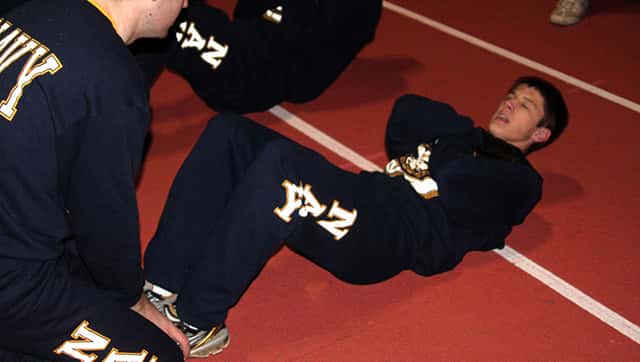
Navy recruits performing the curl-up assessment during PRT testing
Procedure: The aim of this test is to perform as many sit-ups as you can in two minutes. The starting position is lying on your back with your knees bent (heels approximately 10 inches from your buttocks) and feet flat on the floor. Arms should be folded across your chest with hands touching your upper chest or shoulders. A second person is permitted to hold the lower legs or ankles to keep the feet on the floor. On the command 'go,' start the crunch by raising your upper body forward till the elbows touch the thighs while maintaining contact between your hands and chest/shoulders. Then return to the floor until your shoulder blades touch the ground. This is counted as one complete sit up. Repeat this for two minutes.
Scoring: The maximum number of correctly performed sit ups in the allocated time is recorded.
Comments: No bouncing or arching of the lower back is allowed, and the buttocks and feet must remain in constant contact with the floor throughout the test. Resting during the exercise is permitted in either the up position, but cannot hold on to their legs in order to stay up. Shoes are optional.
Understanding Navy PRT Scoring Categories
The Navy PRT uses a point-based scoring system that converts your raw curl-up count into a standardized score. Here's what each rating category means:
- Outstanding (90-100 points): Top-tier performance demonstrating exceptional abdominal strength and endurance. These sailors exceed all requirements significantly and represent the fitness standard all Navy personnel should strive toward.
- Excellent (75-89 points): Well above average performance showing dedicated fitness training. Personnel at this level demonstrate commitment to physical readiness beyond minimum requirements.
- Good (60-74 points): Above satisfactory performance indicating solid fitness levels. This rating shows the sailor maintains good physical condition suitable for all duty requirements.
- Satisfactory (50-59 points): Meets minimum Navy fitness standards. While passing, sailors at this level should work to improve their scores for career advancement and operational readiness.
- Probationary (45-49 points): Below satisfactory but within a grace period. Personnel in this category must show improvement and may face additional fitness requirements.
- Failure (Below 45 points): Does not meet Navy fitness standards. Failure on any PRT component can result in administrative actions and requires participation in fitness improvement programs.
Sport-Specific Applications
The curl-up test measures muscular endurance that's valuable across many athletic disciplines beyond military fitness:
Combat Sports (Boxing, Wrestling, MMA)
Core endurance is essential for maintaining defensive posture, generating power in strikes, and controlling opponents. Fighters typically target 80+ curl-ups in 2 minutes to ensure adequate stamina for multi-round competitions.
Team Sports (Football, Soccer, Basketball)
Strong abdominal endurance supports rapid direction changes, jumping, and physical contact. Athletes in these sports benefit from scoring at least in the "Good" category (60+ curl-ups) to maintain performance throughout games.
Endurance Sports (Running, Swimming, Triathlon)
Core stability reduces energy waste and maintains efficient form during prolonged activity. Endurance athletes should aim for "Excellent" ratings to support proper posture during hours of continuous movement.
Strength Sports (Powerlifting, Olympic Lifting)
While primarily testing endurance rather than strength, good curl-up performance indicates the core stability needed for heavy lifting. Most competitive lifters can achieve "Outstanding" ratings despite prioritizing strength training.
How to Improve Your Curl-Up Score
If your score falls below your target, consider these evidence-based training strategies:
Progressive Overload Training
Start with your current maximum and add 5-10 reps per week. Practice the exact test protocol twice weekly, with supplemental core exercises on alternate days.
Interval Training Approach
Perform 30-second bursts of maximum curl-ups followed by 30 seconds rest. Complete 4-6 rounds to build both speed and endurance that transfers to the 2-minute test format.
Technique Optimization
Focus on efficiency: breathe out during the up phase, maintain a steady rhythm, and avoid wasted motion. Many sailors improve scores simply by refining their technique without additional conditioning.
Strategic Pacing
Rather than starting at maximum speed and fatiguing early, aim for a consistent pace throughout. Target approximately 30-35 curl-ups per minute for a total of 60-70 over two minutes.
Frequently Asked Questions
How many curl-ups do I need to pass the Navy PRT?
The minimum number varies by age. For those aged 20-24, you need at least 58 curl-ups for a satisfactory score. Requirements decrease with age—those 40-44 need approximately 46, while those 50-54 need around 40. Use the calculator above to see exact requirements for your age group.
What is the difference between curl-ups and sit-ups?
In the Navy PRT context, curl-ups and sit-ups refer to the same exercise. The Navy officially uses "curl-up" terminology, but the movement is identical to what most people call a sit-up. Your elbows must touch your thighs and shoulder blades must return to the floor for each repetition to count.
How long do you have to complete the Navy PRT curl-up test?
You have exactly 2 minutes to complete as many curl-ups as possible. The test begins on the command "go" and ends at the 2-minute mark. A designated counter tracks your correctly performed repetitions throughout the test duration.
Can you rest during the Navy PRT curl-up test?
Yes, but only in the up position. You cannot rest with your back on the floor, and you cannot hold onto your legs to maintain the up position. Strategic 2-3 second rest periods in the up position can help you complete more total repetitions over the 2-minute test.
What happens if you fail the Navy PRT curl-up test?
Failing the curl-up portion results in an overall PRT failure. First-time failures typically require enrollment in the Fitness Enhancement Program (FEP). Multiple failures can lead to administrative actions including negative evaluations, loss of advancement opportunities, and potential separation from the Navy.
How can I improve my Navy PRT curl-up score quickly?
Practice the exact test protocol 2-3 times weekly. Focus on maintaining a steady pace of 30-35 curl-ups per minute rather than starting fast and fatiguing. Supplement with planks, reverse crunches, and bicycle crunches. Most sailors can add 10-15 reps within 4-6 weeks of dedicated training.
Are the Navy PRT curl-up standards different from other military branches?
Yes, each branch has different standards and test protocols. The Army uses a 2-minute sit-up test, while the Marines use crunches. The Navy's curl-up test is unique in its specific form requirements. Our calculator specifically uses official Navy PRT standards.
References
- U.S. Navy. (2024). "Physical Readiness Program Operating Guide." OPNAV Instruction 6110.1J.
- Department of Defense. (2023). "Military Physical Fitness Testing Standards." DoD Directive 1308.1.
- American College of Sports Medicine. (2022). "ACSM's Guidelines for Exercise Testing and Prescription." 11th Edition.
- Naval Education and Training Command. (2024). "PRT Standards and Protocols Manual."
- Hoffman, J. (2014). "Physiological Aspects of Sport Training and Performance." Human Kinetics.
- McGill, S. (2016). "Low Back Disorders: Evidence-Based Prevention and Rehabilitation." Human Kinetics.
- National Strength and Conditioning Association. (2023). "Essentials of Strength Training and Conditioning." 4th Edition.
The Test in Action
- The Curl-Up Test forms part of the Navy Physical Readiness Test.
- Navy personnel complete this assessment every six months as part of their fitness requirements.
- The test is conducted at Navy installations worldwide under standardized conditions.
Similar Tests
- Sit-up test procedures for the US Army and US Marines
- Simple sit-up test that you can do at home
- The Presidents Challenge sit-up test
Related Pages
- About Abdominal Testing
- General Abdominal Endurance Test description
- PRT testing discussion and scoring and links to other PRT test descriptions.
- Videos of Sit Up Fitness Tests
- Other speed and power tests, and all fitness test list
- Sit up exercise at the beach or at home
- Sit Up World Records
 Any comments, suggestions, or corrections? Please let us know.