Sit-Up Test Calculator
Quick Answer
This calculator rates your 1-minute sit-up test performance using validated normative data from Golding et al. (1986). Results help assess your abdominal muscle strength and endurance compared to others in your age and gender group.
- Measures abdominal and hip-flexor strength and endurance
- Based on peer-reviewed fitness assessment standards
- Provides instant ratings from Excellent to Very Poor
Push-Up | Sit-Up | Squat | Step | Vertical Jump | Sit & Reach
About the Sit-Up Test
Abdominal muscle strength and endurance is important for core stability and back support. This sit-up test measures the strength and endurance of the abdominals and hip-flexor muscles. The test is simple to perform at home with no equipment needed other than a timer and a cushioned surface.
How to Perform the Test
Starting Position: Lie on a carpeted or cushioned floor with your knees bent at approximately right angles, with feet flat on the ground. Your hands should be resting on your thighs. The feet are not anchored.
Technique: Squeeze your stomach, push your back flat and raise high enough for your hands to slide along your thighs to touch the tops of your knees. Don't pull with your neck or head and keep your lower back on the floor. Then return to the starting position.
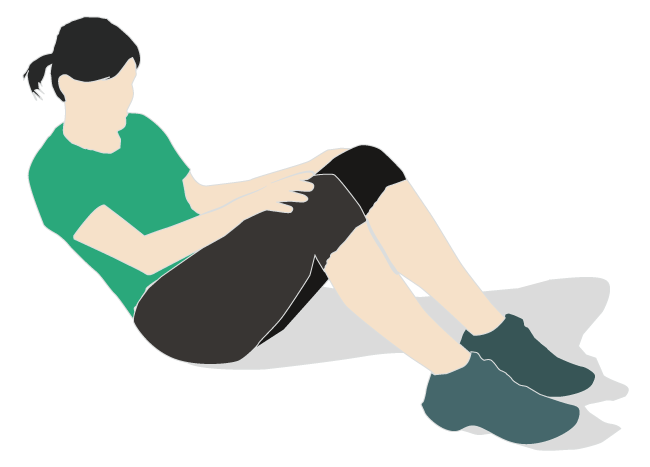
The sit-up assessment technique
Understanding Your Results
Compare your results to the tables below. Remember, these scores are based on doing the tests as described, and may not be accurate if the test is modified at all. Don't worry too much about how you rate — just try and improve your own score over time.
1 Minute Sit-Up Test Norms (Men)
| Age | 18-25 | 26-35 | 36-45 | 46-55 | 56-65 | 65+ |
|---|---|---|---|---|---|---|
| Excellent | >49 | >45 | >41 | >35 | >31 | >28 |
| Good | 44-49 | 40-45 | 35-41 | 29-35 | 25-31 | 22-28 |
| Above Average | 39-43 | 35-39 | 30-34 | 25-28 | 21-24 | 19-21 |
| Average | 35-38 | 31-34 | 27-29 | 22-24 | 17-20 | 15-18 |
| Below Average | 31-34 | 29-30 | 23-26 | 18-21 | 13-16 | 11-14 |
| Poor | 25-30 | 22-28 | 17-22 | 13-17 | 9-12 | 7-10 |
| Very Poor | <25 | <22 | <17 | <13 | <9 | <7 |
1 Minute Sit-Up Test Norms (Women)
| Age | 18-25 | 26-35 | 36-45 | 46-55 | 56-65 | 65+ |
|---|---|---|---|---|---|---|
| Excellent | >43 | >39 | >33 | >27 | >24 | >23 |
| Good | 37-43 | 33-39 | 27-33 | 22-27 | 18-24 | 17-23 |
| Above Average | 33-36 | 29-32 | 23-26 | 18-21 | 13-17 | 14-16 |
| Average | 29-32 | 25-28 | 19-22 | 14-17 | 10-12 | 11-13 |
| Below Average | 25-28 | 21-24 | 15-18 | 10-13 | 7-9 | 5-10 |
| Poor | 18-24 | 13-20 | 7-14 | 5-9 | 3-6 | 2-4 |
| Very Poor | <18 | <13 | <7 | <5 | <3 | <2 |
Sport-Specific Applications
Core strength measured by the sit-up test is essential across virtually all sports. Strong abdominals transfer power between the upper and lower body, stabilize the spine during dynamic movements, and help prevent injuries.
Combat Sports (Boxing, MMA, Wrestling): Core endurance is critical for maintaining defensive posture and generating punching power. Elite fighters often score in the excellent range with 50+ sit-ups per minute.
Team Sports (Soccer, Basketball, Football): Athletes require core stability for rapid direction changes, jumping, and physical contact. Average to above-average scores (35-45 for young males) are typical training baselines.
Endurance Sports (Running, Cycling, Swimming): While not the primary focus, core endurance helps maintain form during fatigue. Marathon runners and triathletes benefit from above-average core fitness to maintain efficient mechanics.
Military and First Responders: The sit-up test is a standard component of fitness assessments for military personnel, police officers, and firefighters. Minimum standards typically require 35-45 sit-ups per minute.
How to Improve Your Score
If your score is below your goals, consistent training can lead to significant improvements within 4-8 weeks.
Progressive Training: Start with 3 sets of sit-ups at 60-70% of your maximum, performed 3-4 times per week. Gradually increase repetitions and add a fourth set as you adapt.
Variety of Core Exercises: Complement sit-ups with planks (front and side), bicycle crunches, leg raises, and Russian twists to develop balanced core strength.
Breathing Technique: Exhale as you raise up, inhale as you lower. Proper breathing improves endurance and helps you maintain pace throughout the minute.
Rest and Recovery: Allow at least 48 hours between intense core training sessions. Muscles grow stronger during recovery, not during exercise.
Frequently Asked Questions
How many sit-ups should I be able to do in 1 minute?
The number varies by age and gender. For men aged 18-25, an average score is 35-38 sit-ups per minute, while women in the same age group average 29-32. Excellent scores exceed 49 for young men and 43 for young women.
What muscles does the sit-up test measure?
The sit-up test primarily measures the strength and endurance of the abdominal muscles (rectus abdominis) and hip flexor muscles. It also assesses core stability which is essential for athletic performance and back support.
Is the sit-up test the same as a crunch test?
No, sit-ups and crunches are different exercises. A full sit-up involves raising your entire torso off the ground, while a crunch only lifts the shoulders. The sit-up test described here involves touching your knees with your hands, which is a partial sit-up/crunch hybrid.
Can I hold my feet during the sit-up test?
The standard protocol for this test specifies that feet should NOT be anchored or held down. If you hold your feet, your results cannot be accurately compared to the normative data provided, as the test becomes easier.
How can I improve my sit-up test score?
Improve your score through consistent core training including planks, bicycle crunches, leg raises, and progressive sit-up training. Aim to train your abdominals 3-4 times per week, gradually increasing repetitions.
Why is abdominal strength important for athletes?
Strong abdominals are crucial for core stability, which transfers power between upper and lower body, maintains proper posture during movement, protects the spine, and improves balance and coordination in virtually every sport.
How often should I test my sit-up fitness?
For tracking progress, test every 4-6 weeks. Testing too frequently won't show meaningful changes and may lead to discouragement. Allow adequate recovery and training time between tests to see improvement.
References
- Golding, L.A., Myers, C.R., & Sinning, W.E. (1986). "Y's Way to Physical Fitness." Human Kinetics Publishers, 3rd edition, pages 113-124.
- American College of Sports Medicine. (2021). "ACSM's Guidelines for Exercise Testing and Prescription." Wolters Kluwer, 11th edition.
- Heyward, V.H., & Gibson, A.L. (2014). "Advanced Fitness Assessment and Exercise Prescription." Human Kinetics, 7th edition.
- McGill, S.M. (2015). "Low Back Disorders: Evidence-Based Prevention and Rehabilitation." Human Kinetics, 3rd edition.
- Kibler, W.B., Press, J., & Sciascia, A. (2006). "The Role of Core Stability in Athletic Function." Sports Medicine, 36(3), 189-198.
- National Strength and Conditioning Association. (2016). "Essentials of Strength Training and Conditioning." Human Kinetics, 4th edition.
- Hibbs, A.E., Thompson, K.G., French, D., et al. (2008). "Optimizing Performance by Improving Core Stability and Core Strength." Sports Medicine, 38(12), 995-1008.
Home Fitness Testing Manual
Download your free copy of the Home Fitness Testing Manual — a guide for you to plan, conduct, analyze and interpret fitness testing at home.
Related Pages
- A Home Fitness Testing Kit — the basics required for you to test yourself at home
- About Abdominal Testing
- See other home fitness tests
- Videos of Sit Up Fitness Tests
- See other variations of the sit-up test
- Sit up exercises at the beach or at home
- Sit Up World Records
Selected Comments
- I am 13 years old, i can do 97 situps in 1 minute, is that good? (Adam, Dec 2021)
- I do roughly 150 sit ups a day and do 50 in each set. Sometimes I do more. When your stomach begins to hurt, take a deep breath and go again. Stay motivated! (Ella, Feb 2021)
- I am a female,11 and did 49 in 1 minute. A good tip is to take deep breaths when you can instead of taking multiple short breaths every time. (noname, Nov 2020)
- 66, female, 58 in a minute. My goal is 77, I believe i can do it. (Amy Bwecknell, 2013)
- male 15 years old got to 111 sit up (Ethan Meinders, 2018)
- That's awesome, but do you take a break between? When you are doing 111 sit ups? (Veronica Kang, 2020)
- 29, female, 52 in a minute. My goal is 63. (Brynne Muir, 2013)
- peeps with mega scores, don't mix sit-up and crunch, they are absolutely different. Real sit up, full body raise, is way harder than crunch (Svipper, 2013)
- Exactly it's all technique (Commodore665, 2014)
- No, a full sit-up, whilst slower than a crunch, is much less useful and physically tiring ... only the middle 2/3 of a full sit up is useful as the very bottom and top of the sit up are using thigh not abdominal muscles... in order to get full gain from a sit up it should not be done to the very top (David Morgan, 2017)
- Full sit ups are generally considered to be really bad for your back and not really that helpful for functional movement anyway. (KJ, 2014)
- That is actually incorrect, people just don't know the proper technique. A sit up require some modicum of abdominal strength to perform to begin with it is something that should be done in a paced manner without swinging your arms or using any thing but abdominal strain to pull yourself up and EASE yourself down, I did around 48 in one minute going slow and making sure my technique was correct. When done correctly it helps your back, seeing as your abdominals support your spine the most. Crunches work a different area of abdominal and are also a risk to your spine if done incorrectly. They are easier to perform at a quick pace so most prefer crunches over sit ups when in fact they are two completely different workouts working two different areas of your abdominals, I recommend doing both. (John, 2016)
- Wow... I must be super excellent. I got 63 in one minute, and I stopped at the last 5 seconds. I knew a kid who could do 75+ (David Bilbo, 2013)
- Crunch or sit-up? (Svipper, 2013)
- I have a friend who did 81 this year for our physical ed fitness testing. He's a freshman. (The Knuckeldredger, 2016)
- i am in year 10 and i got about 49-60 throughout the years and yes crunch is harder than sit ups as your cores are more engaged (Chanel, 2019)
- 14 year old male, 60 push-ups (Hammad, 2014)
- 52 same age (sit ups) (Ben, 2015)
- yea the world record is 139 (Konstanze Pahalage, 2017)
- ya, okay bud I'm sure you can do 150 when you're 9. I'm only a 12 year old male too and only did 46... (Someone?, 2016)
- 16 Year Old Male, I got 53 in a minute (LOL, 2013)
- 12 year old female, 54 (ShaniThePenguin, 2015)
- There's no way you can do that many. I'm 15 years old, male, and can only 48 (Ryan, 2016)
- I'm 14 and female and i can do 60 in a minute (Grace Blakely, 2016)
- lol I know a female in my Njrotc program that can do 200, And that was our freshman year (Evelyn, 2016)
- So she did 33% more situps than the world record? Wow, impressive -_- (Dexiant, 2018)
- 32 male, beside having a daily workout routine I often do 100 push-ups most nights about 30-60 minutes before bed, to help exhaust the remaining energy from the day, last night I timed myself for the first time and accomplished 100 in 57 seconds (full push-ups: meaning all the way up until arms are straight to all the way down, when chest touches the ground and/or elbows are bend past 90 degrees and knees are straight and not bent or touching the floor) (Tony, 2014)
- the world record of situps for one min. belong to Gil Newton who done 139 situps in 1 min. all was recorded by video camera, another gym trainer with clicker, and another 3 gym trainers as a witness (Gil, 2014)
- The most ever done was 139 lmao (Kelsey, 2015)
- so i am a 17 year old girl and i could only do 12 sit-ups in a minute..... what should i do to become better? (Alexis French, 2020)
- I am female and only 13 years old and got to 203 sit ups. (JD, 2020)
- I am 13 when I was younger I used to do 40 sit ups every night I think I will start doing that again so I can get back to doing 80 in a minute. (Autumn, 2020)
- Im 12 years old female and i did 40 sit ups in one minute. My goal is 45 sit ups in one minute! (Nizza, 2019)
- I'm 14 female just did 158 push-ups and 176 sit ups but mom and dad are both marines! (Maddy, 2019)
- I remember a couple years back I did nearly 100 in a minute I will make it happen again male 17 (Ramiresu Migeru, 2017)
- I'm 13 years old and I did 203 sit-ups at once at a boy scout meeting once, all perfect form, spot checked by 3 adults. Is this too far above average? (took about 4 minutes) (Michael12321, 2016)
- 14 yrs 73 in a minute (I'm doing pe as a gcse) (Bethy, 2016)
- I'm a 16 year old female and I did 45 :) Very proud of myself (Elle, 2016)
- I am a 13 year old girl and can do 50 in under a minute..my next goal is 60 (Hailee Low, 2016)
- I'm 11 female and I did 45 sit ups in 1 min. I want to get 60 in 1 minute (Link, 2016)
- 15, female 90 in a min. My goal is 100.. don't feel bad i'm in military training :) before this I can only do 60 (Evelyn (Nick), 2015)
- 13 year old girl, 71 in a minute (Sacrwegf, 2015)
- You must be lying. You can't possibly do that many. (Ryan, 2016)
- Not at all, you saw the average for people under 18 and it was 25. That's actually pretty good (ShaniThePenguin, 2015)
- 13yr old male 55 in 1 minute (Alex, 2015)
- Almost 27 year old guy here, did 31 reps in 1min. So barely average but hopefully I will improve in the future! (Andreas, 2015)
- I do running a lot as well and have fruit and I always go for a run every morning to make me feel a lot better (Liamcorden123, 2015)
- do press ups and that always works for me and make me a lot fitter (Liamcorden123, 2015)
- I'm 13 year old male and I got 41 sit ups in 60 sec. My age group is not in the charts above so I was wondering is that good or bad? my names Jacob by the way not randomness132145 (Randomness132145, 2015)
- 19 year old male no prior working out whatsoever besides a push-up test, did 30 in about 55 seconds. (Chris Cooper, 2015)
- I'm 14 and can do about 28 in a minute (Amira, 2015)
- 37 sit-ups in a minute (not crunches), goal is 50 in a minute. 35 push ups in a minute (normal, not on my knees), goal 50 in a minute (AB, 2015)
- when I was little (8-10), I did 80 consecutives.. (Ai, 2014)
- 84, female. I want to know how can I increase my crunches count, my current score is only 78 a minute. (Samy nany, 2014)
- Can you put your feet under a couch? (Ronald, 2014)
- The norm table above is based on not holding the feet down, but that does not stop you from doing the test this way and monitoring your improvement based on that technique. Just don't expect the table to accurately rate your result. (Rob Admin, 2014)
- 21, male, 26 in a minute, my goal is 30. At least I have a six-pack. (Suprised, 2014)
- I haven't exercised in awhile due to some health issues. So I'm happy with 33 a minute sit-ups (44 years old). These are full sit-ups btw, not crunches. (Sqt, 2013)
- 22, female, 50 full sit ups (entire top half of body off floor) in 58 seconds. Why does this website call crunches, sit ups. (Siobhan, 2014)
 Any comments, suggestions, or corrections? Please let us know.