


NHL Draft Combine Testing
The annual NHL Entry Draft combine assessment involves interviews, medical screenings, and fitness tests over a four-day period. All 30 NHL teams send representatives to watch the testing and to take part in the interviewing of the young prospects. The assessment includes fitness testing, medical evaluation, psychological evaluation, an interview and possibly skill testing.
The assessments are conducted by a nationally accredited high performance athlete testing laboratory. Following the draft selections, additional tests may also be conducted by some teams. The information below about the tests was primarily sourced from the document "2015 NHL SCOUTING COMBINE FITNESS TESTING SUMMARY". Previously test details were taken from the document by Gledhill and Jamnik (2007).
To see for yourself what goes on at the draft camp, check out these videos. Results from previous combines are listed on the NHL Scouting Combine Results page.
In 2014 the combine followed the following format. Interviews were conducted during a five-day period; the functional movement screening was held on Thursday, medical examinations on Friday and the fitness testing on Saturday. In 2015, VO2max test was moved to be held on the Friday, along with the body composition and grip strength tests, and the medical examinations held on Thursday. No player is allowed to test until clearing the medical screening.
Fitness Testing
Historical Changes
In 2007, new tests were added: the hexagon test for agility, balance test and a 'standing squat' test (vertical jump with a pause). Also grip strength fatigue and wingspan were also first measured. In 2013 a 'Functional Movement Screen' was introduced. In 2014, overhand pull-ups, single leg squats (both legs) and pro agility tests replaced push-ups, the push-pull station and the seated medicine ball throw. In 2014 there were four body composition tests and 11 individual fitness tests.
In 2015, a new format and testing was implemented as a result of a combine review. The fitness testing assessments were moved into an arena offering an increased viewing area, better sight lines and live result monitors, allowing for the testing to be captured on video. In the vertical jump, instead of using the Vertec® Apparatus, the jump height will be measured with a Force plate, also allowing the measurement of jump forces. The BodPod is now used for body composition testing and the Y-balance test for assessing balance.
The bench press test was once a maximum test performed at 70-80% of body weight in time with the metronome at a rate of 25 per minute, but was changed to a weight 50% of body weight, and performed as quickly as possible for three reps, with maximum power measured.
In total the testing component of the combine lasts about an hour and a half for each player. The current battery of tests are listed below (as of 2023).
Body Composition
- Standing Height: measured to the nearest 0.25 inch.
- Wingspan: measured to the nearest 0.25 inch from the middle finger tip to middle finger tip.
- Body Weight: using a calibrated beam-type balance and recorded to the nearest quarter lb.
- BodPod: uses air displacement technology for measuring and tracking body fat and lean mass.
Strength, Power and Muscular Endurance
- Grip Strength: test of hand grip muscle strength, conducted on each hand.
- Bench Press Max Power: Lifting 50% of body weight as quickly as possible for three reps, with maximum power measured. A "Gym Aware" device is used to measure the velocity of the bar and the athlete's ability to produce power. The reported score is recorded in watts/kg.
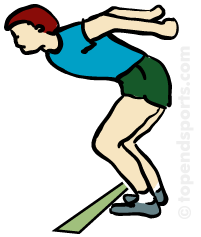
- Standing Long Jump: test of leg power. Record the distance from the jumping line the heel mark in the best of three trials. The measurement is recorded to the nearest quarter inch.
- Vertical Jump: test of leg power. This test was once conducted using the Vertec® jump measurement apparatus and Jump Timing Mat, and since 2015 using a force plate. Leg power using the force plate is measured in three different ways (vertical jump, squat jump, no arm jump).
- Pull-Ups: measurement of the maximum number of pull ups, using the overhand technique. The test requires each player to perform a maximum number of consecutive repetitions with the correct technique while pausing for one second at the top and bottom of the movement. Partial pull-ups are not counted.
Agility & Balance
- Pro Agility Test: a lateral movement test that measures the agility of the athlete, especially body control and change of direction.
- Y-Balance Test: a dynamic test performed in a single-leg stance that requires strength, flexibility, core control and proprioception.
Anaerobic Fitness
- Wingate test: a 30 second bike test for anaerobic power (measureing explosive leg power and fatigue). The resistance used is 9% of the athleteʼs body mass.
Aerobic Fitness
- VO2max Test: assessed by measuring the amount of oxygen utilized (VO2max) during maximal cycle ergometer exercise. In addition, heart rate is monitored continuously. The initial workload is set at 2.0 kp and increased 1.0 kp every 2 minutes for the first 3 levels, and at a cadence of 70 revolutions per minute. Thereafter the workload increased 0.5 kp every 1 minute at a cadence of 80 revs.
Tests that have been used previously
We have found that the following tests have previously been part of the NHL assessment protocol. Some test protocols, such as for the bench press, have changed too.
- Single Leg Squats: The single leg squats evaluate unilateral strength, balance and full body coordination. Each player must perform five successive repetitions on each leg. Each squat is worth 15 points with a maximum score of 75 (per leg).
- Curl-ups: test of core muscle strength and endurance. Record maximum number that can be done at a rate of 25 curl-ups per minute.
- Skinfold Bodyfat Measurements: all measurements were made on the right side of the body with the exception of the abdominal skinfold. Sites assessed Chest, Triceps, Subscapular, Suprailiac, Abdomen, Front Thigh. Body fat calculation was based on formula from Yuhasz.
- Balance Board: the players were required to balance on a balance board, and measured how many times the board touches the floor in 60 seconds.
- Hex Agility: like the hexagon test, there is an ‘X’ at the center of a circle and you have to jump from the ‘X’ to the top of the circle, then back to the ‘X’, then to the right side, then back to the ‘X’ and so on. There are sensors all around the circle to measure speed/time.
- Push-ups: test of chest muscle strength and endurance. Record maximum number at a rate of 25 push-ups per minute.
- Upper Body Push and Pull Strength: using a Strength Dynamometer to measures the maximum upper body push and pull strength.
- Seated Medicine Ball Throw: test of upper-body (arm) power. Maximum distance ball can be thrown from seated position.
- Sit and Reach: measures hamstring and lower back flexibility. The baseline is set at the 25.4 cm (10 inch) mark.
Medical Evaluation
The medical assessment is comprised of a health questionnaire and a physical examination conducted by a medical physician. An extensive knee examination is also conducted if the physician identifies a possible problem. In 2009 an echocardiogram test was added to the medical screening. The medical portion of the testing takes about a half an hour, and includes:
- Completion of a health questionnaire
- Questions and examination by doctors
- Photographs of the player
- An eye test
- Two hand/eye coordination tasks - to determine the time it takes to complete a specific motor-vision task. The assessment of hand-eye coordination will be conducted in the room where the medical examinations are conducted. The test results are reported as the time in seconds to compete the tasks.
- Echocardiogram test
Functional Movement Screen
The Functional Movement Screen (FMS) was added to the protocol in 2013. The FMS requires the prospects to perform seven specific joint tests that are graded on a 1-3 scale, with a highest possible total score of 21. Research shows that a score of less than 14 might indicate a risk of future injury. The test includes a deep squat, hurdle step, lunges, shoulder mobility movements, leg raises and trunk stability and pushups. It takes about 15 minutes to complete and I refer to it as a screen and not a test. The results could ultimately reveal imbalances and symmetry deficiencies in movements of the body.
Psychological evaluation
A psychological evaluation test was introduced in 2007 in response to the teams' request for a mental assessment of the potential draftees. Much of the psychological testing is administered prior to the Combine itself, while a Neuro-cognitive test is administered immediately after the players complete their Wingate and VO2max testing.
The psychological evaluation consists of a two-part computer test of approximately an hour's length. The first part is a long series of questions about the prospect's personality, including such things as mental toughness and coachability. It includes 220 questions that you answer yes or no. One example was something like "if your coach was talking, would you interrupt him if he’s wrong". The second part of the evaluation is a mental efficiency test, which measures spatial awareness, decision speed, decision accuracy, concentration, and rates of mental fatigue. A shortened form of the second part was repeated immediately after the fitness testing component, to determine the how much the individual player's reactions decline under stress and fatigue, and includes measures a player's reaction time and spatial awareness.
Interview
Possibly the most important part of the testing weekend is the daunting 20-minute face-to face interview with team personnel. Some teams include a sports psychologist among their staff at the interview table.
Skill Testing
The NHL was looking into adding an on-ice skill testing component to the test procedures in 2008.
Sources
- 2015 NHL SCOUTING COMBINE FITNESS TESTING SUMMARY, as published on NHL.com
- Gledhill, N. and Jamnik, V. Detailed Assessment Protocols For NHL Entry Draft Players, York University, Toronto 2007.
- Other information has been sourced from online, and may not be completely accurate. The protocols for each test describes the standard protocols for that test, and in some cases may not be exactly the same as that used by the NHL.
Related References
- Cohen JN, Thompson KMA, Jamnik VK, Gledhill N, Burr JF. Relationship of Fitness Combine Results and National Hockey League Performance: A 25-Year Analysis. Int J Sports Physiol Perform. 2022 Mar 3:1-9.
- Burr, J, Jamnik, R, Baker, J, Macpherson, A, Gledhill, N, and McGuire, E. Relationship of physical fitness test results and hockey playing potential in elite-level ice hockey players. J Strength Cond Res 22: 1535–1543, 2008.
- Burr, J, Jamnik, V, Dogra, S, and Gledhill, N. Evaluation of jump protocols to assess leg power and predict hockey playing potential. J Strength Cond Res 21: 1139–1145, 2007.
- Vescovi, JD, Murray, TM, Fiala, KA, and VanHeest, JL. Off-ice performance and draft status of elite ice hockey players. Int J Sports Physiol Perform 1: 207–221, 2006.
- Chiarlitti, Nathan & Delisle-Houde, Patrick & Reid, Ryan & Kennedy, Cory & Andersen, Ross. (2017). The Importance of Body Composition in the National Hockey League Combine Physiologic Assessments. Journal of Strength and Conditioning Research. 32. 1.
Related Pages
- Draft Camp Videos
- NHL Scouting Combine Results
- Poll about the fitness components for ice hockey
- AFL, NFL and NBA draft combine tests.
- Comparing fitness testing for Sports Combines
- Fitness testing for hockey
 Any comments, suggestions, or corrections? Please let us know.
 Current Events