


Fitness Testing for AFL
Fitness is a very important aspect of success in modern AFL football, and it is important to measure fitness in the course of training - to get baseline measures, to identify strengths and weaknesses, and to monitor changes in fitness over time.
Most senior AFL players are in great physical condition. The attributes required for AFL include good physical size, excellent running speed and agility and aerobic capacity (see more on the fitness components for AFL). At each year end the AFL conducts a draft camp in which prospective players are put through a battery of fitness, physical and psychomotor tests. More details of these tests and the results can be followed on the AFL Draft Camp.
Here are some recommended fitness tests for assessing AFL players. Many of these are the same as used in the AFL Draft Camp.
- BODY SIZE: anthropometric measures - height, hand span, arm length, body mass & skinfolds. Tall players are at an advantage, though there are many successful AFL players that are not tall. Any excess body fat would affect the AFL player's ability to jump vertically, move freely around the ground, and the extra weight will increase fatigue. The width of the hand outstretched may be related to the ability to grab opposition players and mark the ball. Longer arms may be an advantage for football players when taking a mark or tackling an opposition player.
- STRENGTH: grip strength, 1RM Bench Press
- POWER: vertical jump test (there is also an AFL specific running vertical jump test). Vertical jump ability is important for any leaping for marks, and particularly important for the rucks when contesting a bounce down.
- SPEED: 20-meter sprint test. Acceleration (speed over 5 m) is important for breaking away from the opposition player, and a good top running speed is advantageous for longer sprints such as when making a lead.
- AGILITY & REACTION: AFL agility test. The ability to quickly change direction is very important for AFL to be able to get clear of an opponent. Having a quick reaction time is an important skill for an AFL player.
- ANAEROBIC CAPACITY: anaerobic sprint-recovery test
- ENDURANCE: yo-yo test, the shuttle run (beep) test and the 3km time-trial. An average score on the beep test at the AFL draft camp run is level 13.3. A very good level is 14-plus and reaching 15-plus is rare. Aerobic fitness is a very important component of fitness for AFL, with some players (depending on the playing position) running over 10 km throughout a game.
- FLEXIBILITY: sit and reach test. Flexibility is important in terms of being injury free and being able to move freely around the ground. Flexibility would be assessed during the medical sessions.
- SKILL TESTS: kicking efficiency, goalkicking accuracy and clean hands handball
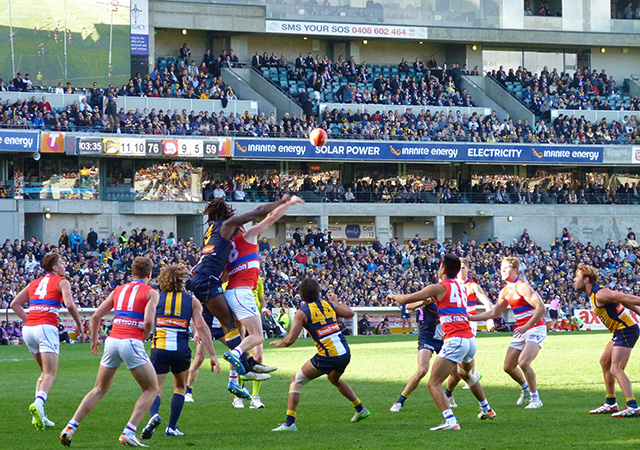 football action
Example Test Protocol
A fitness testing regimen for AFL would include a wide range of physical tests, based on the demands of the game. Brett Deledio, a senior Richmond footy player was tested in 2009 (as detailed in the Herald Sun Newspaper). A summary of his results is in the table below.
| Fitness Test | Result |
|---|---|
| body mass (kg) | 87.5 |
| height (cm) | 187.9 |
| Skinfolds, sum of 7 sites (mm) | 39.6 |
| Grip Strength (kg) | 67 |
| 1RM Bench Press (kg) | 145 |
| Vertical Jump (cm) | 76 |
| Sit and Reach (cm) | +14 |
| VO2max (ml/kg/min) | 60 |
His body strength for his size is very good (he can lift 1.66 x his body weight), which is important in AFL as players need to have strength without too much bulk. He is a good all round player, with a high VO2max endurance score, but still very good leg power (vertical jump).
Overall Football Ability
An article about the AFL draft from 2005 listed these 14 key performance indicators that AFL talent scouts used to rank players. Some of these are physical abilities, but there are also many other non-measurable aspects of the game. This list may or may not be used today by the talent scouts, but either way they provide an insight into what the AFL considers the important characteristics of the elite AFL players.
- Kicking ability
- Marking ability
- Handpassing/vision-awareness
- Clean hands
- Ball-winning ability
- Pace
- Endurance
- Recovery and agility
- Durability
- Leadership and self-discipline
- Aggression, intensity and second efforts
- Football character
- Competitiveness
- Football smarts
Relevant References
- Pyne DB, Gardner AS, Sheehan K, et al. Fitness testing and career progression in AFL football. J Sci Med Sport. 2005
Related Pages
- About the AFL draft camp, and results from previous years.
- A discussion of fitness components of AFL
- Attributes of a Great AFL Player
- Poll: fitness components for AFL
- AFL Player Anthropometry — height, weight and BMI of AFL players.
- Fitness Testing for sports
- Sport-specific fitness testing
- Warming up for AFL
- Draft camp testing for the NBA, NFL and NHL
- About Testing for Intermittent Sports
 Any comments, suggestions, or corrections? Please let us know.
 Current Events