


Fitness Testing for Hockey
Do you have what it takes to be a hockey player? As with most team sports, there are many components of fitness that are important for success. In addition to skating skills, speed, power, agility and endurance fitness are all important. See more information and discussion on the components of fitness for hockey and hockey factors of success.
The follow are some suggested fitness tests suitable for ice hockey players. For each physical attribute there are many suitable tests that may be used. See more information about selecting fitness tests. For other test protocols (which include some of the same tests as below), see the information about the NHL draft combine, SPARQ testing for hockey and Hockey Next Testing.
Body Size
Arm reach and body size is important for reaching out for tackles and puck control. Measures of Height and Weight, and Wingspan which determines arm span or reach.
Body Composition
Excess body fat would affect the hockey player's ability to move freely around the ice, and the extra weight to be carried will increase fatigue. Body fat can be measured using the skinfold method. If this is not available, monitoring body weight changes would give an indication of body fat changes, assuming no change in muscle mass.
Flexibility
Good hamstring and lower back flexibility is important for hockey players. The sit and reach test can be done for lower back and hamstring flexibility.
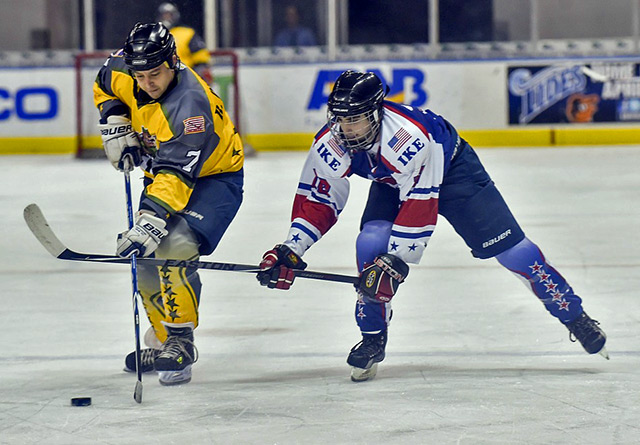 ice hockey players need Strength and Power
Strength and Power
Strength (and power tests) should also be done to determine strength levels and to monitor strength changes in conjunction with training programs. The vertical jump test can be performed to measure leg power. Maximal strength tests for specific exercises should be conducted. For upper body strength endurance a push-up test can be done, A hand grip strength test is also suitable.
Speed
Maximum speed and acceleration are very important in hockey. Speed on the ice is most important. A short skating speed test can be performed, or you can perform a standard running Sprint Test over 40 yards, with a split time for the first 5 and 10 yards.
Anaerobic Power and Capacity
Hockey players require the ability to repeat sprints at high intensity. The Wingate test 30 second bike test for anaerobic power. Another test is the Yo-Yo Intermittent Recovery Test which measures endurance capacity and ability to recover from intense bursts of activity.
Agility
The ability to quickly change direction is very important for hockey. An on ice agility test is best to measure skating agility. Off-ice you can perform the hexagon test. There is also an off-ice hand-eye coordination and agility test developed specifically for hockey players, the Shuttle Cross Pick-Up.
Aerobic Fitness
Aerobic fitness is an important component of fitness for hockey. The shuttle run (beep) test would usually be the most appropriate test for testing a hockey team. There is also an on ice version of the beep test. See more information on many other aerobic tests here.
News
The Toronto Maple Leafs switched from using a bicycle based VO2max test to an on ice "skating efficiency test" which provided measurements for heart rate and blood lactic acid levels. The test involved skating at incrementally increasing lengths of the ice surface over timed intervals. The players also skated an all-out sprint through a series of four laser gates to measure their acceleration and power. (Reported in The Star, September 25, 2014)
Related Pages
- Fitness components for ice hockey
- Warm Up for Hockey
- Poll about the important fitness components for ice hockey
- See information about specific fitness test protocols: the NHL draft combine, SPARQ testing for hockey and Hockey Next Testing.
- Ice hockey specific beep test
- Women playing the men in professional ice-hockey
- Fitness testing for sports
- About Testing for Intermittent Sports
 Any comments, suggestions, or corrections? Please let us know.
 Current Events