


30-second Wingate Test
The Wingate test is a cycle test of anaerobic leg power, conducted over 30 seconds. The test is also known as the Wingate Anaerobic Test (WANT), and was developed at the Wingate Institute in Israel during the 1970's.
purpose: the aim of this test is to measure the anaerobic power of the lower body.
equipment required: Fleisch or a modified Monark cycle ergometer.
pre-test: Explain the test procedures to the subject. Perform screening of health risks and obtain informed consent. Prepare forms and record basic information such as age, height, body weight, gender, test conditions. Check and calibrate the ergometer. Adjust seat and handlebar height. Perform an appropriate warm-up. See more details of pre-test procedures.
procedure: The subject should first perform a cycling warm up of several minutes. The subject is instructed to pedal as fast as possible for 30 seconds. In the first few seconds, the resistance load is adjusted to the pre-determined level, which is usually about 45 g/kg body weight (Fleisch) or 75 g/kg body weight (Monark) for adults. The NHL pre-draft testing uses 90 g/kg. Power athletes would generally use high resistances, while children and older athletes may use lower. See Wingate Video.
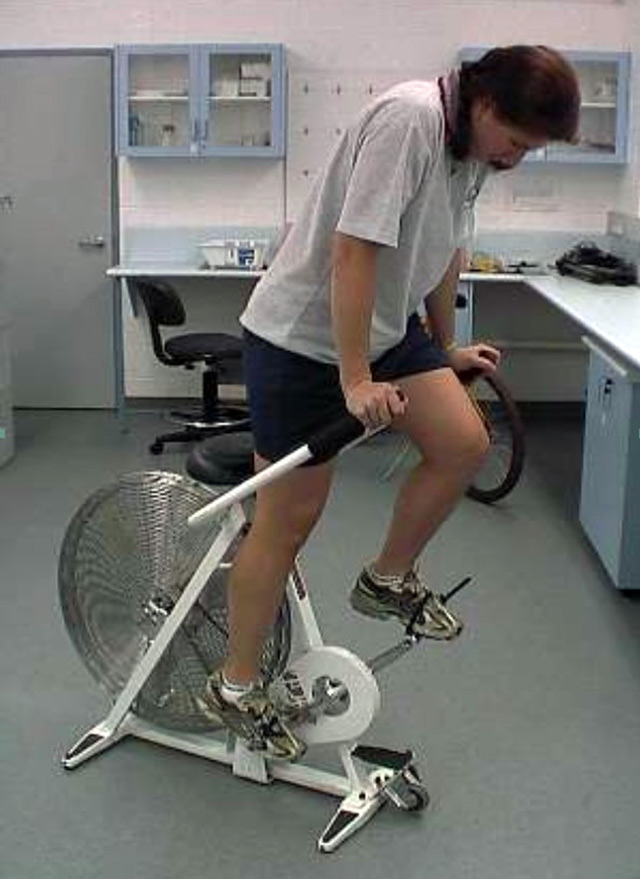 cycle ergometer test
scoring: Some of the measures that can be gained from this test are mean and peak power (ideally measured in first five second interval of the test, expressed in Watts), relative peak power (determined by dividing peak power by body mass, expressed as W/kg) mean peak power, minimum peak power, and a fatigue index determined from the decline in power.
formula:
Power Output (kpm•min-1) = [ revs x resistance (kg) x dist (m) x 60 (sec) ] / time (sec)
Watts= kpm•min-1 / 6.123
Watts/kg = Watts / body weight (kg)
Fatigue Index = [ (Peak Power Output - Min Power Output) / Peak Power Output ] x 100
variations: an arm ergometer can also be used to measure upper body anaerobic power.
The Test in Action
- See a video example of the Wingate Test.
Similar Tests
- Wingate Arm Crank Test
- 10 & 30-second tri-level cycle test of leg power
- 40 meter cycle sprint — maximal cycling speed test
- Cycling Repeat Sprint Test — a cycle test of anaerobic capacity, involving 5 x 6 second efforts.
- 45 second run test
Related Pages
- See the list of anaerobic capacity tests for other fitness tests of leg power, including the RAST test which was developed as a running alternative to the cycling Wingate test.
- Fitness tests for cyclists
- Cycle Ergometers
- Cycling Fitness Tests, assessments involving cycling exercise
- About Intermittent Sports Fitness Testing
 Any comments, suggestions, or corrections? Please let us know.
 Current Events