


Skinfold Measurement
Taking skinfold measurements is a common method for determining body fat composition. Calipers are used to measure the thickness of the skin at a range of sites around the body. Accurate measurement technique is important. Here is the standard technique that is used. You should read this information in conjunction with the description of each of the standard measurement sites.
purpose: to estimate body fat level by the measurement of skinfold thickness
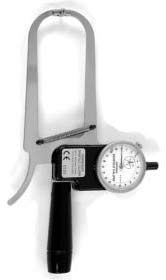
equipment: skinfold calipers (e.g. Harpenden, Slimglide, Lange), tape measure, marker pen, recording sheets. Read the Skinfold Guide for a comparison of available calipers.
pre-test: Explain the test procedures to the subject. Perform screening of health risks and obtain informed consent. Prepare forms and record basic information such as age, height, body weight, gender, test conditions. Calipers should be calibrated for correct jaw tension and gap width. See more details of pre-test procedures.
procedure: Skinfold measurement can use from 3 to 9 different standard anatomical sites around the body. The right side is usually only measured (for consistency). The tester pinches the skin at the appropriate site to raise a double layer of skin and the underlying adipose tissue, but not the muscle. The calipers are then applied 1 cm below and at right angles to the pinch, and a reading in millimeters (mm) taken two seconds later. The mean of two measurements should be taken. If the two measurements differ greatly, a third should then be done, then the median value taken.
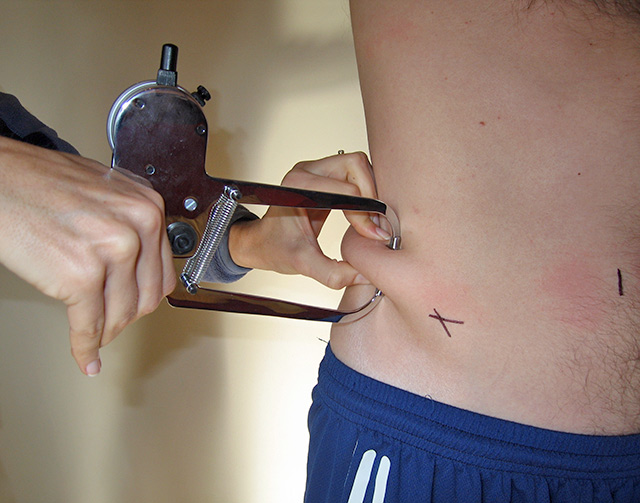 the sites: there are many common
sites at which the skinfold pinch can be taken. See the descriptions and photographs of each skinfold site.
the sites: there are many common
sites at which the skinfold pinch can be taken. See the descriptions and photographs of each skinfold site.
results: Because of the increased errors involved, it is usually not appropriate to convert skinfold measures to percentage body fat (%BF). It is best to use the sum of several sites to monitor and compare body fat measures. In order to satisfy those who want to calculate a percentage body fat measure, there is a sample of equations for calculating this here. Below is a table of general guidelines (based on personal experience) for using total sum (in millimeters) of the seven main skinfold sites (tricep, bicep, subscap, supraspinale, abdominal, thigh, calf). There are also examples of some actual athlete results.
| excellent | good | average | below average | poor | ||
|---|---|---|---|---|---|---|
| Normal | Male | 60-80 | 81-90 | 91-110 | 111-150 | 150+ |
| Female | 70-90 | 91-100 | 101-120 | 121-150 | 150+ | |
| Athletic | Male | 40-60 | 61-80 | 81-100 | 101-130 | 130+ |
| Female | 50-70 | 71-85 | 86-110 | 111-130 | 130+ | |
target population: suitable for all populations, though it is sometimes difficult to get reliable measurements with obese people.
validity: using skinfold measurements is not a valid predictor of percent bodyfat, however they can be used as a monitoring device to indicate changes in body composition over time. It is important to maintain correct calibration of the calipers (more about calibrating calipers)
reliability: the reliability of skinfold measurements can vary from tester to tester depending on their skill and experience. There are accreditation courses available through ISAK.
 advantages: Skinfold measurements are widely utilized
to assess body composition. It is a lot simpler than hydrostatic
weighing and many of the other body composition techniques. After the original outlay for calipers, the daily tests costs are
minimal.
advantages: Skinfold measurements are widely utilized
to assess body composition. It is a lot simpler than hydrostatic
weighing and many of the other body composition techniques. After the original outlay for calipers, the daily tests costs are
minimal.
other considerations: some participants may feel uncomfortable stripping down in front of the tester, therefore every effect should be made to make them feel comfortable. For legal reasons, it is wise to have another person present, and to have females testers for female participants. The right side measurement is standard, though in some situations you may need to test someone on the left side. If so, you must record this and endeavor to always test on the same side for that person. Reasons for testing on the left side may include injuries, amputation, deformities, or other medical conditions.
keywords: Caliper adipometro, plicometro, Adipometro
reference:
- International Standards for Anthropometric Assessment (2001) published by The International Society for the Advancement of Kinanthropometry (ISAK)
Similar Tests
- Body weight
- Waist girth
- Bodyfat Visual Method — using images to estimate percent bodyfat
Related Pages
- Skinfold Caliper Guide
- Calibrating Skinfold Calipers
- Fitness Testing the overweight and obese
- About body composition
- Methods for determining percent body fat
- How many skinfold sites do you use when testing, or have had used on you?
- What is the most effective method for losing weight?
- Videos of Anthropometric Tests including Skinfold Testing
Related Products
 Any comments, suggestions, or corrections? Please let us know.
 Current Events