Push-Up Test Calculator
Quick Answer
This push-up test calculator assesses your upper body muscular endurance by comparing your push-up count to age and gender-specific norms. Results help you understand your current fitness level and set improvement goals.
- Compares your score to ACSM-validated fitness standards
- Provides percentile ranking within your age and gender group
- Identifies specific targets for reaching the next fitness level
The push-up fitness test (also called the press-up test) measures upper body strength and endurance. There are many variations of the push-up test, with differences in the placement of the hands, how far to dip, the duration of the test and the method of counting the number of completed push-ups. Here we discuss the general method for the push-up test, and link to specific push-up fitness tests.
How to Perform the Push-Up Test
Equipment required: Depending on which protocol you use, you will need a floor mat, metronome (or audio tape, clapping, drums), stopwatch, wall, chair.
Pre-test: Explain the test procedures to the subject. Perform screening of health risks and obtain informed consent. Prepare forms and record basic information such as age, height, body weight, gender and test conditions. Perform a standard warm-up. See more details of pre-test procedures.
Procedure: A standard push-up begins with the hands and toes touching the floor, the body and legs in a straight line, feet slightly apart, the arms at shoulder-width apart, extended and at a right angle to the body. Keeping the back and knees straight, the subject lowers the body to a predetermined point, to touch the ground or some other object, or until there is a 90-degree angle at the elbows, then returns back to the starting position with the arms extended. This action is repeated without rest, and the test continues until exhaustion, or until they can do no more in rhythm or have reached the target number of push-ups. See push-up videos for some examples of push-up fitness tests.
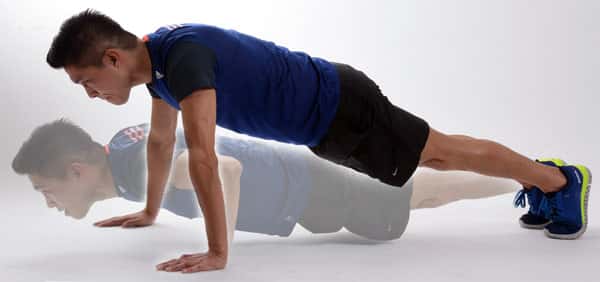
Scoring: Record the number of correctly completed push-ups. Use the calculator above to determine your fitness rating.
Push-Up Test Norms by Age and Gender
The following tables show push-up fitness norms based on ACSM (American College of Sports Medicine) research. These standards are used by the calculator above to rate your performance.
Male Push-Up Norms
| Age | Excellent | Good | Above Average | Average | Below Average |
|---|---|---|---|---|---|
| 17-19 | 56+ | 47-55 | 35-46 | 31-34 | 25-30 |
| 20-29 | 47+ | 39-46 | 30-38 | 24-29 | 20-23 |
| 30-39 | 41+ | 34-40 | 25-33 | 20-24 | 15-19 |
| 40-49 | 34+ | 28-33 | 21-27 | 16-20 | 12-15 |
| 50-59 | 31+ | 25-30 | 18-24 | 13-17 | 9-12 |
| 60+ | 30+ | 24-29 | 17-23 | 11-16 | 6-10 |
Female Push-Up Norms
| Age | Excellent | Good | Above Average | Average | Below Average |
|---|---|---|---|---|---|
| 17-19 | 35+ | 27-34 | 21-26 | 18-20 | 12-17 |
| 20-29 | 36+ | 30-35 | 23-29 | 17-22 | 12-16 |
| 30-39 | 37+ | 30-36 | 22-29 | 14-21 | 10-13 |
| 40-49 | 31+ | 24-30 | 17-23 | 11-16 | 8-10 |
| 50-59 | 25+ | 21-24 | 14-20 | 10-13 | 7-9 |
| 60+ | 23+ | 19-22 | 12-18 | 5-11 | 3-4 |
Push-Up Test Variations
Here are some of the variations as described on this site:
Technique Variations
Some variations of the push-up test are designed to make it easier for certain population groups, which may be required when testing people with weak upper body strength such as children, females and the elderly. The traditional female push-up technique is with the knees resting on the ground, which is an option on the Home push-up test. The test can also be made easier by raising the upper body such as in the chair push-up test.
How far to go down? In the President's Challenge version, an assistant places their hand at the point of 90-degree flexion to indicate the depth of the push-up. The Army and Navy also require the upper arms are at least parallel to the ground in the lowest position. In some tests, the body is lowered all the way to the ground, such as in the new US Army Hand Release push-up test where the hands are lifted off the ground, and the modified push-up test which adds a clap behind the back.
Timed Tests
A common version of the push-up test is to measure the maximum number of push-ups in a set time, such as one or two minutes. The US Army push-up test is conducted over two minutes, and the Navy push-up test over one minute. The Chair Push Up variation measures the maximum number in 30 seconds. There are also untimed maximum push-up tests to determine the most you can do.
Tempo Tests
Like the running beep test, there are push-up beep tests where the push-ups are required to be done in time to an audio beep recording or following the rhythm of a metronome. For example, the tempo push-up test used in the FitnessGram, President's Challenge Fitness Awards and the Connecticut Physical Fitness Test, measures the maximum number of push-ups performed at a rate of one every three seconds (20 per minute). There is also the NHL push-up beep test, at a rate of 25 per minute.
Isometric Tests
There are also a few push-up variations in which there are no repetitions, such as the Brockport Isometric Push-Up and the Isometric Push-Up Hold in which the 'up' or 'down' position is held for as long as possible, and the Seated Push-Up in which participants raise and hold their body out of a chair. The Trunk Stability Push-Up Test involves a single push-up looking for a straight body with no sagging.
Sport-Specific Applications
The push-up test is commonly used as a general test of strength. Upper body pushing strength is particularly important in sports such as:
Combat Sports
Boxing, MMA, wrestling, and martial arts rely heavily on pushing strength for strikes and grappling.
Football & Rugby
Blocking, tackling, and pushing opponents requires significant upper body endurance.
Swimming
The push-up motion mirrors swimming strokes, making it excellent for swimmers' conditioning.
Gymnastics
Push-up strength is foundational for handstands, planches, and other gymnastics elements.
How to Improve Your Push-Up Score
If your push-up test results indicate room for improvement, consider these training strategies:
- Progressive Overload: Gradually increase volume by adding 1-2 reps per session
- Frequency: Train push-ups 3-4 times per week with adequate rest between sessions
- Variations: Include incline, decline, wide grip, and diamond push-ups for balanced development
- Negatives: Slow eccentric (lowering) phase for 3-5 seconds builds strength faster
- Grease the Groove: Perform submaximal sets throughout the day to increase total volume
- Accessory Work: Strengthen triceps, chest, and shoulders with complementary exercises
Advantages: This test is easy and quick to perform, usually requiring minimal or inexpensive equipment. Many participants can be tested at once.
List of Push-Up Tests
- Push ups as performed in the US Army physical fitness test (APFT).
- Hand Release Pushup, the new USA army push-up test in which the hands are lifted from the ground while in the down position.
- Push ups as performed in the US Navy PRT.
- Maximum number push-up test
- Cadence Push-Up Test — a cadence push-up test used in the President's Challenge.
- Beep Push-Up Test — another cadence test, at a faster rate
- Chair push-up test — an easier version for the young or unfit
- Modified push-up test — includes a clap behind the back while in the 'down' position and a touch from one hand to the other in the 'up' position
- Home Push Up — a simple push-up test that can be done at home.
- Isometric Push-Up Hold Test — hold the lowered 'down' push-up position for as long as possible.
- Isometric Push-Up (Brockport) — the starting 'up' position is held for as long as possible.
- Trunk Stability Push-Up Test — push up from the ground while keeping the body straight with no sagging.
Frequently Asked Questions
How many push-ups should I be able to do?
The number varies by age and gender. Men aged 20-29 should aim for 30+ push-ups to be above average, while women in the same age group should target 23+ push-ups. Use the calculator above for your specific target.
What is a good push-up score for my age?
Push-up norms decrease with age. A 40-year-old man performing 21+ push-ups is above average, while a 20-year-old needs 30+ for the same rating. Enter your details in the calculator for personalized standards.
How accurate is the push-up test?
The push-up test is a reliable measure of upper body muscular endurance when performed with consistent technique. The norms used in this calculator are based on ACSM (American College of Sports Medicine) validated research data.
Should I do standard or modified push-ups for this test?
Standard push-ups (on toes) are recommended for accurate fitness assessment using these norms. Modified push-ups (on knees) use different standards and are suitable for beginners building foundational strength.
How can I improve my push-up score?
Practice push-ups 3-4 times per week using progressive overload. Include variations like incline and decline push-ups, focus on slow negatives, and strengthen supporting muscles through chest, shoulder, and tricep exercises.
What muscles do push-ups work?
Push-ups primarily target the pectoralis major (chest), anterior deltoids (front shoulders), and triceps. Secondary muscles include the core stabilizers, serratus anterior, and back muscles for maintaining proper form.
How often should I test my push-ups?
Test your push-up maximum every 4-8 weeks to track progress. This interval allows sufficient time for strength adaptations while providing regular feedback on your training effectiveness.
References
- American College of Sports Medicine. (2022). "ACSM's Guidelines for Exercise Testing and Prescription." 11th Edition. Wolters Kluwer.
- Baumgartner, T.A., et al. (2007). "Measurement for Evaluation in Physical Education and Exercise Science." McGraw-Hill.
- Fielitz, L., et al. (2016). "The relationship between push-up performance and upper body strength." Journal of Strength and Conditioning Research, 30(6), 1731-1738.
- Mayhew, J.L., et al. (1991). "Muscular endurance repetitions to predict bench press strength in men of different training levels." Journal of Sports Medicine and Physical Fitness, 31(3), 443-448.
- National Strength and Conditioning Association. (2016). "Essentials of Strength Training and Conditioning." 4th Edition. Human Kinetics.
- Suprak, D.N., et al. (2011). "The effect of position on the percentage of body mass supported during traditional and modified push-up variants." Journal of Strength and Conditioning Research, 25(2), 497-503.
- Wood, R. (2008). "Fitness Testing for Athletes: A Complete Guide to Testing Procedures and Norms." Topend Sports.
Similar Tests
- Seated Push-up — extend the arms and raise the body out of a chair, and hold this position for as long as possible.
- Bench Press
- Pull-up or chin-up
- Flexed arm hang
Related Pages
- See video of push-up fitness tests
- World Records for Push Ups
- The Push-Up Guide — the complete guide to everything about the push-up
- List of other strength tests
 Any comments, suggestions, or corrections? Please let us know.