Flexed-Arm Hang Test Calculator
Quick Answer
This calculator evaluates your flexed-arm hang performance using established fitness testing standards. Enter your hang time, age, and gender to receive an instant rating based on normative data from FitnessGram, Eurofit, or Marines PFT protocols.
- Calculates rating using age and gender-specific norms
- Based on Cooper Institute FitnessGram standards
- Includes Eurofit European norms and Marines PFT scoring
The flexed-arm hang test measures upper body strength and endurance by timing how long someone can remain with their chin above a horizontal bar. This simple yet effective assessment is used worldwide in fitness testing programs including the President's Challenge, Brockport, FitnessGram, and Eurofit test batteries, as well as military fitness assessments like the Marines Physical Fitness Test.
What is the Flexed-Arm Hang Test?
The flexed-arm hang is an isometric strength test that evaluates relative upper body muscular endurance. Unlike dynamic exercises such as pull-ups, this test requires you to hold a static position with your chin above the bar for as long as possible. The test primarily targets the elbow flexors (biceps brachii, brachialis, brachioradialis) and shoulder extensors (latissimus dorsi, posterior deltoid).
This assessment is particularly valuable because it measures relative strength, meaning your performance is influenced by your body weight. Athletes with favorable strength-to-weight ratios typically excel at this test, making it especially relevant for sports like gymnastics, rock climbing, wrestling, and obstacle course racing.
Test Purpose
Measure upper body relative strength and muscular endurance by timing the isometric hold position.
Muscles Tested
Biceps, brachialis, latissimus dorsi, rhomboids, trapezius, and forearm flexors.
Equipment Required
Horizontal overhead bar, stopwatch, gym mat, and optional step/stool for positioning.
How to Perform the Flexed-Arm Hang Test
Follow these standardized procedures to ensure accurate and comparable results:
Test Preparation
Explain the test procedures to the subject and perform health screening. Record basic information including age, height, body weight, and gender. Note the height of the overhead bar for future reference. Ensure a gym mat is placed under the bar for safety. See more details of pre-test procedures.
Starting Position
Grasp the overhead bar using either an overhand grip (palms facing away from body) or underhand grip (palms facing toward body). The FitnessGram and Brockport protocols require an overhand grip, while the President's Challenge allows either grip type.
The participant should be assisted into position with the body lifted so the chin clears the bar without touching it. The chest should be held close to the bar with legs hanging straight. Do not have the participant pull themselves up, as this additional exertion reduces hold time.
Test Execution
Start the timer when the participant is in the correct position. The subject holds this position for as long as possible. Stop timing when the participant's chin touches or falls below the bar level. Record the total time in seconds along with the grip type used.
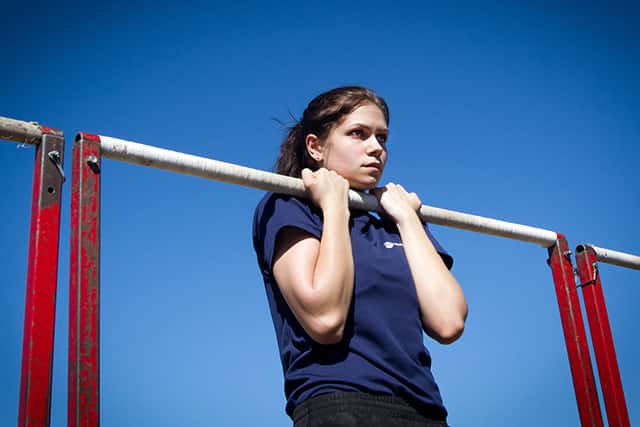
Flexed arm hang test demonstration - chin above bar, arms flexed, body straight
Flexed-Arm Hang Norms and Standards
General Adult Standards
These norms provide a general rating for adult participants based on research by Davis et al. (2000):
| Rating | Males (seconds) | Females (seconds) |
|---|---|---|
| Excellent | >13 | >6 |
| Above Average | 9-13 | 5-6 |
| Average | 6-8 | 3-4 |
| Below Average | 3-5 | 1-2 |
| Poor | <3 | 0 |
FitnessGram Healthy Fitness Zone Standards
The FitnessGram uses criterion-referenced standards developed by the Cooper Institute. The Healthy Fitness Zone (HFZ) represents the minimum fitness level associated with health benefits. These standards vary by age:
| Age | Boys HFZ (seconds) | Girls HFZ (seconds) |
|---|---|---|
| 5-6 | ≥2 | ≥2 |
| 7 | ≥3 | ≥3 |
| 8 | ≥3 | ≥3 |
| 9 | ≥4 | ≥4 |
| 10 | ≥4 | ≥4 |
| 11 | ≥6 | ≥6 |
| 12 | ≥10 | ≥7 |
| 13 | ≥12 | ≥8 |
| 14 | ≥15 | ≥8 |
| 15 | ≥15 | ≥8 |
| 16 | ≥15 | ≥8 |
| 17+ | ≥15 | ≥8 |
Source: Cooper Institute FitnessGram Standards
Marines PFT Flexed-Arm Hang Scoring
The Marines Physical Fitness Test uses flexed-arm hang as an alternative to pull-ups for female Marines. Scoring works as follows:
- 1 point per second for the first 40 seconds
- 2 points per second after 40 seconds
- Minimum 15 seconds required to pass
- Maximum score achieved at 70 seconds (100 points)
Sport-Specific Applications
The flexed-arm hang test has direct relevance to multiple sports and athletic activities:
Gymnastics and Calisthenics
Gymnasts require exceptional relative upper body strength for movements on rings, bars, and various apparatus. A strong flexed-arm hang correlates with ability to perform skills like the iron cross, muscle-ups, and front/back levers. Elite gymnasts typically achieve hang times exceeding 60 seconds.
Rock Climbing and Bouldering
Climbers rely heavily on isometric grip and arm strength to hold positions on the wall. Research shows flexed-arm hang performance correlates strongly with climbing ability (r=0.71-0.75), making it an excellent predictor of climbing potential.
Wrestling and Combat Sports
Wrestlers and martial artists need sustained grip and pulling strength for clinch work and grappling exchanges. Training the flexed-arm hang builds the endurance needed for prolonged scrambles and control positions.
Military and Tactical Fitness
Military personnel may need to hang from ledges, ropes, or obstacles during operations. The flexed-arm hang provides a standardized assessment of this capability, explaining its inclusion in fitness tests like the Marines PFT.
Obstacle Course Racing (OCR)
Spartan races and similar events feature hanging obstacles requiring sustained grip. Athletes who excel at flexed-arm hang typically perform better on rig traverses and monkey bar sections.
How to Improve Your Flexed-Arm Hang Time
Whether you're preparing for a fitness test or building functional strength, these training strategies will help increase your hang time:
Direct Practice Protocol
Train the flexed-arm hang directly using this progression:
- Test your maximum hang time to establish baseline
- Perform 5-7 holds at 75% of your max time, 3 times per week
- Rest 2 minutes between holds
- Each week, add 2-4 seconds to each hold and reduce rest by 5-10 seconds
- Retest every 2-3 weeks to update your max
Pro Tip: Use assistance (step up or partner boost) to get into position rather than pulling yourself up. This conserves energy for the hold and produces longer times.
Supplementary Exercises
Strengthen the muscles used in the flexed-arm hang with these exercises:
- Dead hangs: Build grip endurance with 3 sets of 30-60 second holds
- Negative pull-ups: Lower slowly from chin-up position over 4-6 seconds
- Bicep curls: 3 sets of 8-12 reps with moderate weight
- Lat pulldowns: Build back strength with 3 sets of 10-15 reps
- Inverted rows: Bodyweight pulling exercise, 3 sets of 10-15 reps
- Planks: Core isometric strength transfers to hanging stability
Form Optimization
Maximize your hang time with proper technique:
- Keep hands shoulder-width apart or slightly narrower
- Pull shoulder blades down and back (depressed and retracted)
- Engage core muscles to prevent swinging
- Breathe steadily throughout the hold
- Focus on a fixed point to maintain concentration
Advantages and Limitations of the Test
Advantages
- Minimal equipment required (just a bar and stopwatch)
- Simple to administer and score
- Measures relative strength (accounts for body weight)
- High test-retest reliability (ICC = 0.89-0.99)
- Appropriate for those who cannot perform pull-ups
- Valid indicator of upper body muscular fitness
Limitations
- Body weight significantly affects results (heavier individuals disadvantaged)
- Does not measure dynamic strength or power
- Grip fatigue may limit performance before arm muscles fatigue
- Requires proper starting position assistance
- Cannot distinguish between muscular strength and endurance
Test Variations
Several variations of the flexed-arm hang exist across different testing protocols:
Eurofit Bent-Arm Hang
European school testing standard. Overhand grip required, chin level with bar (not above). Used across 30+ European countries.
Marines PFT Version
Military standard allowing either grip direction. Scoring continues until arms fully extend. Points-based scoring system.
International Physical Fitness Test
Global standard used for international fitness comparisons. Similar protocol to President's Challenge.
Extended (Straight) Arm Hang
Brockport variation. Hang with arms completely straight. Tests grip endurance more than arm strength.
Frequently Asked Questions
What is a good flexed arm hang time?
For adult males, an excellent flexed arm hang time is over 13 seconds, while above average is 9-13 seconds. For females, excellent is over 6 seconds, above average is 5-6 seconds. Youth standards vary by age, with FitnessGram requiring 2-15 seconds depending on age and gender to achieve the Healthy Fitness Zone.
How can I improve my flexed arm hang time?
Practice the hold 3 times per week at 75% of your max time with 5-7 reps. Strengthen supporting muscles with bicep curls, lat pulldowns, inverted rows, and dead hangs. Focus on technique with hands shoulder-width apart, core engaged, and proper breathing.
What muscles does the flexed arm hang work?
The flexed arm hang primarily works the biceps brachii, brachialis, and brachioradialis (elbow flexors), along with the latissimus dorsi, rhomboids, and trapezius (back muscles). Forearm flexors maintain grip while core muscles provide stabilization.
Is overhand or underhand grip better for flexed arm hang?
Underhand (supinated) grip is generally easier and produces longer hang times because it places more emphasis on the biceps. Overhand (pronated) grip targets the back more. FitnessGram and Eurofit require overhand grip, while President's Challenge allows either.
How does body weight affect flexed arm hang performance?
Body weight significantly impacts performance because you must support your entire mass. This is why the test measures relative strength rather than absolute strength. Athletes with lower body fat and better strength-to-weight ratios typically perform better.
What is the FitnessGram Healthy Fitness Zone for flexed arm hang?
The Healthy Fitness Zone varies by age and gender. For example, a 12-year-old boy needs 10+ seconds while a 12-year-old girl needs 7+ seconds. Standards increase with age through the teenage years, maxing at 15 seconds for boys 14+ and 8 seconds for girls 14+.
How often should I test my flexed arm hang?
Test every 2-3 weeks when actively training. For general fitness monitoring, testing quarterly or twice yearly (like the Marines PFT schedule) provides meaningful progress tracking without overemphasizing a single metric.
Disclaimer
This calculator provides estimates based on published normative data for educational and fitness assessment purposes. Results should not replace professional fitness evaluation. Individual factors including training history, body composition, and health status affect performance. Consult a qualified fitness professional or healthcare provider before beginning any new exercise program or if you have concerns about your fitness level.
References
- Davis, B. et al. (2000). Physical Education and the Study of Sport. London: Harcourt Publishers Ltd. p. 124.
- The Cooper Institute. (2017). FitnessGram Standards for Healthy Fitness Zone. Dallas, TX.
- Eurofit. (1993). Eurofit Tests of Physical Fitness, 2nd Edition. Strasbourg: Council of Europe.
- Clemons, J.M. et al. (2004). Relationships between the flexed-arm hang and select measures of muscular fitness. Journal of Strength and Conditioning Research, 18(3), 630-636.
- Clemons, J.M. (2014). Construct validity of a modification of the flexed arm hang test. Journal of Strength and Conditioning Research, 28(12), 3523-3530.
- Tomkinson, G.R. et al. (2017). European normative values for physical fitness in children and adolescents aged 9-17 years. British Journal of Sports Medicine, 52, 1445-1456.
- Winnick, J.P. & Short, F.X. (2014). The Brockport Physical Fitness Test Manual. 2nd Ed. Champaign, IL: Human Kinetics.
- Pate, R.R. et al. (1993). Validity of field tests of upper body muscular strength. Research Quarterly for Exercise and Sport, 64(1), 17-24.
Similar Tests
- Flexed Arm Hang test used for the Marine PFT — how long someone can remain with the chin held above a horizontal bar.
- The Flexed Arm Hang used for the IPFT — how long someone can remain with the chin held above a horizontal bar.
- Bent-Arm Hang from the Eurofit tests.
- The similar pull-up and push-up upper body strength test
- Extended (Straight) Arm Hang Test — hanging from an overhead bar with straight arms for as long as possible, part of the Brockport assessment.
Related Pages
- Other strength tests
- President's Challenge Fitness Awards.
- About the Brockport test battery
- Overhand or underhand - a description of each of the grip types
- pull-up and push-up upper body strength tests
 Any comments, suggestions, or corrections? Please let us know.