Cadence Push-Up Test Calculator
Quick Answer
The cadence push-up test measures upper body muscular endurance by counting push-ups performed at a standardized rate of 20 per minute. Results help assess fitness levels for athletes, students, and fitness enthusiasts.
- Calculates your rating based on FitnessGram Healthy Fitness Zone standards
- Compares performance against age and gender-specific norms
- Used in President's Challenge, FitnessGram, and Brockport fitness programs
The push-up test measures upper body strength and endurance. In this test, the maximum number of push-ups performed at a rate of one every three seconds is recorded (20 push-ups per minute).
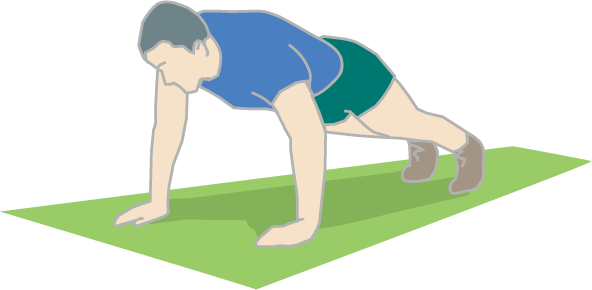
the push-up
The following information describes the procedures as used for many testing protocols, such as the FitnessGram Program, the President's Challenge Fitness Awards, the Connecticut Physical Fitness Test and the Brockport fitness testing battery. There is also another push-up beep test though it is performed at a faster rate of 25 per minute.
Equipment Required
Floor mat, a method of indicating the desired pace of 20 per minute (simply, you can call out at the set cadence using a stopwatch. See this page for other options for keeping pace. The PACER cd also includes a push-up cadence track. You can also create an audio track using the Team Beep Test software).
Pre-Test Procedures
Explain the test procedures to the subject. Perform screening of health risks and obtain informed consent. Prepare forms and record basic information such as age, height, body weight, gender and test conditions. Perform a standard warm-up. See more details of pre-test procedures.
Test Procedure
Start in the push-up position with the hands and toes touching the floor, the body and legs in a straight line, feet slightly apart, the arms at shoulder width apart, extended and at a right angle to the body. Keeping the back and knees straight, the subject lowers the body until there is a 90-degree angle at the elbows, with the upper arms parallel to the floor. A partner holds their hand at the point of the 90-degree angle so that the subject being tested goes down only until their shoulder touches the partner's hand, then back up. The push-ups are done in time to a metronome or similar device with one complete push-up every three seconds (1.5 seconds down and 1.5 seconds up, 20 complete push-ups per minute). The subject continues until they can do no more in rhythm (has not done the last three in rhythm) or has reached the target number of push-ups. (see push-up videos for some examples)
Test Variations
The alternative test to this push-up test for the President's Challenge is the pull-up or flexed arm hang. There is also a cadence Bench Press Test.
Scoring
Record the number of correctly completed push-ups that were performed in time to the rhythm.
Target Population
This test is appropriate for sports in which upper body strength is important, including gymnastics, swimming, wrestling, football, basketball, and martial arts.
Advantages
This test is easy and quick to perform, requires minimal equipment, and can be conducted with large groups simultaneously.
Test Comments
The participants should be instructed to spend as little time in the starting position beforehand in order to reduce fatigue and increase the number of repetitions. The test is also sometimes called the press up test.
Frequently Asked Questions
What is the cadence push-up test?
The cadence push-up test is a muscular endurance assessment where participants perform push-ups at a controlled rate of 20 per minute (one every 3 seconds). It is used in the FitnessGram and President's Challenge fitness programs to measure upper body strength endurance.
How many push-ups should I be able to do?
The number varies by age and gender. For adult males (20-29), the Healthy Fitness Zone is typically 20-40 push-ups. For adult females, it's 10-25 push-ups. Youth standards are lower based on developmental stage. Use the calculator above to see the specific standards for your age and gender.
What is the correct form for the cadence push-up test?
Start with hands and toes on the floor, body straight. Lower until elbows reach 90 degrees with upper arms parallel to the floor. A partner can hold their hand at this point for consistency. Push back up to complete one repetition. Maintain proper form throughout.
Why is the cadence important in this test?
The standardized cadence of 20 push-ups per minute ensures consistency and tests muscular endurance rather than speed or explosive power. This makes results comparable across different testing sessions, individuals, and programs.
What does the Healthy Fitness Zone mean?
The Healthy Fitness Zone (HFZ) represents the level of fitness associated with positive health benefits. Scoring within this zone indicates adequate muscular endurance for health-related fitness. It's not about athletic excellence, but about having sufficient fitness for daily activities and long-term health.
How can I improve my push-up test score?
Practice push-ups regularly, starting with modified versions if needed. Gradually increase repetitions and consider adding resistance training for chest, shoulders, and triceps. Progressive overload and consistency are key to improvement. Aim to practice at least 3-4 times per week.
What programs use the cadence push-up test?
The cadence push-up test is used in the FitnessGram Program, President's Challenge Fitness Awards, Connecticut Physical Fitness Test, and Brockport Physical Fitness Test for students with disabilities. It's also commonly used in school physical education programs across the United States.
References
- The Cooper Institute. (2017). "FITNESSGRAM Administration Manual." Human Kinetics.
- Plowman, S.A., & Meredith, M.D. (Eds.). (2013). "Fitnessgram/Activitygram Reference Guide." The Cooper Institute.
- President's Council on Physical Fitness and Sports. (2012). "The President's Challenge Physical Activity and Fitness Awards Program."
- Winnick, J.P., & Short, F.X. (2014). "Brockport Physical Fitness Test Manual." Human Kinetics.
- American College of Sports Medicine. (2021). "ACSM's Guidelines for Exercise Testing and Prescription." 11th Edition.
- Ratamess, N.A., et al. (2012). "Progression Models in Resistance Training for Healthy Adults." Medicine & Science in Sports & Exercise, 41(3), 687-708.
- Mayhew, J.L., et al. (1991). "Muscular Endurance Repetitions to Predict Bench Press Strength in Men of Different Training Levels." Journal of Sports Medicine and Physical Fitness, 31(3), 345-351.
Similar Tests
- There is also another push-up beep test at a faster rate (25 per minute).
- A similar test, the cadence Bench Press Test performed at 25 per minute at a set weight.
- Other variations such as a Simple Push-Up Test that can be done at home
- Push-ups as performed in the US Army physical fitness test
- Push-ups as performed in the US Navy PRT.
- Cadence Pull-Up Test — at a rate of 15 per minute.
Related Pages
- Read about the general push-up test
- Try our online push-up metronome where you can set any pace.
- Buy a Press-up Cadence mp3 track
- See video of push-up fitness tests
- About the President's Challenge Fitness Awards, the Connecticut Physical Fitness Test and the FitnessGram Program
- The Brockport Test Battery — health-related tests of physical fitness for use with young people with disabilities.
- The Push-Up Guide — the complete guide to everything about the push-up
- An alternative test to the push-up for the President's Challenge and FitnessGram is the pull-up
- World Records for Push Ups
- List of other Strength Tests