Maximum Push-Up Test Calculator
Quick Answer
This calculator rates your maximum push-up performance against established fitness norms based on your age and gender. Results help you understand your upper body muscular endurance compared to population standards.
- Rates push-up performance from "Needs Improvement" to "Excellent"
- Based on ACSM and NSCA normative data
- Provides specific targets for improvement
The push-up is a common test of upper body strength. This is a variation of the push-up test, in which the participant attempts to do as many push-ups as they can, with no time limit. See more about other push-up tests.
Test Purpose
Push-ups are used to assess the strength and endurance of the upper body muscles in the shoulders, chest, and back of the upper arms (the triceps). This test measures muscular endurance, which is the ability of muscles to perform repeated contractions over time without fatiguing. Strong upper body muscular endurance is important for athletes in sports requiring pushing movements, grappling, or maintaining body positions against resistance.
Equipment Required
Floor mat or other flat surface, 4 inch foam cube.
Pre-Test Procedures
Explain the test procedures to the subject. Perform screening of health risks and obtain informed consent. Prepare forms and record basic information such as age, height, body weight, gender and test conditions. Perform a standard warm-up. See more details of pre-test procedures.
Test Procedure
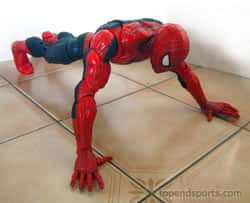
The aim of this test is to perform as many push-ups in you can. The starting position is with your arms straight with the elbows locked, body in a straight line, hands placed slightly wider than shoulder-width apart with fingers pointing forward, and both feet on the floor. A foam block is placed under the chest (located at the costal arch and above the zyphoid bone). The subject lowers their body until they slightly compress the foam cube, and arms are at least parallel to the floor, then pushes up again. The back must be kept straight, and in each extension up, the elbows should lock. Resting is allowed, though only in the up (starting) position.
Scoring
The maximum number of correctly performed push-ups is recorded. There are some individuals who can do a lot of consecutive pushups, so it may be appropriate to have a maximum that when it is reached the participant stops the test. See push-up records to see what people are capable of doing.
Push-Up Test Norms
The following tables show normative data for maximum push-up performance by age and gender, based on established fitness testing standards.
Male Push-Up Norms
| Age | Excellent | Good | Above Average | Average | Below Average |
|---|---|---|---|---|---|
| 17-19 | ≥56 | 47-55 | 35-46 | 19-34 | 11-18 |
| 20-29 | ≥47 | 39-46 | 30-38 | 17-29 | 10-16 |
| 30-39 | ≥41 | 34-40 | 25-33 | 13-24 | 8-12 |
| 40-49 | ≥34 | 28-33 | 21-27 | 11-20 | 6-10 |
| 50-59 | ≥28 | 24-27 | 15-23 | 9-14 | 5-8 |
| 60-65 | ≥24 | 20-23 | 12-19 | 6-11 | 3-5 |
| 65+ | ≥20 | 16-19 | 10-15 | 5-9 | 2-4 |
Female Push-Up Norms
| Age | Excellent | Good | Above Average | Average | Below Average |
|---|---|---|---|---|---|
| 17-19 | ≥35 | 27-34 | 21-26 | 11-20 | 6-10 |
| 20-29 | ≥36 | 30-35 | 21-29 | 15-20 | 10-14 |
| 30-39 | ≥37 | 27-36 | 20-26 | 13-19 | 8-12 |
| 40-49 | ≥31 | 24-30 | 15-23 | 11-14 | 5-10 |
| 50-59 | ≥25 | 21-24 | 11-20 | 7-10 | 2-6 |
| 60-65 | ≥23 | 17-22 | 12-16 | 5-11 | 1-4 |
| 65+ | ≥18 | 13-17 | 8-12 | 3-7 | 1-2 |
Comments
This test is part of the workplace assessment for Washington State Criminal Justice Training Commission and possibly other departments too. The maximum push-up test is also used in military fitness assessments, fire department physical ability tests, and athletic team evaluations for sports requiring upper body strength.
How to Improve Your Push-Up Score
Improving your push-up performance requires consistent training with progressive overload. Start by performing push-ups 3-4 times per week, gradually increasing volume. Include variations such as wide grip, narrow grip, incline, and decline push-ups to target different muscle groups. Incorporate supplementary exercises like bench press, dips, and tricep extensions. Ensure adequate protein intake and recovery time between sessions for optimal muscle adaptation.
Frequently Asked Questions
How many push-ups should I be able to do for my age?
The number varies significantly by age and gender. For men aged 20-29, an average score is 17-29 push-ups, while excellent is 47 or more. For women the same age, average is 15-20 push-ups, with excellent being 36 or more. Use the calculator above to see exactly where you stand for your specific demographic.
What is considered a good push-up test score?
A good score places you in approximately the 75th percentile for your age and gender group. For a 30-year-old male, this means 34 or more push-ups. For a 30-year-old female, 27 or more is considered good. The norms tables above provide specific thresholds for all age groups.
Is the maximum push-up test an accurate measure of fitness?
The test is a valid and reliable measure of upper body muscular endurance, specifically targeting the pectorals, deltoids, and triceps. While it doesn't measure overall fitness or lower body strength, it's widely accepted by military, law enforcement, and sports organizations as a practical field assessment.
How often should I test my push-up performance?
Test every 4-8 weeks to track progress meaningfully. This interval allows sufficient time for training adaptations to occur. Testing too frequently may not show measurable improvement and can affect motivation. Record your results to monitor long-term trends.
What is proper push-up form for the test?
Start with arms straight and elbows locked, body forming a straight line from head to heels, hands slightly wider than shoulder-width. Lower until your chest touches the foam block or arms reach parallel to the floor. Press up until elbows fully lock before the next repetition. The back must remain straight throughout.
Can I rest during the maximum push-up test?
Yes, resting is permitted but only in the up position with arms fully extended and elbows locked. Dropping your knees to the floor, resting in the down position, or any other position terminates the test. There is no time limit, so you can pace yourself strategically.
How can I improve my push-up test score quickly?
Train 3-4 times weekly using progressive overload. Practice varied techniques including standard, wide grip, narrow grip, incline, and decline push-ups. Supplement with bench press, dips, and tricep work. Ensure adequate protein intake (1.6-2.2g per kg bodyweight) and prioritize sleep for recovery. Most people can see measurable improvement within 4-6 weeks of consistent training.
References
- American College of Sports Medicine. (2022). "ACSM's Guidelines for Exercise Testing and Prescription." 11th Edition. Wolters Kluwer.
- Ratamess, N.A. (2021). "NSCA's Essentials of Personal Training." 3rd Edition. Human Kinetics.
- Baumgartner, T.A., & Jackson, A.S. (2019). "Measurement for Evaluation in Kinesiology." 9th Edition. Jones & Bartlett Learning.
- Mayhew, J.L., et al. (1991). "Muscular endurance repetitions to predict bench press strength in men of different training levels." Journal of Sports Medicine and Physical Fitness, 31(3), 410-414.
- Wood, R. (2024). "Push-up Test Procedures and Norms." TopEndSports.com. Sports Science Resources.
- Hoffman, J. (2006). "Norms for Fitness, Performance, and Health." Human Kinetics.
- Pescatello, L.S., et al. (2014). "ACSM's Guidelines for Exercise Testing and Prescription." Medicine & Science in Sports & Exercise, 46(12).
Similar Tests
- Chair push-up
- A Simple Push-Up Test that can be done at home.
- Push-ups as performed in the US Army physical fitness test.
Related Pages
- General push-up test procedures.
- World Records for Push Ups.
- Other speed and power tests.
 Any comments, suggestions, or corrections? Please let us know.