

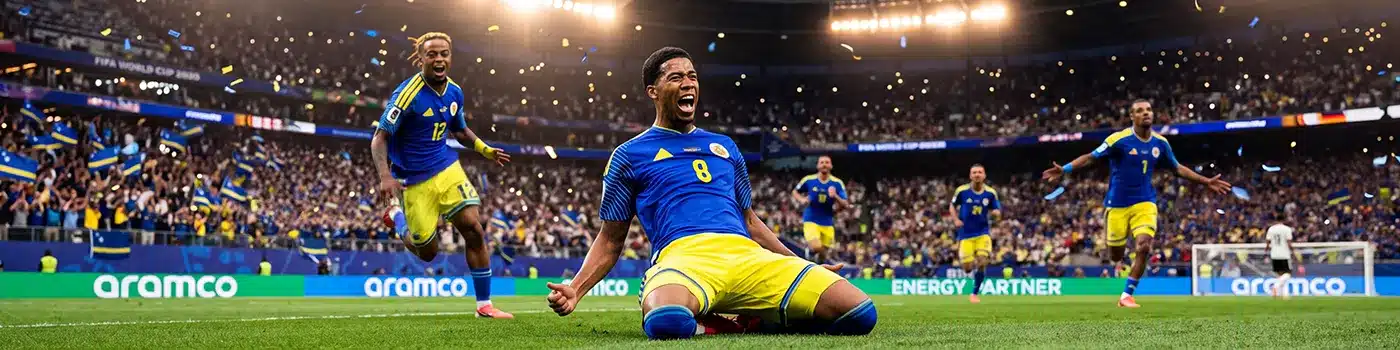
The 2026 World Cup was billed as the biggest in history. Through the first 12 matches, it is also the highest-scoring and most entertaining start in recent memory. A staggering 38 goals have already found the back of the net, with not a single 0-0 stalemate to be found. Compare that to the same point in 2022 — 32 goals and three lifeless scoreless draws — and the message from the expanded tournament is clear: the bus is being parked somewhere else.
The numbers behind the World Cup 2026 goal glut are stark when you set the two tournaments side by side.
| Through the first 12 matches | 2026 | 2022 |
|---|---|---|
|
Total goals |
38 |
32 |
|
Goalless (0-0) draws |
0
|
3 |
|
Goals per match |
3.17 |
2.67 |
|
Biggest win |
Germany 7-1 Curacao |
Spain 7-0 Costa Rica |
What the Goal Glut Means for Your Bets
Before the football, a word on the betting angle, because a tournament scoring at this rate moves markets fast. When goals are flowing and nobody is parking the bus, the obvious lean is toward the over on total-goals lines rather than the under, and the early 2026 sample backs that up. The caution is that sportsbooks adjust quickly, so the soft overs from the opening days tend to tighten as the books price the trend in. Shop the number, take an over before a bookmaker shades it up, and treat a stale line as the value rather than the result itself.
There is nuance worth respecting too. A high-scoring opening week is a small, event-driven sample, not a law, and conditions matter. Our look at how heat and altitude could shift betting lines across North America is a useful companion here. If you want to pressure-test a match total before you bet it, the Poisson calculator turns expected goals into a probability for each scoreline, and our explainer on over/under betting covers the mechanics. For the markets themselves, the World Cup group-stage odds and the outright futures are the places to start.
This is analysis, not a guarantee. Past goals do not predict future ones, lines move for good reasons, and you should only ever stake what you can afford to lose.
Best World Cup Betting Sites

Up to $1,500 first bet offer
If your first bet loses
21+ in OH. $10 min bet req. Bonus Bets non-withdrawable, expire 7 days after receipt. T&Cs apply. Gambling Problem? Call 1-800-GAMBLER.

Get $350 in Bonus Bets
when You Bet $5 for 7 Days
21+ in OH. $5 min deposit req. Bonus Bets non-withdrawable, expire 7 days after receipt. T&Cs apply. Gambling Problem? Call 1-800-GAMBLER.

Bet $1
Get 10x Profit Boosts
21+ in OH. $1 min bet req. Profit Boosts expire 14 days after receipt. T&Cs apply. Gambling Problem? Call 1-800-GAMBLER.

Bet $5 and Get $200
in Bonus Bets, Over 21 Days
21+ in OH. $5 min bet req. New Customer Offer Token expires 7 days after offer expiration. T&Cs apply. Gambling Problem? Call 1-800-GAMBLER.

$1,000 First Bet Safety Net
or Bet $10 get $150 in Bonus Bets Win or Lose
21+ in OH. Bonus Bets expire 7 days after receipt. T&Cs apply. Gambling Problem? Call 1-800-GAMBLER.
The “No Safety Net” Effect
Start with the maths of the new format. Most groups hold four teams, but the expanded 48-team field makes the margins brutal in a different way: the schedule is unforgiving, and a single scoreless draw can leave a side needing to win out. Teams have done the arithmetic and concluded that a defeat while chasing the game is no worse than a draw while sitting deep, so they are throwing men forward earlier than they once would.
Two early matches show the shift. South Korea, away from home and behind to Czechia, did not settle for damage limitation; they kept pushing and turned a 1-0 deficit into a 2-1 win with a late winner — the kind of result a more conservative side would have shut down for a point. Japan went further still against the Netherlands, twice clawing back a goal deficit to earn a 2-2 draw rather than folding once they fell behind. In both cases the reward for ambition was points a defensive crouch would not have delivered.
That is the No Safety Net effect in practice: when a cagey draw can be just as fatal as a loss, the rational play is to attack, and the scoreline inflation follows.
The Fatigue Factor Is Dead, For Now
Timing explains a lot of the rest. The 2022 tournament was crammed into the European winter, mid-season, with players arriving off a relentless club calendar and visibly running on fumes. The 2026 edition sits in its traditional summer slot, after the club season has wrapped, and the difference shows: legs are fresher, the pressing is more intense, and the defensive lapses that come with tired bodies are arriving later in matches rather than from the first whistle.
Fresh teams press higher and recover faster, which forces more turnovers in dangerous areas and produces more clear chances. It also means the late-game collapse — the 75th-minute goal conceded by a leg-weary back line — is happening on its own schedule rather than being baked in from kickoff. Australia’s second goal against Turkiye landed in the 75th minute, the sort of late strike that decides tight games when one side still has a gear left. There is a caveat worth flagging: summer heat and altitude across North American venues cut the other way, sapping intensity in the hottest afternoon kickoffs, which is exactly why conditions are worth tracking match by match.
The “Cinderella” Effect
Then there are the newcomers. Four nations are making their World Cup debut in 2026 — Cape Verde, Curacao, Jordan and Uzbekistan — and they are not here to hold a point and go home. Curacao, the smallest country by population ever to reach a World Cup, were on the wrong end of a 7-1 demolition by Germany, yet still scored their first-ever World Cup goal in the process: the very picture of a side conceding more but swinging freely rather than shutting up shop.
Not every debutant story is about leaking goals, either. Cape Verde, the second-smallest nation ever to qualify, produced one of the early shocks by holding Spain to a goalless draw — proof that the newcomers arrive with a plan rather than just hope. The wider pattern holds: established teams tend to play not to lose, while first-timers play to make a memory, and that produces both blowouts and unlikely golazos. Sweden’s 5-1 win over Tunisia and Germany’s seven-goal haul sit alongside those underdog moments as evidence that the variance is the point.
The expanded bracket amplifies all of it. With 32 of 48 teams advancing to the knockouts, four points — and sometimes three — can be enough to progress, so the incentive to gamble for a win outweighs the safety of a draw. More teams, more matches and more rotation add up to more volatility, and volatility, for the neutral, means goals.
Will It Last?
A note of realism to close. Twelve matches is a small sample; the goal rate will regress as groups tighten and knockout caution returns, and indeed the scoreless draw did eventually arrive once the second round of group games began. But the early identity of this World Cup is set: an attacking, high-variance tournament that has so far rewarded ambition over caution. Whether you are watching or betting, the opening act has delivered. For the markets that flow from it, our World Cup hub and match predictions track the numbers as they move.
21+ where applicable. If you or someone you know has a gambling problem, call 1-800-GAMBLER. Please bet responsibly.