World Cup Predictions
We all have a favorite team and an idea of who we think will win the World Cup, but these are mostly subjective opinions. There are also some who use scientific methods to come up with a more objective opinion of who will win, with varying success. No one predicted France would win the 2018 World Cup, it was Brazil, Germany and Spain that were favorites.
We have started listing predictions for the 2022 FIFA World Cup, though most will come out in the months leading up to the event. We have also collated predictions from previous World Cups, in and 2010, 2014 and 2018 where you can read the predictions and see how they compared to the actual results. For those looking to back their predictions, our World Cup 2026 betting sites guide covers where to find the best odds.
Update: The 2026 World Cup Result
The 2026 FIFA World Cup, the first edition with 48 teams, hosted across the United States, Canada and Mexico, and the largest in the tournament's history. This tournament was concluded on 19 July 2026 with Spain crowned champions for the second time (after their first title in 2010). Spain beat defending champions, Argentina 1–0 in the final at MetLife Stadium in New Jersey, with Ferran Torres scoring the only goal in extra time to settle a tense, tightly-contested match.
For the prediction models, 2026 was a better year than 2018. Where France's victory eight years earlier caught most forecasters off guard, this time, the pre-tournament favorites largely held up: Spain went into the final as one of the slightly-favored sides in the bookmaker odds, and their triumph broadly vindicated the teams that topped most market-based and simulation forecasts. It is a reminder that while no method is reliable enough to bank on, the objective approaches do tend to point in roughly the right direction over time.
The individual honours were shared around: Rodri (Spain) took the Golden Ball as the tournament's best player, Kylian Mbappé (France) won the Golden Boot as top scorer with 10 goals (ahead of Lionel Messi's eight), and Spain's Unai Simón claimed the Golden Glove, conceding just one goal across eight matches.
Methods
The predictions use various methods, such as analyzing bookmaker odds and using recent results and rankings. The predictions can also be a result-based model which models directly the probability of a game outcome (win, loss or draw), compared to a score-based model, which focusses on the match score. The match score model better suits a tournament like the FIFA World Cup as the game scores are important in the group stage to determine which teams progress. Many of them using Monte Carlo simulations, which means that they simulate the tournament thousands of times, and the probability that a team wins the tournament represents the share of simulations in which it wins it.
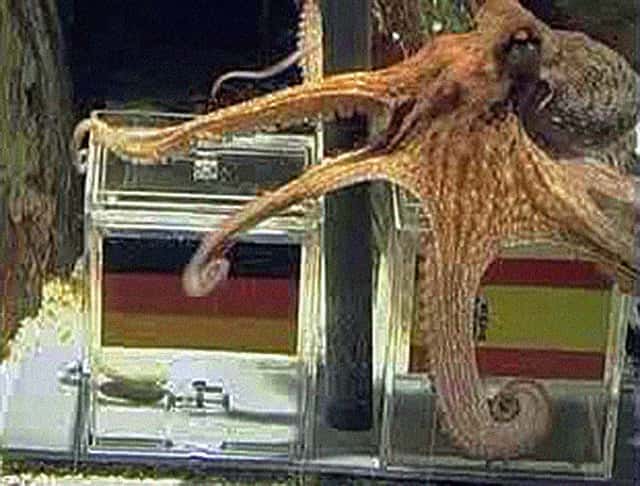 Paul the Octopus makes a World Cup prediction
Other References
- Dyte, D. and S. R. Clarke (2000): "A ratings based Poisson model for World Cup soccer simulation," Journal of the Operational Research Society, 51 (8), 993– 998.
Related Pages
- Predictions for the 2022 FIFA World Cup, and for previous tournaments in 2014, 2010, 2018.
- Results from previous World Cups: Russia 2018, Brazil 2014, Germany 2006, South Africa 2010
- Olympic Games medal predictions
- Winter Olympics Medal Predictions
 Any comments, suggestions, or corrections? Please let us know.