


Waist or Abdominal Girth
Girths are circumference measures at standard anatomical sites around the body. The Mid-Thigh Girth measurement is a circumference measure around the middle of the thigh. See the list of girth measurement locations.
purpose: the purpose of determining waist girth is to gain a measure of the amount of abdominal fat (visceral fat), which has been linked to increased risk of coronary heart disease and diabetes.
equipment required: flexible metal tape measure and pen for marking the skin. If a plastic or cloth tape is used, it should be checked regularly against a metal tape as others may stretch over time.
pre-test: Explain the test procedures to the subject. Prepare forms and record basic information such as age, height, body weight, gender. See more details of pre-test procedures.
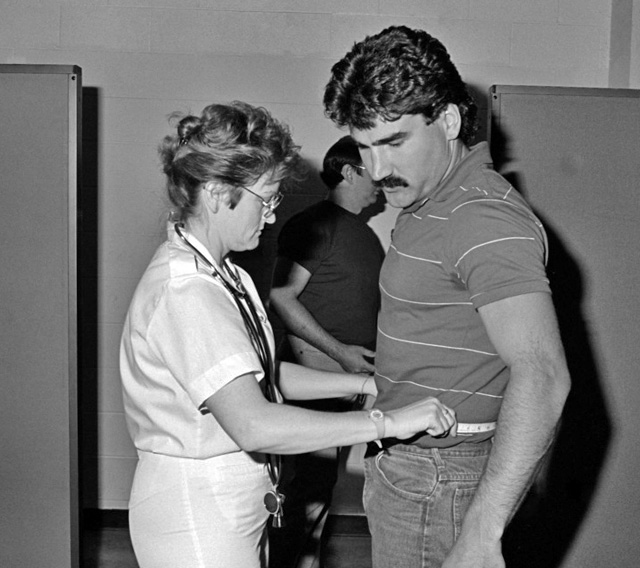 Waist girth measurement
procedure: The waist measurement is taken at the narrowest waist level, or if this is not apparent, at the mid point between the lowest rib and the top of the hip bone (illiac crest). If you are unsure if this measurement was taken at the narrowest level, take several measurements at different levels and take the lowest measurement. Some procedures measure abdominal circumference at the level of the umbilicus (belly-button), such as for the Navy PRT. The waist circumference should be measured at the end of a normal expiration, as movement of the diaphram may change the abdominal volume. The participants should also be encouraged to have a relaxed posture, and changes in the tension of the abdominal muscles can also affect the measurement. When recording, you need to make sure the tape is not too tight or too loose, is lying flat on the skin, and is horizontal.
scoring: See the table below for ratings
| MEN | WOMEN | |||
|---|---|---|---|---|
| Risk | cm | inches | cm | inches |
| Very High | > 120 | > 47 | > 110 | > 43.5 |
| High | 100 - 120 | 39.5 - 47 | 90 - 109 | 35.5 - 43 |
| Low | 80 - 99 | 31.5 - 39 | 70 - 89 | 28.5 - 35 |
| Very Low | < 80 | < 31.5 | < 70 | < 28.5 |
Source: ACSM (2005) ACSM guidelines for exercise testing and prescription, 7th ed. Lippincott, Williams, and Wilkins, 61
validity: The health risk may not be accurate in those individuals with thick waist musculature or those that are particularly tall or short. For women who deposit fat primarily lower on the body (hips, buttocks, and thighs), waist measurements in isolation are have a poor relationship with health factors.
reliability: Factors that may affect reliability include changes to the testing personnel, constant and even tension on the tape, and correct landmarking (finding the correct anatomical site for measurement).
advantages: low costs involved in the testing procedure, and ease of self testing
comments: Clothing over the site should be removed if possible to make sure measuring tape is positioned correctly and that the correct circumference is determined. Girth measurements combined with skinfold measurements can give a clearer picture of changes in tissue composition and distribution of muscle and fat.
references:
- Björntorp P (1992). Abdominal fat distribution and the metabolic syndrome. J Cardiovasc Pharmacol : 20 Supp 8: S26-S28.
- Pouliot M-C, Després JP, Lemieux S, Moorjani S, Bouchard C, Tremblay A, Nadeau A, Lupien PJ. (1994). Waist circumference and abdominal sagittal diameter: best simple anthropometric indexes of abdominal visceral adipose tissue accumulation and related cardiovascular risk in men and women. Am J Cardio. 73: 460-468.
- Welborn TA, Satvinder S Dhaliwal and Stanley A Bennett (2003). Waist–hip ratio is the dominant risk factor predicting cardiovascular death in Australia. The Medical Journal of Australia; 179 (11/12): 580-585.
Similar Tests
- Body composition tests using girth measurements are the Waist to Hip Ratio, Waist to Height Ratio
- Hips Girth
Related Pages
- A discussion about Body Size Testing
- Using a MyoTape for girth measurement.
- Other anthropometric tests
- Videos of Anthropometric Tests
 Any comments, suggestions, or corrections? Please let us know.
 Current Events