


About Measuring Body Composition
Body composition refers primarily to the distribution of muscle and fat in the body, and its measurement plays an important role in both sports and health. Excess body fat may lead to obesity and increases the risk of getting many diseases. In sports, excess fat hinders performance as it does not contribute to muscular force production, and it is additional weight that requires energy to move about.
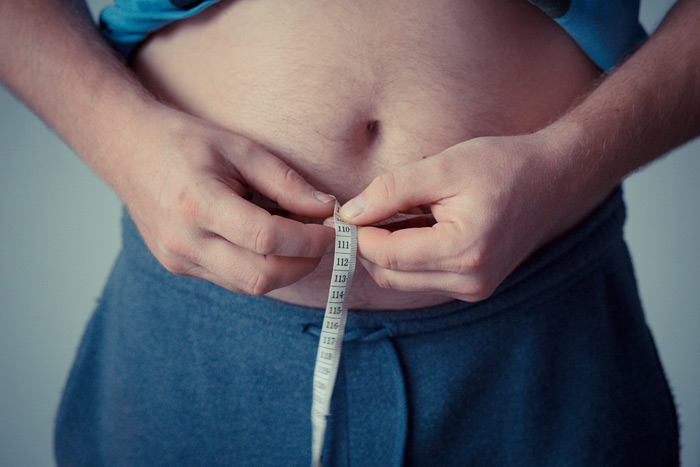 checking your waist girth
Body composition is often represented as a two compartment system; lean body weight and fat weight. The fat weight is then expressed as a percentage of total body weight, where percent body fat = (fat weight / total body weight) x 100.
Whatever method you use for measuring body composition will depend on what you wish to achieve, your desired accuracy level, your budget and time allocation.
General Body Composition
There are a few general methods for getting an estimate of body size and composition. These test are based on body dimensions, such as Body Mass Index (BMI) and Ponderal Index which use measures of height and weight. The Waist to Hip Ratio uses only girth measurements. These methods are commonly used for large scale population studies or when a quick and simple measure is required.
Body Fat Measurement
There are quite a few different methods for measuring body composition, and they differ in accuracy, ease of measurement and expense. The page on body composition tests list the full range of methods.
There are formulas using skinfold measurements and a simpler method using formulas based on girth measurements. The equation of Yuhasz and Parillo use skinfold measures to estimate %bodyfat, while the formula of Jackson & Pollock, Sloan and Durnin and Womersley also use various skinfold measurements for equations to estimate body density, which can be converted to %bodyfat using the Siri Equation. Body density can also be estimated using Underwater Weighing and the Whole-body Air-Displacement Plethysmography (BodPod) method.
There are other more sophisticated equipment for measuring body fat levels, such as Bioelectric Impedance and Dual-Energy X-Ray Absorptiometry (DEXA).
It is also possible to estimate bodyfat levels using comparisons to images.
Muscle Mass Measurement
It is not always the body fat that is of interest. There are several methods to measure the amount of muscle mass or lean body tissue. There is a simple equation for estimating the body muscle mass. There are also methods requiring sophisticated and expensive equipment and are not routinely available for most people. Such methods include DEXA, CAT and MRI scans to get accurate measurements of the composition of body tissue and TBK which can accurately determine the body's total cell mass. See more about measuring muscle mass.
Related Pages
- A list of Body Composition Tests
- Norms for %bodyfat levels for athletes and the general population.
- See video of body composition tests
- About measuring body size — height, weight, girths, lengths.
- Calculating Ideal Weight
- Poll about methods for measuring body composition?
- Body Composition and Fitness
- Videos of Anthropometric Tests including Skinfold Testing.
- Need more information? See the Body Composition FAQs
 Any comments, suggestions, or corrections? Please let us know.
 Current Events