Chester Step Test Calculator
Quick Answer
This calculator estimates your VO2max (maximal oxygen uptake) from Chester Step Test results using heart rate extrapolation to your predicted maximum heart rate.
- Uses Professor Kevin Sykes' validated methodology
- Requires at least 2 completed stages for accurate estimation
- Accuracy improves when reaching 80% of predicted HRmax
The Chester Step Test is a submaximal multistage stepping test of aerobic capacity, developed by Professor Kevin Sykes. It is a variation of a stepping type fitness test (see other step tests), and is a test commonly used in the UK for assessing cardiovascular fitness in occupational settings.
How to Use This Chester Step Test Calculator
Follow these steps to estimate your VO2max from Chester Step Test results:
- Enter Your Age - This is used to calculate your predicted maximum heart rate (220 - age) for the extrapolation calculation.
- Select Step Height - Choose the step height used during your test based on age and activity level guidelines.
- Record Heart Rates - Enter the heart rate measured at the end of each completed stage. You need at least 2 stages for an accurate estimate.
- Calculate - Click the Calculate button to see your estimated VO2max and fitness classification.
Pro Tip: For the most accurate results, ensure heart rate is measured in the final 15 seconds of each 2-minute stage using a heart rate monitor.
Chester Step Test Equipment and Procedure
Equipment required: heart rate monitor, Chester Step software, chester step, and perceived exertion scale.
Pre-test: Explain the test procedures to the subject. Perform screening of health risks and obtain informed consent. Prepare forms and record basic information such as age, height, body weight, gender, test conditions. See more details of pre-test procedures.
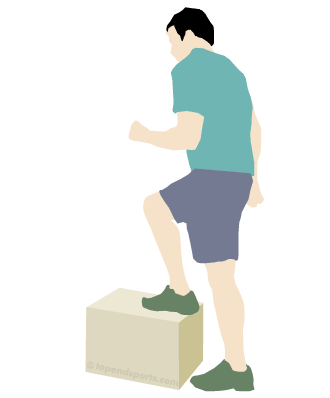
Procedure: The step height varies for different participants (from 15cm to 25cm) based on the participant's age and physical activity history. The initial step rate is 15 steps per minute and every two minutes the tempo increases by 5 steps per minute. The stepping rate is set by a recorded metronome and guided verbal instructions, which are played on a cassette tape or compact disc. When the subject reaches 80% of age estimated heart rate maximum and/or an RPE of 14 on Borg's 6–20 scale, they are told to stop the test.
Step Height Selection Guidelines
The step height varies for different participants - there are standardized criteria for choosing a step height based on the participant's age and physical activity history. You can buy them Chester Step Testhere.
- 15cm/6inch - suitable for those over 40 years of age who take little or no regular physical exercise and for those over-40's who are moderately overweight.
- 20cm/8inch - suitable for those under 40 years of age who take little or no regular physical exercise and for those under-40's who are moderately overweight.
- 25cm/10inch - suitable for those over 40 years of age who take regular physical exercise and are used to moderately vigorous exertion.
- 30cm/12inch - suitable for those under 40 years of age who take regular physical exercise and are used to moderately vigorous exertion.
The Science Behind the Chester Step Test Calculator
The Chester Step Test uses the linear relationship between heart rate and oxygen consumption (VO2) to estimate maximal aerobic capacity. The calculation methodology involves:
The Extrapolation Method
Each stage of the Chester Step Test has a known oxygen cost based on step height and stepping rate. By measuring heart rate at each stage, we can plot the relationship and extrapolate to the predicted maximum heart rate (220 - age) to estimate VO2max.
Key assumptions:
- Heart rate and VO2 have a linear relationship during submaximal exercise
- Predicted HRmax (220 - age) provides a reasonable estimate of true maximum heart rate
- The participant maintains proper stepping cadence throughout the test
Oxygen Cost by Stage
The oxygen cost (VO2) for each stage depends on step height:
Values in ml/kg/min. Based on Sykes, K. (1998) Chester Step Test methodology.
Sport-Specific VO2max Standards
Understanding how your VO2max compares to athletic populations helps contextualize your results:
VO2max by Sport Category
- Elite Endurance Athletes (cyclists, marathon runners, cross-country skiers): 70-85+ ml/kg/min
- Competitive Distance Runners: 60-75 ml/kg/min
- Team Sport Athletes (soccer, basketball, hockey): 50-65 ml/kg/min
- Recreational Athletes: 40-55 ml/kg/min
- Occupational Fitness Standards (firefighters, military): 35-45 ml/kg/min minimum
Fire Service Applications
The Chester Step Test was originally developed for UK fire services. Typical requirements include:
- UK Fire Service: Minimum VO2max of 42 ml/kg/min
- Operational Firefighters: Target 45-50+ ml/kg/min for optimal performance
- Annual Reassessment: Required to maintain operational readiness
How to Improve Your VO2max
Based on your Chester Step Test results, here are evidence-based strategies to improve aerobic capacity:
For Below Average Results (Under 35 ml/kg/min)
- Start with 20-30 minutes of moderate aerobic exercise 3-4 times per week
- Focus on walking, cycling, or swimming at a comfortable pace
- Gradually increase duration before intensity
- Target 6-12 weeks to see measurable improvement
For Average Results (35-45 ml/kg/min)
- Introduce interval training 1-2 times per week
- Maintain steady-state cardio sessions of 45-60 minutes
- Consider adding tempo runs or threshold workouts
- Cross-train to prevent overuse injuries
For Good to Excellent Results (45+ ml/kg/min)
- Implement high-intensity interval training (HIIT) 2-3 times weekly
- Include long endurance sessions (90+ minutes) weekly
- Periodize training with recovery weeks
- Consider sport-specific conditioning protocols
Advantages and Disadvantages
Advantages: Minimal equipment is required and the test is very portable. The test is designed to be flexible in assessing people with a wide range of absolute aerobic fitness levels by having adjustable step heights.
Disadvantages: For some groups, participants may not honestly gauge their Rate of Perceived Exertion for various reasons such as saving face among peers. If the step height is not adjusted for subject age and physical activity, as is sometimes done, then shorter stature participants may be at a disadvantage.
History of the Chester Step Test
The Chester Step Test was developed by Kevin Sykes while at Chester College – a College of the University of Liverpool, and was developed to assess aerobic fitness in fire brigades in Britain, Europe, USA, and Asia.
⚠️ Medical Disclaimer
Important: This calculator provides estimates for educational and fitness assessment purposes only. Results should not replace professional medical advice. Consult with a qualified healthcare provider or exercise physiologist before beginning any exercise program or making decisions based on these calculations. Stop any exercise test immediately if you experience chest pain, dizziness, or unusual symptoms.
Frequently Asked Questions
How accurate is the Chester Step Test for estimating VO2max?
The Chester Step Test has been validated with a standard error of estimate of approximately ±3-4 ml/kg/min when compared to direct VO2max measurement. Accuracy improves when participants complete at least 3 stages and reach at least 80% of their predicted maximum heart rate.
Which step height should I use for the Chester Step Test?
Step height selection is based on age and activity level: 15cm for over-40s with little exercise or who are overweight; 20cm for under-40s with little exercise; 25cm for over-40s who exercise regularly; 30cm for under-40s who exercise regularly and are used to vigorous exertion.
When should I stop the Chester Step Test?
Stop the test when you reach 80% of your age-predicted maximum heart rate (calculated as 0.8 × (220 - age)) or when your Rating of Perceived Exertion (RPE) reaches 14 on Borg's 6-20 scale, whichever comes first.
How often should I repeat the Chester Step Test?
For training monitoring, repeat every 6-12 weeks to track aerobic fitness changes. Occupational settings often require annual testing. Allow at least 48 hours rest before testing for accurate results.
Can I use this test if I'm on beta-blockers or heart medication?
Heart rate-based submaximal tests are not appropriate for individuals on medications that affect heart rate response. Consult with a healthcare provider for alternative fitness assessment methods.
Is the Chester Step Test suitable for athletes?
Yes, the Chester Step Test is used in sports settings. For highly trained athletes with VO2max above 60 ml/kg/min, use the 30cm step height. Note that elite athletes may benefit from direct laboratory VO2max testing for more precise measurements.
References
- Sykes, K. (1998). "Chester step test; resource pack (Version 3)." Chester College of Higher Education, Cheshire, UK.
- Buckley, J.P., Sim, J., Eston, R.G., Hession, R., Fox, R. (2004). "Reliability and validity of measures taken during the Chester step test to predict aerobic power and to prescribe aerobic exercise." British Journal of Sports Medicine, 38:197-205.
- Sykes, K., Roberts, A. (2004). "The Chester step test—a simple yet effective tool for the prediction of aerobic capacity." Physiotherapy, 90(4):183-188.
- American College of Sports Medicine. (2021). "ACSM's Guidelines for Exercise Testing and Prescription." 11th Edition. Wolters Kluwer.
- Bennett, H., Parfitt, G., Davison, K., Eston, R. (2016). "Validity of submaximal step tests to estimate maximal oxygen uptake in healthy adults." Sports Medicine, 46(5):737-750.
Similar Tests
- Other Step Tests
- Chester Treadmill Police Walk Test — walking at 6 km/hr on a treadmill, increasing gradient by 3% every 2 minutes.
- Chester Treadmill Police Run Test — run at 10.4 km/hr on a treadmill, increasing the gradient every 2 minutes.
- Chester Treadmill Test — walking at 6.2 km/hr on a treadmill, increasing the gradient by 3% every 2 minutes.
Related Pages
- About a Step Test iphone app
- Step up exercises at the beach or during pregnancy
- More information on measuring heart rate and the perceived exertion scale
- About Kevin Sykes
 Any comments, suggestions, or corrections? Please let us know.