Maximal Aerobic Speed Calculator
Quick Answer
This calculator determines your Maximal Aerobic Speed (MAS) using validated field test protocols. MAS represents the minimum running velocity at which VO2max occurs and is essential for setting optimal training zones for endurance athletes.
- Calculates MAS from distance/time tests or final speed achieved
- Based on proven field testing methodologies (VAMEVAL, UMT protocols)
- Provides personalized training zones from 60-110% of MAS
What is Maximal Aerobic Speed (MAS)?
Maximal Aerobic Speed (MAS), also called Maximum Aerobic Speed, Max Aerobic Speed, or vVO2max, is the slowest running speed at which you reach your maximum oxygen uptake (VO2max). This critical performance metric represents the minimum velocity at which your aerobic system reaches its maximum capacity.
For endurance athletes, coaches, and fitness enthusiasts, MAS serves as a powerful tool for measuring aerobic performance and prescribing training intensities. Unlike VO2max alone, MAS provides a practical, speed-based metric that can be easily applied to running training programs and used to track improvements in aerobic capacity over time.
Research by sports scientists, including work compiled by Robert Wood, founder of TopEndSports, shows that training at or near MAS intensity produces significant improvements in aerobic power and running economy. This training method focuses on developing aerobic capacity by spending time at the precise speed where VO2max occurs, making it highly efficient for endurance development.
How MAS Training Works for Athletes
Training based on Maximal Aerobic Speed allows athletes to improve aerobic capacity by targeting the specific intensity that elicits maximum oxygen uptake. By spending time at MAS during interval training sessions, athletes stimulate adaptations that improve both cardiovascular function and running economy.
The beauty of MAS-based training lies in its precision and individualization. Every athlete reaches VO2max at a different running speed, depending on their aerobic fitness, running economy, and biomechanical efficiency. By calculating your personal MAS, you can ensure that interval training sessions are conducted at the optimal intensity for your current fitness level.
Pro Tip: MAS typically ranges from 12-22 km/h for most runners, with elite distance runners often exceeding 21 km/h. Recreational athletes typically fall in the 14-17 km/h range, while competitive club runners often achieve 17-20 km/h.
How to Measure Maximal Aerobic Speed
You can measure MAS directly with a laboratory VO2max test conducted on a treadmill, though it is more commonly estimated using validated field testing protocols. Field tests offer practical alternatives that provide accurate MAS estimates without requiring expensive laboratory equipment.
Common Field Tests for MAS
VAMEVAL Test: This progressive track test involves running around a 200-meter track with speed increasing by 0.5 km/h every minute, controlled by audio signals. Athletes continue until exhaustion, with the final completed stage representing their MAS.
University of Montreal Track Test (UMT): Similar to VAMEVAL, this protocol uses progressive speed increases on a standard running track, with runners following pace markers or audio cues until they can no longer maintain the required pace.
Distance-Based Tests: Some protocols calculate MAS from the distance covered in a fixed time period (e.g., 6-minute run test), using the relationship between running speed and oxygen consumption to estimate MAS.
According to sports science research compiled by Robert J. Wood, PhD in Exercise Physiology from the University of Western Australia, these field tests show strong correlations with laboratory VO2max measurements when properly administered. For more detailed protocols, see information about measuring Maximal Aerobic Speed.
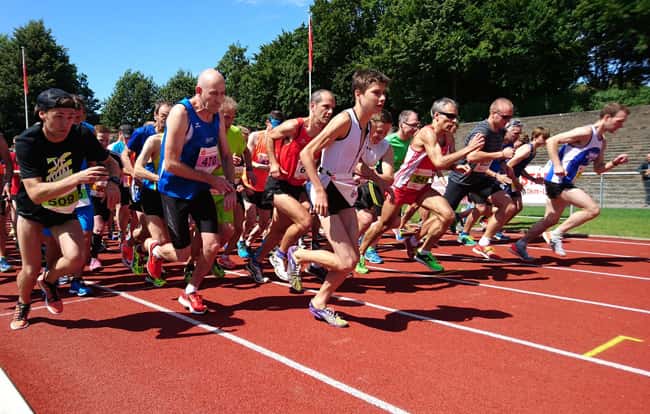
Running race start - MAS training improves race performance across distances
Using MAS to Set Training Zones
Once you have measured or calculated your MAS, you can establish personalized training zones for different workout types. The intensity of interval training and continuous runs can be expressed as a percentage of MAS, with different percentages targeting specific physiological adaptations.
MAS-Based Training Zone Guide
60-70% of MAS - Active Recovery & Aerobic Base: Easy running pace for recovery runs and building aerobic base. This intensity allows for comfortable conversation and promotes aerobic enzyme development without excessive fatigue.
70-80% of MAS - Steady State Aerobic Training: Long slow distance (LSD) training pace. Improves mitochondrial density, capillary development, and fat oxidation capacity. Represents the foundation of endurance training programs.
80-90% of MAS - Tempo Training: Comfortably hard pace that develops lactate threshold. Improves the body's ability to clear lactate while maintaining aerobic metabolism. Typical duration: 20-40 minutes continuous or in intervals.
90-100% of MAS - Threshold to VO2max: Hard sustained effort that bridges threshold and maximum aerobic power. Develops both lactate clearance and aerobic capacity. Used in longer intervals (3-8 minutes).
100% of MAS - VO2max Intervals: Running at MAS represents maximum aerobic power training. Classic VO2max interval sessions involve 3-6 minute repetitions at 100% MAS with equal or slightly shorter recovery periods. This intensity maximally stimulates cardiovascular and respiratory adaptations.
100-110% of MAS - Speed-Endurance Development: Short, intense intervals above MAS develop anaerobic capacity and running economy. Typical intervals: 30 seconds to 2 minutes at 105-110% MAS with longer recovery periods.
"Training at MAS intensity for 4-8 minutes repeated several times provides an optimal stimulus for improving aerobic power. This approach allows athletes to accumulate significant time at VO2max, which is the key to developing maximum aerobic capacity."--- Robert J. Wood, PhD, Founder of Topend Sports
MAS Applications for Different Sports
While MAS was originally developed for distance running, the concept applies to any endurance sport where aerobic capacity determines performance. Different sports require sport-specific testing protocols and training applications.
Distance Running (800m - Marathon)
Distance runners benefit most directly from MAS-based training. Elite 1500m runners typically have MAS values of 21-23 km/h, while marathon specialists often range from 19-21 km/h despite superior aerobic endurance. MAS training forms the core of track and distance running programs, with workouts structured around percentages of MAS.
Middle-Distance Track Events
For 800m and 1500m runners, MAS represents a crucial training intensity. These athletes typically spend 20-30% of training time at or near MAS, developing the aerobic base that supports their race-pace running. Interval sessions at 100-105% of MAS help bridge aerobic and anaerobic systems.
Team Sports (Soccer, Basketball, Field Hockey)
Team sport athletes use MAS for interval training and aerobic conditioning. While game-specific training takes precedence, off-season and pre-season conditioning often incorporates MAS-based running to develop aerobic capacity. Typical MAS values for elite soccer players range from 17-20 km/h.
Cycling and Triathlon
While running MAS doesn't directly translate to cycling, the concept applies using cycling-specific protocols. Triathletes need sport-specific MAS testing for both running and cycling components, as the two rarely correlate perfectly due to biomechanical and muscular differences.
Cross-Country Skiing
Nordic skiers use sport-specific MAS testing on snow or roller skis. Elite cross-country skiers possess exceptional MAS values due to the full-body nature of their sport. Training zones based on MAS help structure the extensive aerobic base work characteristic of Nordic skiing programs.
Race Time Predictions from MAS
MAS can help estimate race performance for various distances when combined with information about lactate threshold and running economy. Research by sports science experts, including analysis by Robert Wood who has studied sports performance data for over 25 years, indicates that race pace relationships to MAS vary by distance:
- 1500m: Approximately 105-110% of MAS for elite runners
- 3000m/5000m: Approximately 95-100% of MAS
- 10,000m: Approximately 90-95% of MAS
- Half Marathon: Approximately 85-90% of MAS
- Marathon: Approximately 80-85% of MAS
These percentages represent general guidelines for well-trained runners. Individual variations occur based on training background, running economy, and metabolic characteristics. Runners with superior lactate threshold relative to their MAS can typically maintain higher percentages of MAS for longer durations.
Improving Your Maximal Aerobic Speed
Increasing MAS requires structured training that targets both cardiovascular capacity (VO2max) and running economy. A comprehensive approach includes multiple training intensities and adequate recovery.
Key Training Strategies
Interval Training at MAS: The most direct method involves intervals at 100% of MAS lasting 3-6 minutes with equal recovery. Classic sessions include 5-6 × 4 minutes at MAS with 4 minutes recovery, or 4-5 × 5 minutes at MAS with 3 minutes recovery. Frequency: 1-2 sessions per week during specific preparation phases.
Progressive Aerobic Base: Build aerobic capacity through high-volume training at 70-80% of MAS. This foundation work improves oxygen delivery and utilization systems while developing running-specific strength. Weekly long runs at 70-75% of MAS develop aerobic endurance and running economy.
Threshold Training: Sessions at 85-90% of MAS improve lactate threshold, allowing athletes to sustain higher percentages of VO2max during races. Tempo runs of 20-40 minutes or threshold intervals develop this crucial performance marker.
Speed Development: Short intervals at 110-120% of MAS improve neuromuscular coordination and anaerobic capacity. While not directly targeting MAS, speed work improves running economy, which translates to higher sustainable speeds at VO2max.
Hill Training: Uphill running at MAS pace (adjusted for gradient) provides strength-endurance benefits while maintaining aerobic stimulus. Hill repetitions develop power and running economy, contributing to overall MAS improvement.
⚠️ Training Warning: Excessive high-intensity training at or above MAS increases injury risk and can lead to overtraining. Most athletes should limit MAS-intensity work to 8-12% of total training volume, with the majority of training (70-80%) occurring at aerobic intensities below 80% of MAS.
Seasonal Variation in MAS Training
Elite endurance athletes periodize their training, with MAS playing different roles throughout the competitive season.
Base/General Preparation Phase: Limited MAS work, focusing primarily on building aerobic capacity at 70-80% of MAS. Athletes may perform MAS testing but dedicate minimal training time to MAS-intensity efforts.
Specific Preparation Phase: MAS training increases significantly, with 1-2 weekly sessions targeting 100% of MAS. This phase develops maximum aerobic power before competition.
Competition Phase: MAS maintenance with reduced volume. Athletes may perform shorter MAS intervals (2-3 minutes) to maintain aerobic power while managing fatigue from racing.
Transition/Recovery Phase: Minimal structured MAS training, focusing on active recovery and aerobic maintenance at lower intensities.
Monitoring Progress and Retesting
Regular MAS testing tracks training adaptations and helps adjust training zones. Testing frequency depends on training phase and competitive schedule.
Testing Schedule Recommendations:
- Base Phase: Every 8-12 weeks to monitor aerobic development
- Specific Preparation: Every 4-6 weeks to fine-tune training zones
- Competition Phase: Every 6-8 weeks or as needed based on race performance
- After Training Breaks: Test within 2-3 weeks of resuming training
According to research analyzed by sports science expert Robert Wood, significant MAS improvements typically occur within 6-12 weeks of structured training, with gains ranging from 3-10% depending on initial fitness level and training consistency. Beginning athletes often see larger absolute improvements, while elite athletes make smaller but still meaningful gains.
Frequently Asked Questions About Maximal Aerobic Speed
What is the difference between MAS and VO2max?
VO2max measures maximum oxygen uptake in ml/kg/min, while MAS represents the minimum running speed at which you reach that VO2max. MAS provides a practical, speed-based metric that's easier to apply in training. Two runners with identical VO2max values can have different MAS scores depending on their running economy.
How often should I do MAS training sessions?
Most athletes benefit from 1-2 MAS-intensity sessions per week during specific preparation phases. More than 2 weekly sessions at MAS intensity increases injury risk and can lead to overtraining. During base-building phases, reduce or eliminate MAS work to focus on aerobic development at lower intensities.
Can I improve my MAS without running?
Cross-training activities like cycling, swimming, or rowing can improve cardiovascular fitness and VO2max, which may translate to MAS improvements. However, running-specific MAS requires running training due to the biomechanical and neuromuscular specificity of the activity. Cross-training works best as supplementary training rather than primary MAS development.
What is a good MAS for my age and gender?
MAS varies significantly by training status rather than age alone. Recreational runners typically achieve 14-17 km/h, competitive club runners 17-20 km/h, and elite distance runners 20-23 km/h. Women's values are typically 10-15% lower than men's due to physiological differences. Masters athletes maintain high MAS values with consistent training, though absolute values gradually decrease with age.
How long should MAS intervals be?
Classic MAS intervals last 3-6 minutes at 100% of MAS intensity. This duration allows athletes to accumulate significant time at VO2max while managing fatigue. Shorter intervals (2-3 minutes) maintain intensity but limit VO2max time, while longer intervals (6-8 minutes) become difficult to complete at true MAS pace due to accumulating fatigue.
Should I train above my MAS?
Training at 105-110% of MAS develops anaerobic capacity and speed-endurance through shorter intervals (30 seconds to 2 minutes). This intensity complements MAS training but shouldn't replace it. Most programs dedicate more time to training at or slightly below MAS (95-100%) than above it, as this intensity provides the greatest aerobic adaptations.
How quickly can I improve my MAS?
Initial MAS improvements typically occur within 6-8 weeks of structured training for beginners, with gains of 5-10% possible. Well-trained athletes see smaller improvements (2-5%) over longer periods (8-12 weeks). Consistency matters most—regular training at appropriate intensities yields better results than sporadic high-intensity efforts.
References
- Newton, M. (2010). "How to conduct a running based Maximal Aerobic Speed test and structure an aerobic interval training session based on the test results." Australian Strength & Conditioning International Conference on Applied Strength & Conditioning. Gold Coast, Nov. 12-14.
- Berthoin, S., Manteca, F., Gerbeaux, M., & Lensel-Corbeil, G. (1995). "Effect of a 12-week training program on maximal aerobic speed (MAS) and running time to exhaustion at 100 percent of MAS for students aged 14 to 17 years." Journal of Sports Medicine and Physical Fitness, 35(4), 251-256.
- Billat, V. L., & Koralsztein, J. P. (1996). "Significance of the velocity at VO2max and time to exhaustion at this velocity." Sports Medicine, 22(2), 90-108.
- Dupont, G., Akakpo, K., & Berthoin, S. (2004). "The effect of in-season, high-intensity interval training in soccer players." Journal of Strength and Conditioning Research, 18(3), 584-589.
- Chamari, K., Hachana, Y., Ahmed, Y. B., et al. (2004). "Field and laboratory testing in young elite soccer players." British Journal of Sports Medicine, 38(2), 191-196.
Related Pages
Measuring Maximal Aerobic Speed
Detailed protocols for field testing MAS including VAMEVAL and UMT tests.
Learn More →Heart Rate Training Zones
Calculate training zones using the Karvonen formula for heart rate-based training.
Learn More →Running Speed Calculator
Convert between pace, speed, and split times for training and racing.
Learn More → Any comments, suggestions, or corrections? Please let us know.