Lane Agility Drill Calculator
Quick Answer
The Lane Agility Drill Calculator scores your agility test performance against position-specific basketball norms. Enter your completion time to see how you compare to guards, forwards, and centers at elite levels.
- Calculates rating based on NBA Combine and SPARQ protocols
- Position-specific norms for guards (10.2-10.9s), forwards (11.0-11.4s), and centers (11.5-12.3s)
- Validated for basketball player agility assessment
About the Lane Agility Drill Test
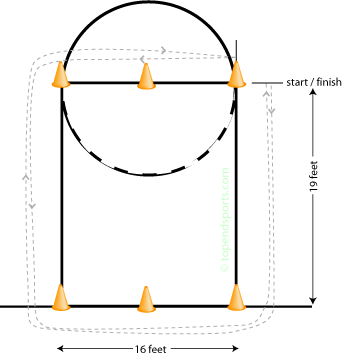
The Lane Agility Drill is a standardized test of agility specifically designed for basketball players. The running course is set up around the basketball key, measuring an athlete's speed, body control, and ability to change direction—critical skills for basketball defense.
This test is part of the fitness testing battery for the SPARQ basketball program and the NBA Draft Combine. The protocol requires athletes to sprint forward, shuffle sideways, backpedal, and shuffle back while completing two full laps around the key.
Position-Specific Scoring Norms
Expected time ranges vary by position due to differences in body size and movement requirements. These norms are based on data from the NBA Combine and FIBA testing protocols:
| Position | Males (seconds) | Females (seconds) |
|---|---|---|
| Guards | 10.2 - 10.9 | 13.0 - 14.5 |
| Forwards | 11.0 - 11.4 | 14.6 - 15.5 |
| Centers | 11.5 - 12.3 | 14.6 - 15.5 |
Test Purpose and Applications
The Lane Agility Drill measures three key athletic qualities essential for basketball performance:
Speed
Evaluates explosive speed in multiple directions including forward sprinting and backpedaling velocity.
Body Control
Assesses ability to maintain balance and proper athletic positioning while changing directions rapidly.
Change of Direction
Tests agility through lateral shuffles and transitions between movement patterns without losing speed.
Equipment Required
To conduct the Lane Agility Drill test properly, you will need:
- Stopwatch or timing gates for accurate measurement
- Measuring tape to verify court dimensions
- 6 marker cones to define the course
- A regulation basketball court with proper key markings
Test Procedure
Pre-test preparation: Explain the test procedures to the athlete. Perform screening of health risks and obtain informed consent. Prepare forms and record basic information such as age, height, body weight, gender, and test conditions. Ensure participants are adequately warmed-up with dynamic stretching and basketball-specific movements. See more details of pre-test procedures.
Test layout: Set up the cones around the pro-sized foul lane (16 feet wide × 19 feet deep). If using a high school court (12 feet wide), markers may need to be placed outside the lane markings to maintain standard dimensions.
Execution: The athlete starts with one foot behind the start line with no rocking movement allowed. Hand timing starts from first movement from the set position. The athlete runs forwards to the baseline, then changes to a side shuffle moving sideways to the right across the baseline. At the next cone, they backpedal up the lane to the foul line, then side shuffle left back towards the start line.
At the start line, the athlete touches the floor at a point even with the starting cone, then reverses direction to complete another revolution: side shuffle right, forward sprint, side shuffle left, then backpedal to complete the test. Athletes must remain facing forwards towards the baseline throughout the entire test. Two trials are allowed, with the best time recorded.
Fouls and Disqualification
A foul results in an invalid trial and includes:
- Moving or knocking down a cone
- Cutting a corner of the drill course
- Sprinting sideways instead of defensive shuffling
- Crossing feet during lateral shuffles
- Not touching the change-of-direction line
- Falling down during the test
How to Improve Your Lane Agility Score
Athletes looking to improve their Lane Agility Drill times should focus on these training strategies:
Defensive Slide Drills
Practice proper lateral shuffle technique daily. Focus on staying low with bent knees and maintaining a wide base.
Lateral Plyometrics
Include lateral bounds, skater jumps, and lateral box jumps to develop explosive side-to-side power.
Hip Mobility Work
Improve hip flexibility and rotational mobility to enhance direction change efficiency and reduce injury risk.
Transition Drills
Practice moving from shuffle to sprint to backpedal. The transitions between movements often determine test times.
The Test in Action
- This test is part of the fitness testing battery for SPARQ basketball
- This test is one of the tests in the NBA Draft Combine
Frequently Asked Questions
What is a good Lane Agility Drill time?
For male guards, a good time is 10.2-10.9 seconds. Forwards typically score 11.0-11.4 seconds, while centers average 11.5-12.3 seconds. Elite NBA prospects often score under 10.5 seconds regardless of position. Female players generally score 1.5-3 seconds slower than males at each position.
How is the Lane Agility Drill performed?
The test uses a basketball key measuring 16 feet wide by 19 feet deep. Athletes sprint forward to the baseline, shuffle sideways right, backpedal to the foul line, shuffle left to the start, then reverse and complete a second lap. Athletes must stay facing forward throughout the entire test.
What does the Lane Agility Drill measure?
The Lane Agility Drill measures speed, body control, and ability to change direction (agility). It specifically tests lateral movement quality, backpedaling speed, and transitional quickness—all critical skills for basketball defense and overall court mobility.
Is the Lane Agility Drill used in the NBA Combine?
Yes, the Lane Agility Drill is a standard test in the NBA Draft Combine and SPARQ basketball testing protocols. NBA scouts use it to evaluate defensive movement potential, lateral quickness, and overall agility of draft prospects.
Why do centers have slower norm times than guards?
Centers typically have greater body mass and height, which affects acceleration and deceleration capabilities. The larger body requires more force to change directions quickly. However, centers are evaluated against position-specific norms, so their scores reflect performance relative to their position requirements.
How can I improve my Lane Agility Drill time?
Focus on defensive slide drills, lateral plyometrics like skater jumps, hip mobility exercises, and practicing proper shuffle technique. Pay special attention to transitions between movement patterns, as these transitions often determine overall test times. Strength training for the legs and core also contributes to improved agility.
Can I practice the Lane Agility Drill at home?
Yes, you can set up the drill in any space measuring at least 16 × 19 feet using cones or markers. Many athletes practice components like defensive slides and backpedaling separately before combining them. Consistent practice of the full drill improves both technique and conditioning.
References
- Sigmon, C. (2005). "Agility Drills." FIBA Assist Magazine, 17, 62-64.
- NBA Basketball Operations. (2024). "NBA Draft Combine Testing Protocols." National Basketball Association.
- Sheppard, J.M., & Young, W.B. (2006). "Agility literature review: Classifications, training and testing." Journal of Sports Sciences, 24(9), 919-932.
- Spiteri, T., et al. (2014). "Mechanical determinants of faster change of direction and agility performance in female basketball athletes." Journal of Strength and Conditioning Research, 28(8), 2205-2214.
- SPARQ Training. (2023). "Basketball SPARQ Rating Testing Protocol." SPARQ Performance.
- Delextrat, A., & Cohen, D. (2009). "Strength, power, speed, and agility of women basketball players according to playing position." Journal of Strength and Conditioning Research, 23(7), 1974-1981.
- McGill, S.M., et al. (2012). "Comparison of different strongman events: trunk muscle activation and lumbar spine motion, load, and stiffness." Journal of Strength and Conditioning Research, 26(5), 1259-1268.
Similar Tests
Related Pages
 Any comments, suggestions, or corrections? Please let us know.