

Illinois Agility Test Calculator
Quick Answer
This Illinois Agility Test calculator instantly scores your agility performance and compares it to athletic norms. Enter your test time to receive a performance rating from Excellent to Poor.
- Calculates performance rating based on validated Getchell (1979) norms
- Provides percentile ranking among athletic populations
- Includes sport-specific interpretations for athletes and coaches
What is the Illinois Agility Test?
The Illinois Agility Test (also known as the Illinois Agility Run or IAT) is one of the most widely used assessments of agility in sports performance testing. Developed by Getchell in 1979, this test evaluates an athlete's ability to accelerate, decelerate, and change direction efficiently while maintaining speed and body control.
Agility is a critical component in team sports such as soccer, rugby, American football, basketball, field hockey, and netball. The Illinois Agility Test specifically measures:
- Acceleration - Ability to reach top speed quickly from a prone start
- Deceleration - Controlled slowing to prepare for direction changes
- Change of direction - Efficient turning at various angles (180° and weaving)
- Body control - Maintaining balance during rapid movements
- Coordination - Synchronizing multiple movement patterns
How to Perform the Illinois Agility Test
Equipment required: flat non-slip surface, 8 marking cones, stopwatch or timing gates, and measuring tape.
Pre-test preparation: Explain the test procedures to the athlete. Perform health screening and obtain informed consent. Record basic information including age, height, body weight, and gender. Measure and mark out the test area precisely. Check timing equipment calibration. Allow adequate warm-up time. See more details of pre-test procedures.
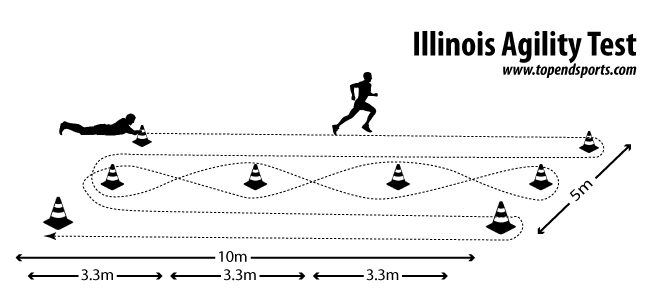
Course Setup
The Illinois Agility Test course dimensions are:
- Length: 10 meters (approximately 33 feet)
- Width: 5 meters (approximately 16 feet)
- Center cones: 4 cones placed 3.3 meters apart down the center line
Four cones mark the start, finish, and two turning points at the corners. Four additional cones are placed down the center of the course at equal distances (3.3 meters apart) for the weaving section.
Test Procedure
- Starting position: The athlete lies face down (prone) with their head at the start line and hands positioned by their shoulders.
- On the "Go" command: Start the stopwatch as the athlete gets up as quickly as possible.
- First sprint: Run 10 meters forward to the far cone and turn around it (180° turn).
- Return sprint: Run 10 meters back toward the start area.
- Weaving section: Weave in and out through the four center cones.
- Final sprints: Run 10 meters to the far cone, turn around it, and sprint 10 meters back.
- Finish: Stop the timing when the athlete crosses the finish line.
Athletes should complete several trials with adequate rest between attempts. Record the best (fastest) time achieved.
Illinois Agility Test Norms and Ratings
The following normative data is based on the original Getchell (1979) research and subsequent athletic population studies. These norms provide performance benchmarks for adults.
Male Athletes - Performance Standards
| Rating | Time (seconds) | Percentile Range |
|---|---|---|
| Excellent | < 15.2 | 85th - 99th |
| Above Average | 15.2 - 16.1 | 70th - 84th |
| Average | 16.2 - 18.1 | 30th - 69th |
| Below Average | 18.2 - 18.3 | 16th - 29th |
| Poor | > 18.3 | < 16th |
Female Athletes - Performance Standards
| Rating | Time (seconds) | Percentile Range |
|---|---|---|
| Excellent | < 17.0 | 85th - 99th |
| Above Average | 17.0 - 17.9 | 70th - 84th |
| Average | 18.0 - 21.7 | 30th - 69th |
| Below Average | 21.8 - 23.0 | 16th - 29th |
| Poor | > 23.0 | < 16th |
For complete normative data across different age groups and populations, see the full rating norm scores for the Illinois Test.
Sport-Specific Applications
The Illinois Agility Test is particularly relevant for athletes competing in sports that require frequent changes of direction. Here's how different sports utilize agility testing:
Soccer and Football
Soccer players need exceptional agility for dribbling around opponents, defensive positioning, and quick directional changes during play. Professional soccer players typically achieve times under 15 seconds (males) and 16.5 seconds (females). The test is used extensively in youth academies and professional tryouts.
Rugby and American Football
Running backs, wide receivers, and defensive backs in American football require elite agility for route running and coverage skills. Rugby players, especially backs and wingers, use the Illinois test as part of combine testing. NFL combine-level athletes typically complete the test in under 15 seconds.
Basketball and Netball
Court sports demand rapid changes of direction for offensive moves and defensive slides. The Illinois test helps assess an athlete's ability to cut, pivot, and move laterally. Elite basketball players typically score in the excellent range for their gender.
Field Hockey and Lacrosse
Stick sports require agility while potentially carrying equipment. Training programs often incorporate Illinois test improvements alongside sport-specific skills. Competitive players aim for above-average or excellent ratings.
Tactical Professions
Police, military, and firefighter fitness assessments frequently include the Illinois Agility Test. These professions require the ability to pursue suspects, navigate obstacles, and move efficiently in confined spaces.
How to Improve Your Illinois Agility Test Score
Improving your agility test performance requires targeted training that addresses acceleration, deceleration, and change of direction abilities.
Training Recommendations
Pro Tip: Practice the actual Illinois test course during training. Familiarity with the specific movement pattern can improve times by 0.5-1.0 seconds even without physical conditioning changes.
- Cone drills: Set up various cone patterns for change of direction practice. Include 5-10-5 shuttles, T-drills, and figure-8 patterns.
- Ladder drills: Agility ladder exercises improve foot speed, coordination, and neuromuscular efficiency.
- Plyometric training: Box jumps, bounds, and reactive jumps develop explosive power for acceleration.
- Deceleration practice: Work on controlled stopping and lowering center of gravity before direction changes.
- Core stability: Strong core muscles help maintain body control during rapid movements.
- Sprint technique: Improve arm drive, body lean, and foot strike patterns for faster acceleration.
Training Program Example
A sample weekly agility training program for intermediate athletes:
- Monday: Ladder drills (15 min) + Cone patterns (20 min)
- Wednesday: Plyometric training (25 min) + Sprint intervals (15 min)
- Friday: Illinois test practice (3-4 trials) + Reactive agility games (20 min)
Allow 48-72 hours recovery between high-intensity agility sessions. Progress training intensity gradually over 6-8 weeks for measurable improvement.
Advantages and Limitations
Advantages of the Illinois Agility Test
- Simple setup requiring minimal equipment (cones, stopwatch, tape measure)
- Tests multiple movement patterns including forward sprinting, turning, and weaving
- Well-established normative data available for comparison
- Applicable across multiple sports and fitness contexts
- Relatively quick to administer (under 30 seconds per trial)
- Can be conducted indoors or outdoors on any flat surface
Limitations
- Footwear type and running surface significantly affect times
- Manual stopwatch timing introduces measurement error (±0.2 seconds)
- Does not distinguish between left and right turning ability
- Test duration (15-25 seconds) involves both anaerobic capacity and agility
- Starting position (prone) may not reflect sport-specific situations
- Weather conditions affect outdoor testing
For improved reliability, consider using electronic timing gates and standardized footwear. The modified Illinois Agility Test addresses some limitations by reducing the straight sprinting component.
Test Variations
Several variations of the Illinois Agility Test exist to accommodate different testing needs:
- Modified Illinois Test: A shorter version with reduced straight sprinting distance while maintaining the weaving components. See Illinois Agility Test (Modified).
- Short Illinois Test: A compact version for facilities with space limitations. See Illinois Agility Test (Short).
- Reversed direction: Swapping start and finish sides to test agility turning in the opposite direction.
- Touch variations: Requiring athletes to touch cones or lines at turning points with their hand.
- Imperial measurements: In the USA, course dimensions are sometimes given as 30 ft × 15 ft.
Frequently Asked Questions
What is a good Illinois Agility Test time?
A good time is under 15.2 seconds for males and under 17.0 seconds for females, which places you in the "excellent" category. Average times range from 16.2-18.1 seconds for males and 18.0-21.7 seconds for females. Elite professional athletes typically complete the test in 14-15 seconds (males) or 15-16.5 seconds (females).
How accurate is the Illinois Agility Test?
The Illinois Agility Test has good test-retest reliability (r = 0.95) when properly administered. Manual timing introduces approximately ±0.2 seconds of error, while electronic timing gates improve accuracy to ±0.01 seconds. The test is valid for assessing general agility but may not capture sport-specific movement patterns.
How do I set up the Illinois Agility Test course?
Mark a 10-meter by 5-meter rectangle with cones at each corner. Place four additional cones in a straight line down the center, spaced 3.3 meters apart. The starting cone and finishing cone should be at opposite ends of the course on the same side.
What sports use the Illinois Agility Test?
The Illinois Agility Test is used extensively in soccer, rugby, American football, basketball, field hockey, netball, tennis, and volleyball. It is also common in police and military fitness assessments, firefighter evaluations, and general athletic development programs.
How can I improve my Illinois Agility Test score?
Improve through consistent agility training including cone drills, ladder exercises, plyometrics, and sport-specific movement practice. Focus on acceleration technique, efficient deceleration before turns, and maintaining a low center of gravity during direction changes. Most athletes can improve their time by 0.5-2.0 seconds with 6-8 weeks of targeted training.
Why do I start lying face down?
The prone start position standardizes the test by ensuring all athletes begin from the same position. It also adds a reaction and acceleration component that simulates game situations where athletes must quickly transition from a low position to sprinting, such as recovering from a tackle in rugby or getting up after a slide in soccer.
What is the difference between the Illinois test and T-Test?
The Illinois Agility Test focuses on forward sprinting with 180-degree turns and weaving, covering approximately 60 meters total. The T-Test includes lateral shuffling and backward running in a T-shaped pattern, covering about 40 meters. The Illinois test better assesses forward agility while the T-Test evaluates multi-directional movement.
References
- Getchell, B. (1979). "Physical Fitness: A Way of Life." 2nd ed. New York: John Wiley and Sons, Inc.
- Roozen, M. (2004). "Illinois Agility Test." NSCA's Performance Training Journal, 3(5), 5-6.
- Sheppard, J.M., & Young, W.B. (2006). "Agility literature review: Classifications, training and testing." Journal of Sports Sciences, 24(9), 919-932.
- Vescovi, J.D., & McGuigan, M.R. (2008). "Relationships between sprinting, agility, and jump ability in female athletes." Journal of Sports Sciences, 26(1), 97-107.
- Wood, R. (2005). "Illinois Agility Test." Topend Sports Website.
- Haff, G.G., & Triplett, N.T. (2016). "Essentials of Strength Training and Conditioning." 4th ed. Human Kinetics.
- Miller, M.G., Herniman, J.J., Ricard, M.D., Cheatham, C.C., & Michael, T.J. (2006). "The effects of a 6-week plyometric training program on agility." Journal of Sports Science and Medicine, 5, 459-465.
Similar Agility Tests
- Illinois Agility Test (Modified) — A modification of the standard Illinois test which reduces some straight sprinting.
- Illinois Agility Test (Short) — A modification of the standard Illinois test which reduces the distance covered.
- T-Test — Running a T-shape course involving forward, lateral, and backwards running.
- SEMO Agility Run — Run around a rectangular area incorporating forward sprints, diagonal backpedaling, and side shuffling.
- Zig-Zag Test — Sprint through a zigzag course of cones.
- Figure-of-Eight Agility Run Test — Running figure-8 patterns around cones.
Related Pages
- See rating norm scores for the Illinois Test
- Other agility tests


