


20m PACER Fitness Test
The Progressive Aerobic Cardiovascular Endurance Run (PACER) test is a variation of the Beep Test, and is part of the FitnessGram and Brockport test batteries. It is a maximal aerobic fitness test, where the participants run 20m shuttles at increasing speeds. The speeds and levels of the 20 meter PACER test is based on the original details of the shuttle run test developed by Leger et al. (1988). There is also a 15m PACER test for use where space is limited.
equipment required: Flat non-slip surface, marking cones, up to 20m measuring tape, PACER test cd, cd player, recording sheets.
pre-test: Explain the test procedures to the subject. Perform screening of health risks and obtain informed consent. Prepare forms and record basic information such as age, height, body weight, gender and test conditions (indoors/outdoors, weather, running surface). Measure and mark out the course. Perform a standard warm-up. See more details of pre-test procedures.
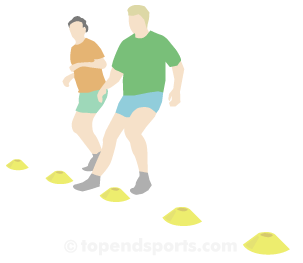
procedure: There are two variations of this test, with the lines placed either 15 or 20 meters apart. The 15 m test distance is used for 2nd and 3rd grade students or when there are space limitations. The test involves continuous running between the two lines in time to recorded beeps. The initial speed is 8.5km/hr, which increases by 0.5km/hr each level (approximately every minute). The time between recorded beeps decrease each minute (level) requiring an increase in pace. The participants continue until they are unable to keep pace with the beeps. (see details of PACER test levels and speeds).
 scoring: The score is the total number
of shuttles reached before the athlete was unable to keep up with
the recording for two consecutive ends. The test scores can be entered into the FitnessGram software for analysis. If the 15m version is used, there is a conversion chart to convert scores on the 15m PACER to a 20m score to enter in the FitnessGram software.
scoring: The score is the total number
of shuttles reached before the athlete was unable to keep up with
the recording for two consecutive ends. The test scores can be entered into the FitnessGram software for analysis. If the 15m version is used, there is a conversion chart to convert scores on the 15m PACER to a 20m score to enter in the FitnessGram software.
target population: The test is suitable for sports teams and school groups of all ages, but not for people in which a maximal exercise test could be considered dangerous.
reliability: Reliability would depend on how strictly the test is run, and the practice allowed for the participants. Several practice trials would be ideal.
advantages: Large groups of children can perform this test all at once for minimal costs. Also, the test continues to maximum effort unlike many other tests of endurance capacity. If there is not enough room to conduct the 20m test, there is a 15m version. If required you can convert the score for the 15m to 20m versions using this conversion chart.
disadvantages: Practice and motivation levels can influence the score attained, and the scoring can be subjective. As the test is usually conducted outside, the environmental conditions can also affect the results.
comments:
- This test is a maximal test which requires a reasonable level of fitness - care must be taken with students who are sick, of poor fitness or elderly.
- The FitnessGram cd also provides the cadences for the curl-up and push-up portions of the test battery
references:
- Leger LA, Mercier D, Gadoury C, Lambert J. The multistage 20 metre shuttle run test for aerobic fitness. J Sports Sci. 1988; 6:93-101.
- Mahar, M.T., Welk, G.J., Rowe, D.A., Crotts, D.J., & McIver, K.L. (2006). Development and validation of a regression model to estimate VO2peak from PACER 20-m shuttle run performance. Journal of Physical Activity and Health, VOL 3; SUPP/2, pages S34-S46.
- McClain, J., Welk, G.J., Ihmels, M., Schaben, J.W. (2006). Comparison of two versions of the PACER aerobic fitness test. Journal of Physical Activity and Health, VOL 3; SUPP/2, pages S47-S57. also abstract published in Medicine & Science in Sports & Exercise: Volume 36(5) Supplement May 2004 p S5. conclusion: Overall, the results suggest the 15m and 20m PACER protocols provide similar information about aerobic fitness in youth. The 15m PACER protocol provides a useful alternative to the 20m protocol for schools with smaller physical education facilities.
Related Products
- Buy the 20m or 15m PACER test cd — this recording provides pacing for the shuttle run portion of the test as well as audio tracks with the cadences for the curl-up and push-up tests.
- Buy the Fitnessgram/Activitygram Test Manual which includes a DVD with video clips and the PACER test cd.
Similar Tests
- 15m PACER test
- 15m Bleep Test — a shorter version of the beep test
Related Pages
- The conversion chart to assist converting scores on the 15m PACER to a 20m score.
- PACER Test 15m & 20m Levels and Speeds.
- This test is part of the FitnessGram and Brockport Test battery.
- Guide to Variations of the beep / bleep test
- More Modified Beep Tests
- The complete guide to the beep test for comprehensive information about the beep test
- Maximizing Your Score — to get the most out of the beep test.
BEEP TEST PACKAGE - only $10
The 20m Beep Test (male & female voices) + Training Levels + 'Beeps Only' track + Excel Spreadsheet + eBook Guide (PARQ, consent form, test recording sheet, warm-up, tips, norms + much more!)
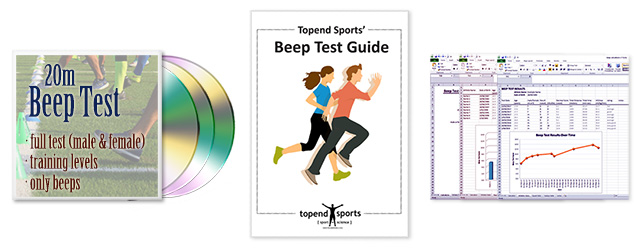
The ultimate beep test package, including two versions of the beep test audio file (male and female voice), an audio track with only the beeps (no voices), 8 audio tracks for training at specific test levels, an Excel spreadsheet with an offline calculator and tables for recording, analyzing and presenting results, a 12-page eBook beep test guide which includes a PARQ, informed consent form, and test recording sheet plus much more. All these files are available individually for $5 each, or even better get them all for $10. Check out the details.
 Any comments, suggestions, or corrections? Please let us know.
 Current Events