


Beep Test Score Calculator
To calculate your predicted VO2max from your 20 meter shuttle run test result, enter your level and number of shuttles for that level in the boxes below, and then click the "calculate" button. For a listing of the number of shuttles for each level, go here.
For example, if you scored 8-5 on the beep test, you would enter 8 in the first box, and 5 in the second.
But what does this mean?
- The above caluclator gives you a fitness rating based on your VO2max score, from these tables: VO2max norms for different ages.
- You can also compare it to the table of Beep Test Norms — ratings for beep test scores for all ages.
Calculations
- The above calculator was developed by Topend Sports from the published tables in Ramsbottom et al. (1988) "A progressive shuttle run test to estimate maximal oxygen uptake." British Journal of Sports Medicine 22: 141-5. The calculator appears to be accurate to within 0.1 ml/kg/min of the published values.
- There is another calculation to determine VO2max using the following equation by Ahmaidi et al. (1992), where velocity is determined using the distance covered in 30 seconds during the last stage of the test.
VO2max = 31.025 + (3.238 × velocity) - (3.248 × age ) + (0.1536 × age × velocity)
Reference: Ahmaidi S, Collomp K, Caillauce C, Prefaut C (1992) Maximal and functional aerobic capacity as assessed by two graduated field methods in comparison to laboratory exercise testing in moderately trained participants. International Journal of Sports Medicine 13(3):243-248.
- There is another published calculation to determine VO2max from the beep test, using the following equation by St Clair Gibson et al. (1998), where vel equals the maximum speed achieved.
predicted VO2max = (6.0 × vel) - 24.4
Reference: St Clair Gibson A, Broomhead S, Lambert MI and Hawley JA (1998) Prediction of maximal oxygen uptake from a 20 m shuttle run as measured directly in runners and squash players. Journal of Sports Sciences 16:331-335.
- The prediction equation from Flouris et al. (2005) where vel equals the maximal attained speed.
VO2max = (vel × 6.65 - 35.8) × 0.95 + 0.182
Reference: A D Flouris, G S Metsios, Y Koutedakis, (2005) Enhancing the efficacy of the 20 m multistage shuttle run test. Br J Sports Med 39:166–170.
Related Pages
- You can also use the Excel Spreadsheet which automatically calculates the VO2max and fitness rating for any beep test score.
- Free download of the beep test mp3
- The solution to calculating beep test averages of a group
- Maximizing Your Score — to get the most out of the beep test.
- Guide to variations of the beep / bleep test
- References for the beep test
- Test Procedure — Detailed instructions for conducting the beep test. Also video examples.
- About Purchasing the beep test cd
- What's your best score? some results of athletes
- Beep Shuttle Listing — a listing of the number of runs for each level.
- Beep Test Software — provides the standard Multistage Fitness Test or Bleep Test right on your PC or Laptop, with many additional features.
- Fitness tests which are modified beep tests
BEEP TEST PACKAGE - only $10
The 20m Beep Test (male & female voices) + Training Levels + 'Beeps Only' track + Excel Spreadsheet + eBook Guide (PARQ, consent form, test recording sheet, warm-up, tips, norms + much more!)
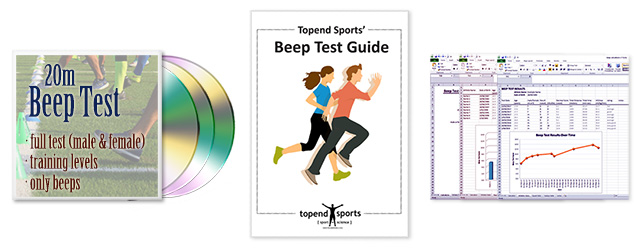
The ultimate beep test package, including two versions of the beep test audio file (male and female voice), an audio track with only the beeps (no voices), 8 audio tracks for training at specific test levels, an Excel spreadsheet with an offline calculator and tables for recording, analyzing and presenting results, a 12-page eBook beep test guide which includes a PARQ, informed consent form, and test recording sheet plus much more. All these files are available individually for $5 each, or even better get them all for $10. Check out the details.
 Any comments, suggestions, or corrections? Please let us know.
 Current Events