Dips Test Calculator
Quick Answer
This calculator evaluates your upper body strength endurance based on the 60-second dip test. Enter your completed dips to receive instant performance classification and personalized training recommendations.
- Calculates performance category from Elite to Below Average
- Based on established fitness testing standards
- Provides sport-specific percentile ranking for athletes
The dip test (dips) is a test of upper body strength and strength endurance. The test involves performing as many dips as possible in one minute, making it an excellent assessment of pushing strength and muscular endurance for the chest, triceps, and shoulders.
Test Purpose and Equipment
Test purpose: This test measures upper body strength and endurance, specifically targeting the pectoralis major, anterior deltoids, and triceps brachii muscles.
Equipment required: Gymnastics parallel bars, or similar gym equipment such as a dip station, dip bars, or parallel bar apparatus.
Pre-test: Explain the test procedures to the subject. Perform screening of health risks and obtain informed consent. Prepare forms and record basic information such as age, height, body weight, gender and test conditions. See more details of pre-test procedures.
How to Perform the Dip Test
Procedure: The aim of this test is to do as many dips as possible in one minute. The subject starts in the up position, with the arms straight and elbows fully locked. One complete dip is performed by bending the arms and lowering the body until the elbows are bent to at least a right angle, then pushing back up to the starting position. Resting in the up position is allowed.
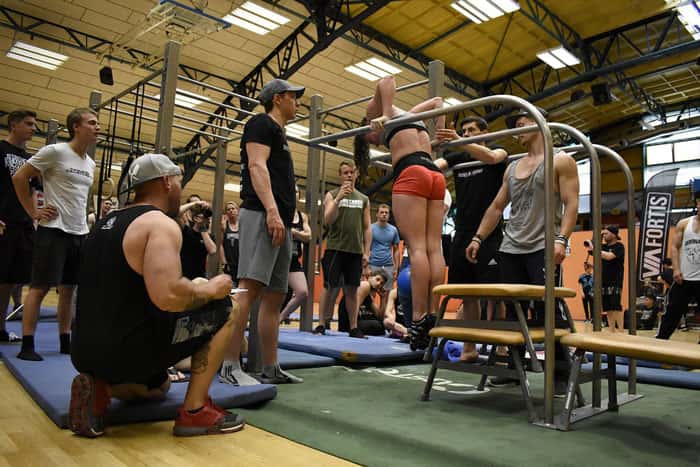
Dips fitness test performed on parallel bars
Scoring: The score is the total number of dips performed in 60 seconds.
Target population: Sports in which upper body strength is important, including gymnastics, wrestling, swimming, throwing events, and combat sports.
Comments: It's important that the arm is bent to at least a right angle, though any more than this will result in premature fatiguing. Consistent depth throughout the test is essential for accurate assessment.
Understanding Your Dips Test Results
The dip test provides valuable insight into your upper body pushing strength and muscular endurance. Your score reflects both your absolute strength and your ability to sustain repeated efforts against your body weight.
Performance Categories for Men (60 seconds)
- Elite: 40+ dips – Competition-ready strength athlete level
- Excellent: 30-39 dips – Well-trained recreational athlete
- Good: 20-29 dips – Above average fitness level
- Average: 10-19 dips – Typical active adult
- Below Average: 5-9 dips – Room for improvement
- Poor: Below 5 dips – Significant strength development needed
Performance Categories for Women (60 seconds)
- Elite: 30+ dips – Exceptional upper body strength
- Excellent: 20-29 dips – Well-trained athlete
- Good: 12-19 dips – Above average fitness
- Average: 6-11 dips – Typical active adult
- Below Average: 2-5 dips – Developing strength
- Poor: Below 2 dips – Strength training recommended
Sport-Specific Applications
The dip test is particularly relevant for athletes in sports requiring significant upper body pushing strength. Here's how different sports utilize dip strength:
Gymnastics
Dips are a fundamental movement in gymnastics, essential for parallel bar routines, ring work, and pommel horse. Elite male gymnasts often score 45+ dips, reflecting their exceptional upper body conditioning.
Wrestling and Combat Sports
Upper body pushing strength translates directly to takedowns, escapes, and controlling opponents. Wrestlers typically aim for 30+ dips to maintain competitive strength-to-weight ratios.
Swimming
Strong pushing muscles assist in the catch and pull phases of strokes, particularly butterfly and breaststroke. Competitive swimmers often incorporate dips into dry-land training.
Football and Rugby
Blocking, tackling, and hand fighting all require significant pushing strength. Linemen and forwards particularly benefit from dip-style strength development.
The Test in Action
- This test was one of the gym test events in the Superstars TV series.
- Many military fitness assessments include dip variations as measures of functional upper body strength.
- The NFL Combine has historically used related pushing tests to evaluate player readiness.
How to Improve Your Dip Test Score
Improving your dip test performance requires a systematic approach combining strength development and endurance training:
For Beginners (Under 10 dips)
- Start with assisted dips using resistance bands or a machine
- Practice negative dips (slow lowering) to build eccentric strength
- Perform bench dips to develop baseline pushing strength
- Train 3x per week, gradually reducing assistance over 4-6 weeks
For Intermediate Athletes (10-25 dips)
- Perform 4-5 sets of max effort dips with 2-minute rest periods
- Add supplementary exercises: push-ups, close-grip bench press, tricep extensions
- Practice timed sets of 30 seconds to build endurance
- Include one weighted dip session per week for strength gains
For Advanced Athletes (25+ dips)
- Use weighted dips (5-20kg) to build maximal strength
- Practice density training: max dips in 5-minute blocks
- Implement rest-pause sets to push beyond normal fatigue limits
- Focus on speed work with bodyweight for endurance adaptation
Frequently Asked Questions
How many dips is good for a man?
For adult men, 20-29 dips in 60 seconds is considered good, placing you above the average fitness level. Achieving 30+ dips indicates excellent upper body strength endurance. Elite athletes and well-trained individuals often exceed 40 dips in the test period.
What is the average number of dips for a beginner?
Beginners typically perform 5-15 dips in 60 seconds depending on their baseline strength and body composition. Many untrained individuals may only complete 5-10 dips before fatigue sets in. With consistent training 2-3 times per week, most people can progress to 20+ dips within 8-12 weeks.
How do you perform the dip test correctly?
Start in the up position with arms straight and elbows fully locked on parallel bars. Lower your body by bending the arms until elbows reach at least a 90-degree angle. Push back up to the starting position with arms fully extended. Count each complete dip. You may rest briefly in the up position during the 60-second test period.
Are dips better than push-ups for building strength?
Dips and push-ups both effectively target the chest, triceps, and shoulders, but dips are generally more challenging as you lift your full body weight through a greater range of motion. Dips place approximately 100% of body weight on the arms, while push-ups load roughly 60-70%. Both exercises are valuable and complement each other in a well-rounded training program.
How often should I do the dip test?
For accurate progress tracking, perform the dip test every 4-8 weeks. Testing too frequently doesn't allow enough time for meaningful strength adaptations. Ensure consistent test conditions including time of day, similar warm-up protocol, and the same equipment for valid comparisons between testing sessions.
Does body weight affect dip test performance?
Yes, body weight significantly impacts dip test scores since you're lifting your entire body weight. Heavier athletes face greater resistance, which may result in lower rep counts despite having substantial absolute strength. This is why strength-to-weight ratio is often considered when interpreting results, particularly for athletes in weight-class sports.
Can dips cause shoulder injury?
When performed with proper technique, dips are safe for most healthy individuals. However, going too deep (beyond 90 degrees) can stress the shoulder joint. Those with existing shoulder issues should consult a healthcare professional before performing dips. Proper warm-up and gradual progression help minimize injury risk.
References
- Heyward, V.H., & Gibson, A.L. (2014). "Advanced Fitness Assessment and Exercise Prescription." Human Kinetics.
- National Strength and Conditioning Association. (2016). "Essentials of Strength Training and Conditioning." 4th Edition.
- American College of Sports Medicine. (2018). "ACSM's Guidelines for Exercise Testing and Prescription." 10th Edition.
- Baechle, T.R., & Earle, R.W. (2008). "Essentials of Strength Training and Conditioning." National Strength and Conditioning Association.
- McKenzie, B. (2005). "101 Performance Evaluation Tests." Electric Word Publishing.
- Wood, R.J. (2008). "Fitness Testing Protocols and Norms." Topend Sports.
Similar Tests
Related Pages
- Other strength tests
- About the dip fitness exercise
- About the Superstars TV Series
 Any comments, suggestions, or corrections? Please let us know.