


Step Up Fitness Test
This page is about step tests in general. For specific information about specific step test procedures, see the individual step test pages below. These tests vary in the step heights, stepping frequency, physiological measures and results calculations, and as such vary in their suitability for specific populations.
General Procedures
purpose: step tests have been developed to measure aerobic fitness using a simple test requiring minimal equipment and space.
equipment required: the equipment required will vary on the test being conducted. The step or platform needs to be of solid construction, and will vary in height between 15-50 cm or 6-20 inches. You will also probably need a stopwatch, and you may need a metronome or pre-recorded cadence tape depending on which procedure you are using.
pre-test: Explain the test procedures to the subject. Perform screening of health risks and obtain informed consent. Prepare forms and record basic information such as age, height, body weight, gender, test conditions. Check step height and set metronome. See more details of pre-test procedures.
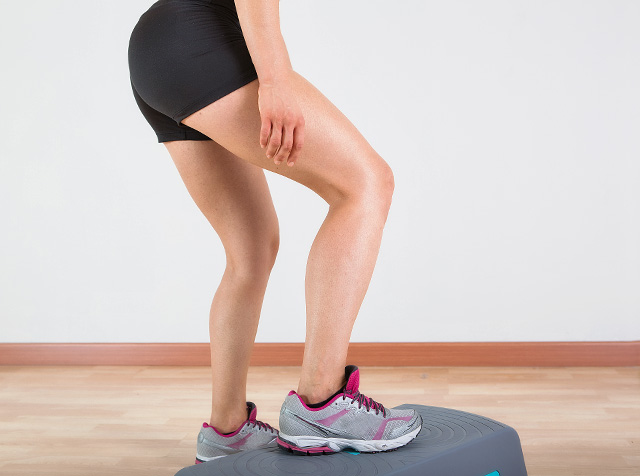 step test
procedure: The athlete steps up and down on the platform at a given rate for a certain time or until exhaustion. Heart rate may be recorded during the test and/or for some period afterwards. See a video of Step tests being performed.
scoring: the results are based on the stepping time and/or heart rate after exercise. A score can be calculated, which is then compared to normative values to determine a fitness rating. The American College of Sports Medicine (ACSM) also has an equation for determining a person's total gross VO2 from the stepping rate and step height.
advantages:
- Low cost for equipment
- Ease of portability
- Permanent calibration
- The fact that stepping is a natural activity.
- Some tests can be also be self-administered.
disadvantages:
- As biomechanical characteristics vary between individuals, a high step height may disadvantage shorter people, underestimating their aerobic fitness.
- Body weight has also been shown to be a factor.
- Testing large groups with this test will be time consuming.
- It is sometimes difficult for the subject to maintain an exact pace set by a metronome or other device
- There is a danger of the subject tripping
- It is difficult to take some physiological measurements if they are required (e.g., heart rate, blood pressure).
List of Step Tests
- Harvard Step Test
- Chester Step Test
- Canadian Home Fitness Test
- Balke Step Test
- YMCA 3-minute Step Test
- Sharkey (Forestry) Step Test
- Queens College Step Test
- Home step test
- Step in Place (no step)
Related Pages
- See a video of Step tests being performed.
- About a Step Test iphone app
- More information on measuring heart rate
- Calculating VO2max from stepping exercise.
- General description of the step-up exercise
- Step up exercises at the beach or during pregnancy
- Online Metronome for setting the stepping pace
 Any comments, suggestions, or corrections? Please let us know.
 Current Events