


Relative Bench Press Test
The Relative Bench Press Test is an upper body muscular strength endurance test. Participants perform the maximum number of bench presses at a set % of their body weight. The NHL had a similar test using 70-80 % of bodyweight performed at a set cadence. The NBA and NFL also have a bench press test, where the athletes bench as many times as they can at a set bar weight, irrespective of body weight. The test described below, using 75% of body weight, was part of the testing for Australia's Greatest Athlete.
purpose: to measure maximum strength endurance of the chest muscle groups.
equipment required: scales for measuring body weight, bench with safety catch, standard weight bar, and various free weights.
pre-test: Explain the test procedures to the subject. Perform screening of health risks and obtain informed consent. Prepare forms and record basic information such as age, height, body weight, gender, test conditions. See more details of pre-test procedures.
procedure: An appropriate and standardized warm up procedure should be followed. Using pre-determined body weight measures, the barbell is set to the appropriate weight depending on what percentage of body weight is being used (e.g. 75%). The athlete begins by lying in a supine position on the bench, with their feet flat on the floor and the upper and lower back in contact with the bench at all times. The bar is grasped at approximately 6 inches wider than shoulder width apart, so that the elbows are at right angles at the lowest point. A complete successful lift is counted from the starting position of the arms fully extended with the weight directly above the chest, to the weight just touching the chest, then returned to the starting position. The movement of the bar should be at a controlled speed and with a smooth motion, and the weight should remain in line with your nipples. No bouncing off the chest is allowed. The testing ends as soon as the athlete is unable to complete a full repetition. See Bench Press Test Videos.
variations: the usual percentage of body weight used is between 70 and 90%. If the %bodyweight amount used is too low, the test becomes one of endurance, the results may not be a good indication of the participant's upper body strength.
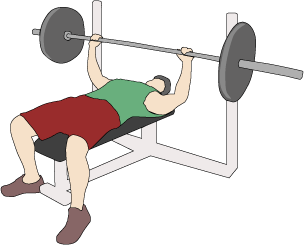 scoring: the maximum number of complete repetitions successfully performed is recorded.
results: in the second series of Australia's Greatest Athlete, the winner of this event Rugby League player Billy Slater performed 33 reps at his relatively light bodyweight, as did Rugby Union player James O'Conner. Some of the heavier other competitors could only manage around 10 reps.
advantages: the required equipment is readily available in most gymnasiums, and the test is simple to perform.
disadvantages: This test should only be performed by those experienced at performing the bench press lift with good technique. Good technique will also enable the lifter to maximize their score.
comments:
- For safety, a spotter should stand at the head of the bench throughout the test.
- The test results of this test may be specific to the equipment used (height of bench, variations in weights), so is best to use the same equipment for test-retest measures.
The Test in Action
- This test, using 75% of body weight, was part of the testing for Australia's Greatest Athlete.
Similar Tests
- Bench Press Max — the maximum number of reps that can be done using a set weight, as used for the NFL, NBA and NHL combines.
- Brockport Bench Press — the subject performs as many bench presses as possible using a 35lb (15.9kg) barbell.
- See the similar Bench Press 1RM fitness tests.
Related Pages
- More about Bench Press Fitness Testing
- See video examples of bench press testing in action.
- bench press technique
- NBA pre-draft camp fitness tests, NHL combine testing and the NFL combine testing
- This test is used for assessing Australia's Greatest Athlete.
- This test was once part of the Football (Gridiron) SPARQ Rating.
 Any comments, suggestions, or corrections? Please let us know.
 Current Events