


Balke Treadmill Test
The Balke Treadmill Test was developed as a clinical test to determine peak VO2 in cardiac patients, though it can also be used to estimate cardiovascular fitness in athletes. The test involves walking on a treadmill to exhaustion, at a constant walking speed while gradient/slope is increased every one or two minutes. Note that there is also the field test also developed by Balke: 15 minute run test, and the Balke Step Test.
purpose: to determine peak VO2, particularly in cardiac patients.
equipment required: treadmill, stopwatch, electrocardiograph (optional)
pre-test: Explain the test procedures to the subject. Perform screening of health risks and obtain informed consent. Prepare forms and record basic information such as age, height, body weight, gender, test conditions. Measure out course and place marker cones. Perform an appropriate warm-up. See more details of pre-test procedures.
procedure: The athlete walks on a treadmill to exhaustion, at a constant walking speed while gradient/slope is increased every one or two minutes. The assistant starts the stopwatch at the beginning of the test and stops it when the subject is unable to continue. There are several modification or variation of the Balke test that are used, with variations in the treadmill speed, time at each level and/or increase in gradient. Here are examples of test protocols that have been used.
- For men the treadmill speed is set at 3.3 mph, with the gradient starting at 0%. After 1 minute it is raised to 2%, then 1% each minute thereafter.
- For women the treadmill speed is set at 3.0 mph, with the gradient starting at 0%, and increased by 2.5% every three minutes.
- Walking speed constant at 3 km/hr whilst the grade was increased by 2.5 percent every two minutes.
results: The test score is the time taken on the test, in minutes. Ideally this should be between 9-15 minutes. The test time can also be converted to an estimated VO2max score using the following formulas where the value "T" is the total time completed (expressed in minutes and fractions of a minute e.g. 9 minutes 15 seconds = 9.25 minutes) (note: this is only applicable if the same protocol is used as when these formula were developed) :
for men: VO2max = 1.444 (T) + 14.99 [Pollock et al., 1976)
for women: VO2max = 1.38 (T) + 5.22 [Pollock et al., 1982)
target population: The Balke test is recommended for cardiac patients since the elevation in workload is moderate and therefore considered safe even for patients with severe left ventricular dysfunction.
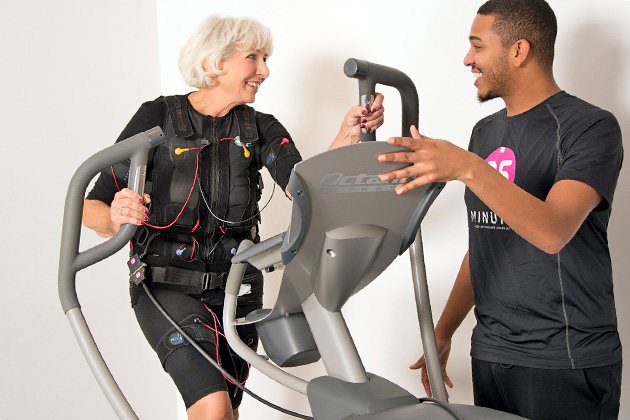 exercise stress testing
advantages: You can also get a measurement of maximum heart rate by recording heart rate during the test, which can be used in training programs to set workload intensity.
disadvantages: It takes a relatively long time to set up and conduct this test, compared to some other aerobic tests, and there are high costs involved in terms of equipment and time.
caution: This test is a maximal test. If used recreational athletes or people with health problems, injuries or low fitness levels, please have medical assistance on hand.
references:
- Hanson, P. (1984) Clinical Exercise Training. In: Sport Medicine. Ed: Strauss, R. Philadelphia, PA: W.B. Saunders Company. 13-40.
Similar Fitness Tests
- Other similar exercise stress test protocols include Astrand, Naughton and Bruce protocols.
- VO2max test
- Balke 15 minute run test for aerobic fitness
- Balke Step Test
Related Pages
- Stress Tests — a general description of exercise stress tests.
- Other tests of aerobic capacity.
- Fitness tests involving walking
- See heart rate measurement methods if heart rate measurement is also required.
- Other fitness tests conducted on treadmills
- Ratings of Perceived Exertion Scale if you want to quantify effort.
 Any comments, suggestions, or corrections? Please let us know.
 Current Events