Head Girth Calculator
Quick Answer
This calculator converts your head circumference measurement into hat sizes and helmet sizes for various sports. Enter your measurement in centimeters or inches to get instant sizing recommendations.
- Converts head girth between metric and imperial units
- Provides US, UK, and International hat sizes
- Recommends helmet sizes for cycling, football, baseball, and more
How to Use the Head Girth Calculator
Follow these simple steps to measure your head circumference and find your correct hat and helmet sizes:
- Measure Your Head: Use a flexible measuring tape positioned about 2.5 cm (1 inch) above your eyebrows and ears, around the widest part of the back of your head. Keep the tape level and snug but not tight.
- Select Your Unit: Use the toggle switch to choose between metric (centimeters) or imperial (inches) measurement.
- Enter Your Measurement: Type your head circumference into the input field, or use the quick preset buttons for common sizes.
- View Your Results: The calculator instantly displays your measurement in both units, plus recommended hat and helmet sizes for various sports.
Pro Tip: Take multiple measurements and use the largest one. Hair can compress during measurement, so ensure consistent technique for the most accurate results.
What is Head Girth?
Head girth, also known as head circumference, is a measurement of the distance around the head at the level immediately above the eyebrows and ears. This anthropometric measurement is essential for properly fitting athletic equipment including helmets, hats, caps, and protective headgear across numerous sports.
For athletes, head circumference measurements serve several important purposes:
- Safety Equipment Sizing: Properly fitted helmets provide optimal protection in cycling, football, baseball, hockey, and motorsports
- Performance Gear: Swimming caps, wrestling headgear, and boxing headgear require accurate sizing for comfort and function
- Anthropometric Assessment: Head girth is one component of comprehensive body composition and body size testing protocols
- Equipment Procurement: Coaches and teams need size data when ordering uniforms and protective equipment
Average Head Circumference by Gender
According to research published in medical literature, adult head circumference varies by gender and is related to overall body height. Understanding these averages helps athletes and coaches determine where an individual falls on the size spectrum:
Adult Males
Average: 57 cm (22.4 inches)
Typical Range: 54-60 cm (21.3-23.6 inches)
Most common hat size: 7 1/4 - 7 3/8
Adult Females
Average: 55 cm (21.7 inches)
Typical Range: 52-58 cm (20.5-22.8 inches)
Most common hat size: 7 - 7 1/8
Head circumference is strongly correlated with height, meaning taller individuals typically have larger head measurements. Research by Bushby et al. (1992) demonstrated that adult head circumference relates to height, with males averaging approximately 1.3 cm larger than females.
Head Girth Measurement Procedure
The head circumference measurement is taken at the level immediately above the brow. This standardized technique ensures consistent, comparable measurements across different testing sessions and between individuals.
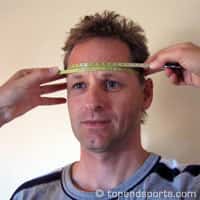
Purpose: To measure the circumference of the head as one of the many measurements of body size, and to determine proper sizing for athletic equipment.
Equipment Required: A flexible metal tape measure and pen suitable for marking the skin if needed. If a plastic or cloth tape is used, it should be checked regularly against a metal tape as these may stretch over time.
Pre-test Procedures: Explain the test procedures to the subject. Prepare forms and record basic information such as age, height, body weight, and gender. See more details of pre-test procedures.
Procedure: The subject may stand or sit for this measurement. When recording, ensure the tape compresses the hair and is kept horizontal. Remove any ties, clips, or accessories from the hair, and ensure the ears are not included in the measurement.
Reliability: Factors that may affect reliability include changes to the testing personnel, maintaining constant and even tension on the tape, and correct landmarking (finding the correct anatomical site for measurement).
Advantages: Low costs involved in the testing procedure, ease of self-testing, and immediate applicability for equipment sizing.
Comments: Girth measurements combined with skinfold measurements can give a clearer picture of changes in tissue composition and distribution of muscle and fat.
Sport-Specific Helmet Sizing
Different sports use varying helmet sizing systems. Understanding these standards helps athletes select properly fitting protective equipment:
Cycling Helmets
Cycling helmet sizes typically follow this standard:
- Small: 51-55 cm (20-21.7 inches)
- Medium: 55-59 cm (21.7-23.2 inches)
- Large: 59-63 cm (23.2-24.8 inches)
Most cycling helmets feature adjustable retention systems for fine-tuning fit within each size range.
Football Helmets
Football helmets require precise fitting due to the high-impact nature of the sport. Professional fitting by certified equipment managers is recommended, with sizes typically ranging from youth to adult XXL.
Baseball/Softball Helmets
Batting helmets commonly use these size designations:
- Small: 6 3/8 - 6 7/8 (51-55 cm)
- Medium: 6 7/8 - 7 1/4 (55-58.4 cm)
- Large: 7 1/4 - 7 5/8 (58.4-61.4 cm)
Hockey Helmets
Ice hockey and field hockey helmets are sized similarly to cycling helmets, with additional considerations for face cage or visor attachment.
Hat Size Conversion Chart
Understanding the relationship between head circumference and hat sizes helps when purchasing fitted caps, beanies, and athletic headwear:
| CM | Inches | US Size | UK Size | International |
|---|---|---|---|---|
| 52 | 20.5 | 6 1/2 | 6 3/8 | XS |
| 53 | 20.9 | 6 5/8 | 6 1/2 | XS |
| 54 | 21.3 | 6 3/4 | 6 5/8 | S |
| 55 | 21.7 | 6 7/8 | 6 3/4 | S |
| 56 | 22.0 | 7 | 6 7/8 | M |
| 57 | 22.4 | 7 1/8 | 7 | M |
| 58 | 22.8 | 7 1/4 | 7 1/8 | L |
| 59 | 23.2 | 7 3/8 | 7 1/4 | L |
| 60 | 23.6 | 7 1/2 | 7 3/8 | XL |
| 61 | 24.0 | 7 5/8 | 7 1/2 | XL |
| 62 | 24.4 | 7 3/4 | 7 5/8 | XXL |
| 63 | 24.8 | 7 7/8 | 7 3/4 | XXL |
Tips for Accurate Head Measurement
To ensure the most accurate head circumference measurement for athletic equipment fitting:
- Use the Right Tool: A flexible fabric or plastic measuring tape provides the most accurate results. Metal tapes are acceptable but less conforming.
- Consistent Positioning: Always measure at the same anatomical landmarks - above the eyebrows and ears at the widest point of the skull.
- Hair Considerations: Compress hair when measuring, or measure with the hairstyle you'll wear during activity (for swimming caps, measure with wet hair).
- Multiple Measurements: Take at least three measurements and use the largest value.
- Between Sizes: When falling between sizes, generally choose the larger size. Most helmets have adjustment systems to fine-tune fit.
Frequently Asked Questions
What is the average adult head circumference?
The average adult head circumference is approximately 57 cm (22.5 inches) for males and 55 cm (21.7 inches) for females. Adult head circumference typically ranges from 52-62 cm (20.5-24.5 inches), with head size generally correlating with overall body height.
How do I measure my head for a helmet?
Wrap a flexible measuring tape around your head about 2.5 cm (1 inch) above your eyebrows and ears, across the most prominent part of the back of your head. Keep the tape level and snug but not tight. Take multiple measurements and use the largest one for the most accurate helmet sizing.
What hat size is 58 cm?
A head circumference of 58 cm equals approximately hat size 7 1/4 (US), size L (International), or 7 1/8 (UK). This measurement is close to the average adult male head size and is one of the most common fitted cap sizes.
How do I convert head circumference from cm to inches?
To convert head circumference from centimeters to inches, divide by 2.54. For example, 57 cm ÷ 2.54 = 22.4 inches. Our calculator performs this conversion automatically and displays both measurements.
What helmet size do I need for cycling?
Cycling helmet sizes are based on head circumference: Small (51-55 cm), Medium (55-59 cm), Large (59-63 cm). Measure your head and consult the specific manufacturer's size chart as sizing can vary between brands. Most helmets feature adjustable retention systems for fine-tuning.
Should I choose a larger or smaller helmet when between sizes?
When falling between helmet sizes, choose the larger size. Most sports helmets have adjustable retention systems, padding, or fit liners that allow you to customize the fit. A slightly larger helmet can be adjusted down, but an undersized helmet cannot be safely expanded.
Does head circumference change with age?
Adult head circumference remains relatively stable after growth plates close (typically by age 16-18). Minor changes may occur with significant weight fluctuations. Skull size is largely determined during development and cannot be significantly increased in adulthood.
Disclaimer
This calculator provides estimates based on standard sizing charts. Actual hat and helmet sizes may vary between manufacturers. Always try on athletic equipment when possible and follow manufacturer-specific sizing guidelines. For safety-critical equipment like sports helmets, professional fitting is recommended.
References
- Bushby, K.M., Cole, T., Matthews, J.N., Goodship, J.A. (1992). "Centiles for adult head circumference." Archives of Disease in Childhood, 67(10), 1286-1287.
- International Society for the Advancement of Kinanthropometry (ISAK). "International Standards for Anthropometric Assessment." ISAK Publications.
- Norton, K., & Olds, T. (1996). "Anthropometrica." UNSW Press.
- American Society for Testing and Materials. "Standard Test Methods for Measurement of the Head for the Sizing of Headwear." ASTM D3508.
- Centers for Disease Control and Prevention. "Growth Charts." CDC Clinical Growth Charts.
- National Operating Committee on Standards for Athletic Equipment (NOCSAE). "Standard Performance Specification for Newly Manufactured Football Helmets."
- Consumer Product Safety Commission. "Safety Standard for Bicycle Helmets." 16 CFR Part 1203.
Similar Tests
Related Pages
Girth Measurements
General description of taking girth measurements and links to other girth measurement sites.
Learn More →Body Size Testing
A comprehensive discussion about body size testing and anthropometric assessment.
Learn More →MyoTape for Girth Measurement
Using the MyoTape tool for accurate self-measurement of body girths.
Learn More →Anthropometric Tests
Complete guide to anthropometric testing protocols and body composition assessment.
Learn More →Videos of Anthropometric Tests
Watch video demonstrations of proper anthropometric measurement techniques.
Watch Videos → Any comments, suggestions, or corrections? Please let us know.