Neck Girth Calculator
Quick Answer
This calculator measures and analyzes neck circumference (girth), providing comparisons to athletic norms and helping track changes in upper body composition. Neck girth is measured immediately above the thyroid cartilage using a flexible tape measure.
- Calculates neck circumference in both metric and imperial units
- Compares measurements to athletic population norms
- Provides sport-specific context for wrestlers, football players, and strength athletes
How to Measure Neck Girth
Neck girth is a circumference measurement taken at a standard anatomical site around the neck. The measurement is taken at the level immediately above the Adam's Apple (thyroid cartilage). Accurate measurement requires proper technique and consistent landmarking for reliable results.
Purpose
To measure the circumference of the neck as part of anthropometric assessment for body composition analysis, sport-specific evaluations, and tracking muscular development.
Equipment Required
Flexible metal tape measure and pen suitable for marking the skin. Plastic or cloth tapes should be regularly checked against metal tapes as they may stretch over time.
Pre-Test Preparation
Explain the test procedures to the subject. Prepare forms and record basic information such as age, height, body weight, and gender. See more details of pre-test procedures.
Test Procedure
The subject stands with head held up, looking straight ahead. Position the tape immediately above the thyroid cartilage, ensuring it lies flat on the skin without compression.
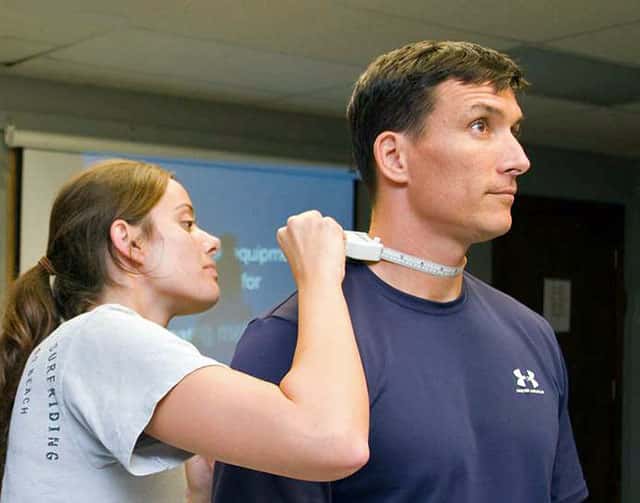
Neck girth testing: tape positioned above thyroid cartilage
What is Normal Neck Circumference?
Neck circumference varies significantly based on gender, body composition, and athletic training status. Understanding normative values helps contextualize individual measurements within appropriate reference populations.
| Category | Male (cm) | Male (inches) | Female (cm) | Female (inches) |
|---|---|---|---|---|
| Small | < 35 | < 13.8 | < 30 | < 11.8 |
| Average | 35-40 | 13.8-15.7 | 30-35 | 11.8-13.8 |
| Large (Athletic) | 40-45 | 15.7-17.7 | 35-38 | 13.8-15.0 |
| Very Large | > 45 | > 17.7 | > 38 | > 15.0 |
Neck Girth for Athletes and Sports
Neck circumference has particular significance in several sports and athletic contexts. Understanding sport-specific applications helps athletes and coaches utilize this measurement effectively.
Combat Sports (Wrestling, MMA, Boxing)
In combat sports, neck size is both a functional consideration and sometimes a factor in weight class management. Wrestlers and MMA fighters often develop substantial neck musculature for defensive purposes, protecting against chokes and reducing injury risk during takedowns. Neck size contributes to overall body weight, which can affect weight class selection strategies.
Contact Team Sports (Football, Rugby)
Research has demonstrated that increased neck strength and size correlates with reduced concussion risk and severity in contact sports. Football and rugby programs increasingly emphasize neck conditioning, and monitoring neck circumference helps track the effectiveness of these programs. NFL linemen typically have neck measurements of 45-55 cm (17.7-21.6 inches), reflecting both training adaptation and position-specific demands.
Strength Sports (Powerlifting, Strongman)
Neck development is a natural consequence of heavy compound lifting, particularly deadlifts and overhead pressing. Competitive strongman athletes often display exceptional neck development, with measurements frequently exceeding 50 cm (19.7 inches). Neck size in these athletes primarily reflects muscular development rather than adiposity.
Body Composition Assessment
Neck circumference is used in several body fat estimation equations, including the U.S. Navy body composition formula. Combined with waist and hip measurements, neck girth helps estimate body fat percentage without specialized equipment. Girth measurements combined with skinfold measurements can give a clearer picture of changes in tissue composition and distribution of muscle and fat. For athletes, these formulas may underestimate body fat due to elevated muscle mass.
The Science Behind Neck Measurements
Anthropometric neck measurements follow standardized protocols established by the International Society for the Advancement of Kinanthropometry (ISAK). The measurement site—immediately above the thyroid cartilage—represents the smallest circumference of the neck and provides consistent landmarking across subjects.
Measurement Protocol
- Subject positioning: Standing upright, head in the Frankfurt plane (horizontal line from ear canal to lower eye socket), looking straight ahead
- Tape placement: Positioned perpendicular to the long axis of the neck, immediately superior to the thyroid cartilage
- Tension: Tape held firmly but without skin compression, using constant tension technique
- Reading: Recorded to the nearest 0.1 cm at the end of normal expiration
Reliability Considerations
Technical error of measurement (TEM) for neck circumference is typically less than 0.5 cm when performed by trained technicians. Factors affecting reliability include: consistent landmarking, even tape tension, proper subject positioning, and standardized measurement timing. For longitudinal tracking, the same technician should perform all measurements when possible.
How to Improve Neck Size for Athletes
Athletes in sports requiring neck strength may benefit from targeted neck training. Progressive resistance training can increase neck circumference by 2-5 cm over 12-24 weeks of dedicated training.
Effective Training Methods
- Neck harness work: Flexion, extension, and lateral flexion against resistance
- Manual resistance: Partner-applied resistance in multiple planes
- Bridging exercises: Front and back bridges for wrestlers
- Shrugs and loaded carries: Indirect neck development through trap training
- Isometric holds: Static contractions against resistance for strength development
Frequently Asked Questions
How do you measure neck girth correctly?
Measure neck circumference immediately above the thyroid cartilage (Adam's Apple) with the head held straight and looking forward. The tape should lie flat against the skin, positioned perpendicular to the neck's long axis, without being too tight or too loose. Take multiple measurements and average them for best accuracy.
What is a normal neck circumference for adults?
Average neck circumference for adult males ranges from 37-40 cm (14.5-15.7 inches), while for females it is typically 32-35 cm (12.6-13.8 inches). Athletes, particularly those in strength and contact sports, often have significantly larger measurements due to muscular development.
Why is neck girth important for athletes?
Neck girth is important for athletes because it indicates upper body muscular development, helps determine weight class in combat sports, is used in body fat calculation formulas, and strong neck muscles help prevent injuries in contact sports like football and rugby.
How often should athletes measure neck circumference?
Athletes should measure neck circumference monthly during training phases to track muscular development. For consistent results, measure at the same time of day, ideally in the morning before training, using identical technique each time.
Can neck circumference predict health risks?
Research indicates that neck circumference above 43 cm for men or 38 cm for women may be associated with increased cardiometabolic risk factors in sedentary populations. However, athletes with muscular necks from training typically have larger measurements without associated health concerns—context matters significantly.
What equipment do I need for neck measurement?
A flexible metal tape measure is recommended for accurate neck girth measurements. Plastic or cloth tapes may stretch over time and should be periodically verified against a metal standard. Specialized anthropometric tapes with tension indicators provide the most consistent results.
How does neck size relate to shirt collar size?
Shirt collar size roughly corresponds to neck circumference plus approximately 1-2 cm for comfort. A 40 cm neck measurement typically corresponds to a size 16 (inch) collar in dress shirts. Athletes with muscular necks often require collar sizes larger than their chest/body size would suggest.
Similar Tests
Related Pages
Girth Measurements
General description of taking girth measurements and links to other circumference tests.
Learn More →Body Size Testing
Discussion about body size testing methods and their applications in sports.
Learn More →MyoTape Measurement
Using MyoTape for consistent girth measurements with controlled tension.
Learn More →Anthropometry Tests
Complete guide to anthropometric testing including body composition assessment.
Learn More →Anthropometry Videos
Watch video demonstrations of anthropometric testing techniques and procedures.
Watch Videos →References
- Marfell-Jones, M., Olds, T., Stewart, A., & Carter, L. (2006). "International Standards for Anthropometric Assessment." ISAK.
- Ben-Noun, L., Sohar, E., & Laor, A. (2001). "Neck circumference as a simple screening measure for identifying overweight and obese patients." Obesity Research, 9(8), 470-477.
- Collins, C.L., Fletcher, E.N., et al. (2014). "Neck strength: A protective factor reducing risk for concussion in high school sports." Journal of Primary Prevention, 35(5), 309-319.
- Eckner, J.T., et al. (2014). "Effect of neck muscle strength and anticipatory cervical muscle activation on the kinematic response of the head to impulsive loads." American Journal of Sports Medicine, 42(3), 566-576.
- Hodgson, J.A., Finni, T., Lai, A.M., Edgerton, V.R., & Sinha, S. (2006). "Influence of structure on the tissue dynamics of the human soleus muscle." Journal of Morphology, 267(5), 584-601.
- Preis, M.A., et al. (2010). "Neck circumference: An independent predictor of cardiometabolic risk." Annals of Internal Medicine, 152(10), 617-626.
- Stewart, A., Marfell-Jones, M., Olds, T., & de Ridder, H. (2011). "International Standards for Anthropometric Assessment." ISAK.
 Any comments, suggestions, or corrections? Please let us know.