FIFA CODA Test Calculator
Quick Answer
The FIFA CODA Test Calculator instantly assesses your change of direction ability against official FIFA standards for assistant referees. Enter your completion time to determine if you pass and see how your performance compares to elite officials.
- Pass threshold: Maximum 10 seconds for all categories
- Test involves: 36 meters total (10m forward + 8m lateral left + 8m lateral right + 10m forward)
- Elite times: Sub-8.5 seconds for international assistant referees
The FIFA Change of Direction Ability (CODA) test is one of the three official FIFA Fitness Tests for Assistant Referees. This agility test assesses the assistant referee's ability to quickly change direction, a critical skill when tracking the offside line during matches. The test was introduced in 2016 as part of FIFA's updated fitness testing protocol.
Use the calculator above to instantly assess your CODA test performance against official FIFA standards. Whether you're preparing for your annual fitness test or training to improve your change of direction speed, this tool provides immediate feedback on your current performance level.
What is the FIFA CODA Test?
The FIFA CODA test evaluates an individual's ability to change direction rapidly, designed specifically to test the physical demands placed on soccer assistant referees during matches. Unlike center referees who primarily run in straight lines, assistant referees must frequently perform lateral movements while tracking the offside line and maintaining visual contact with play.
Test Purpose: Assess the assistant referee's ability to change direction quickly, mimicking the lateral movements required during match situations.
Equipment Required:
- Approximately 15 meters of clear non-slip surface
- Electronic timing gates
- Marking cones
- Measuring tape
Pre-Test: Explain the test procedures to the subject. Perform screening of health risks and obtain informed consent. Prepare forms and record basic information such as age, height, body weight, gender and test conditions. Measure and use cones to mark out the course. See more details of pre-test procedures.
FIFA CODA Test Setup and Course Layout
Test Setup:
- Start and turn lines are marked on the ground 10 meters apart
- A line 0.5m before the start (participant start position)
- A line 2 meters after the start line (point B)
- The distance between B and C is 8 meters
- A single timing gate is set up at the start line (records both start and finish)
How to Perform the FIFA CODA Test
Procedure:
- The participant's front foot is placed behind the starting line, which is 0.5 meters before the timing gates
- When ready, sprint maximally 10 meters forward (A to C)
- Turn and run sideways to the left for 8 meters (C to B)
- Turn and run back sideways to the right for 8 meters (B to C)
- Turn and sprint 10 meters forward back through the starting gates (C to A)
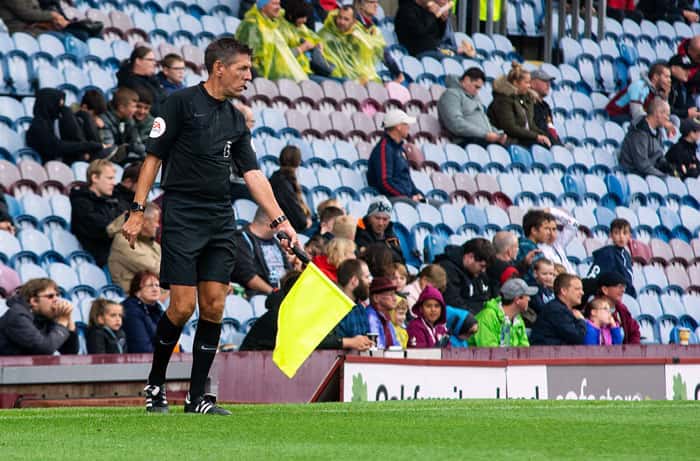
Football assistant referee - the CODA test mimics the lateral movements required during match play
FIFA CODA Test Standards and Passing Times
Scoring: The time to complete the trial is recorded. The standard is a maximum 10 seconds per trial for all categories. If the standard is not reached, another attempt may be granted.
| Category | Maximum Time | Elite Target | Excellent |
|---|---|---|---|
| International/Category 1 (Male) | 10.00 seconds | <8.50 seconds | 8.50-9.00 seconds |
| International/Category 1 (Female) | 10.00 seconds | <9.00 seconds | 9.00-9.50 seconds |
| National/Category 2 | 10.00 seconds | <9.00 seconds | 9.00-9.50 seconds |
| Regional/Lower Categories | 10.00 seconds | <9.50 seconds | 9.50-10.00 seconds |
Understanding Your CODA Test Results
Your CODA test time provides insight into your change of direction ability, a crucial skill for assistant referees. Here's how to interpret your results:
Elite (<8.5s)
Outstanding change of direction ability. You exceed the standards expected of FIFA international assistant referees. Your lateral movement speed is exceptional.
Excellent (8.5-9.0s)
Strong performance suitable for international-level officiating. You demonstrate quick transitions between forward and lateral movements.
Good (9.0-9.5s)
Solid change of direction ability meeting national standards. Room for improvement in lateral movement speed and transition efficiency.
Pass (9.5-10.0s)
Meets minimum FIFA requirements. Focus on improving lateral agility through specific training to build a performance buffer.
The Science Behind Change of Direction Testing
Change of direction ability (CODA) is distinct from true agility, which requires reactive decision-making. The FIFA CODA test measures pre-planned directional changes, isolating the physical components of directional speed:
Key Physical Components Tested:
- Deceleration ability: Slowing down efficiently before direction changes
- Lateral movement speed: Side-shuffling velocity while maintaining body control
- Reacceleration capacity: Quickly regaining speed after each turn
- Dynamic balance: Maintaining stability during rapid directional transitions
- Lower body power: Force production during the push-off phase
Research published in the Journal of Sports Sciences has shown that CODA performance in referees correlates with match performance metrics, particularly for assistant referees who must track the offside line while moving laterally.
Training to Improve Your CODA Test Performance
If your CODA test time needs improvement, focus on these evidence-based training methods:
Lateral Movement Drills
- Lateral shuffles: 3 sets of 8m side shuffles, each direction
- Carioca drills: Cross-over stepping patterns for hip mobility
- Ladder drills: In-and-out, lateral shuffle patterns
Strength Training
- Lateral lunges: 3 sets of 10 each leg
- Single-leg squats: Develop unilateral strength
- Hip abductor exercises: Strengthen lateral movement muscles
Specific CODA Practice
- Practice the actual test course 2-3 times per week
- Focus on efficient turning technique at each cone
- Gradually increase intensity from 80% to 100% effort
⚠️ Training Recommendation
Allow 48-72 hours between high-intensity CODA training sessions for optimal recovery. Overtraining can lead to decreased performance and increased injury risk.
The Complete FIFA Assistant Referee Fitness Test
The CODA test is one of three components in the official FIFA Fitness Test for assistant referees:
| Test | Purpose | Standard |
|---|---|---|
| 1. CODA Test | Change of direction ability | Maximum 10 seconds |
| 2. Repeated Sprint Ability (RSA) | Ability to perform repeated 30m sprints | 5 x 30m within time limits |
| 3. Interval Test | Sustained high-speed running capacity | 40 x 75m run / 25m walk |
Test Sequence:
- Time between CODA and RSA: 2-4 minutes maximum
- Time between RSA and Interval Test: 6-8 minutes maximum
Important Notes for Test Day
- If the participant falls or trips, they should be given an additional trial
- Tests must be performed on a stable surface such as an athletics track or football field
- Athletic spikes may NOT be worn during the tests
- Assistant referees must pass the FIFA Fitness Test at least once a year
- The test was updated in 2016 to include the CODA component
Frequently Asked Questions
What is the FIFA CODA test?
The FIFA Change of Direction Ability (CODA) test is one of the three official FIFA Fitness Tests for assistant referees. It assesses an official's ability to change direction quickly, involving a 10m forward sprint, 8m sideways left, 8m sideways right, and 10m sprint back through the timing gate, covering 36 meters total.
What is a passing time for the FIFA CODA test?
The standard passing time for the FIFA CODA test is a maximum of 10 seconds for all categories. Male international assistant referees typically achieve times around 8.5-9.5 seconds, while female officials generally aim for sub-10 seconds.
How many attempts do you get on the CODA test?
Assistant referees perform one trial. If they fail to meet the standard time, they are given an additional trial. If they fail two trials, they have failed the test.
What is the total distance covered in the CODA test?
The total distance covered in the FIFA CODA test is 36 meters: 10m forward sprint + 8m sideways left + 8m sideways right + 10m forward sprint back to the start.
When was the FIFA CODA test introduced?
The FIFA CODA test was introduced in 2016 as part of the updated FIFA Fitness Tests for assistant referees, replacing elements of the previous testing protocol that only included the RSA and Interval tests.
How can I improve my CODA test time?
Focus on lateral movement drills (side shuffles, carioca), strength training (lateral lunges, single-leg exercises), and regular practice of the actual test course. Allow 48-72 hours recovery between high-intensity sessions.
What surface should the CODA test be performed on?
Tests must be performed on a stable surface such as an athletics track or football field. The surface should be non-slip and clear of obstacles. Athletic spikes are NOT permitted during the tests.
References
- FIFA. (2016). "FIFA Fitness Test for Referees and Assistant Referees." International Football Association Board.
- Castagna, C., Abt, G., & D'Ottavio, S. (2007). "Physiological aspects of soccer refereeing performance and training." Sports Medicine, 37(7), 625-646.
- Weston, M., Castagna, C., Helsen, W., & Impellizzeri, F. (2009). "Relationships among field-test measures and physical match performance in elite-standard soccer referees." Journal of Sports Sciences, 27(11), 1177-1184.
- Yanci, J., Los Arcos, A., Grande, I., & Casajús, J. A. (2016). "Change of direction ability test differentiates higher level and lower level soccer referees." Biology of Sport, 33(2), 173-177.
- Mallo, J., Navarro, E., García-Aranda, J. M., Gilis, B., & Helsen, W. (2007). "Activity profile of top-class association football referees in relation to performance in selected physical tests." Journal of Sports Sciences, 25(7), 805-813.
- Krustrup, P., & Bangsbo, J. (2001). "Physiological demands of top-class soccer refereeing in relation to physical capacity." Journal of Sports Sciences, 19(11), 881-891.
The Test in Action
- This test is part of the FIFA Testing for Referees
Similar Tests
- Simple 1-minute Side Step Test
- T-Test — running a T shape course involving forward, lateral, and backwards running.
- SEMO Agility run — run around a rectangular area incorporating forward sprints, diagonal backpedaling, and side shuffling.
- 20m 5-10-5 agility shuttle — run 5 meters to one side, 10 meters back the other way, finishing with 5 meters back to the start line.
- FIFA Interval Test (Part 1) - 6 x 40m sprints with 60 seconds recovery between bouts.
- FIFA Interval Test (Part 2) - alternating 75m run and 25m walk, repeating this for 10 laps.
- Assistant Referee Intermittent Endurance Test — an intermittent yo-yo type test involving forwards and sideways running.
Related Pages
 Any comments, suggestions, or corrections? Please let us know.