2 km Cycle Test Calculator
Quick Answer
This calculator analyzes your 2km cycle time trial performance, converting your finishing time into average speed and comparing it to athletic standards. Results help cyclists track fitness progress and set training targets.
- Calculates average speed in km/h or mph instantly
- Compares performance to cycling fitness standards
- Provides sport-specific training recommendations
This is a test of aerobic fitness, an important component of endurance based and team sports. The 2-km cycle test is part of the eTID Talent Identification Testing Program for cycling, and their protocol is listed here. See also the 5km cycle ergometer test and the 40m cycle sprint.
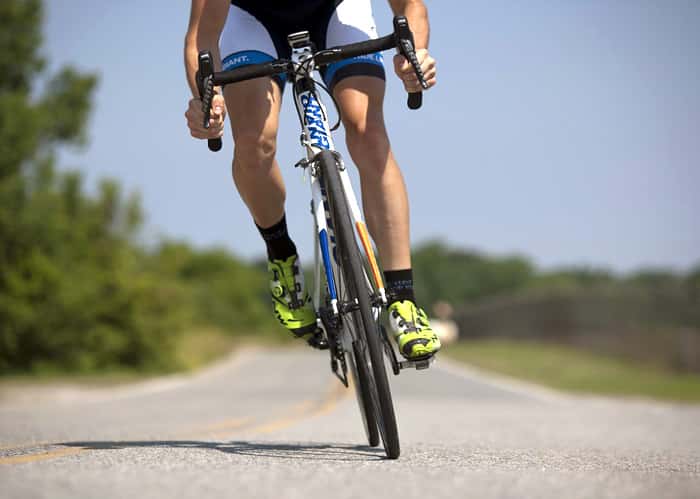
2-km cycle test on the road
What Does the 2km Cycle Test Measure?
Test Purpose: This test measures aerobic fitness and leg muscles endurance, as well as cycling technique. The 2km distance provides an ideal balance between pure anaerobic power and aerobic capacity, making it particularly valuable for identifying cycling talent and monitoring training progress.
The 2km cycle test assesses multiple physiological systems simultaneously. Athletes must maintain a high percentage of their VO2max while managing lactate accumulation and fatigue. This makes the test especially relevant for track cyclists, time trialists, and any athlete requiring sustained high-intensity cycling performance.
Equipment Required
Equipment Required: An appropriate 2km route (e.g., a road or velodrome), bicycle, stopwatch.
For standardized testing, a velodrome track is ideal as it eliminates variables like wind, gradient, and traffic. When testing on roads, select a flat, straight course with minimal turns. The bike should be properly fitted to the athlete with correct seat height and handlebar position for optimal power output.
Pre-Test Procedures
Pre-Test: Explain the test procedures to the subject. Perform screening of health risks and obtain informed consent. Prepare forms and record basic subject information such as age, height, body weight, gender. Record the test conditions, such as the weather, wind and track surface, particularly if testing is performed outside. Record details of the bike used, and set up the seat and handlebars to suit the athlete. See more details of pre-test procedures.
Athletes should arrive well-rested, adequately hydrated, and should avoid heavy meals for at least 2 hours before testing. A proper warm-up of 10-15 minutes including progressive intensity cycling is essential for optimal performance and injury prevention.
Test Procedure
Procedure: Using a bike of their choice, the subject is required to cover the 2km distance as fast as possible. The subject starts from a stationary start with their feet on the pedals with a person holding onto the subject. Begin on the signal 'ready, start'. The tester should start the stopwatch as soon as they say 'start'. Stop the timer when the subject crosses the finish line on completion of the 2km.
Pacing strategy is crucial for optimal performance. Athletes should aim for a slightly conservative start to avoid early lactate accumulation, then maintain a steady effort before increasing intensity in the final 500 meters. Even pacing generally produces better results than aggressive starts.
Scoring and Results
Scoring: The total time to complete the course is recorded for each participant, in minutes and seconds. Use the calculator above to convert your time into meaningful performance metrics including average speed, pace, and comparison to athletic standards.
Advantages of the 2km Cycle Test
Advantages: Large groups of athletes can be tested at once, and it is a very cheap and simple test to perform. If the test is conducted on a velodrome track, all the athletes will be in view throughout the test.
Additional advantages include:
- High specificity for cycling sports
- Requires minimal equipment beyond a standard bicycle
- Results are easily comparable across testing sessions
- Can be conducted in various environments (road, velodrome, trainer)
- Provides data on both aerobic and anaerobic capacity
Disadvantages and Limitations
Disadvantages: Practice and pacing are required, and performance on this test can be affected greatly by motivation. If cycling around a velodrome track, you will be able to provide continual feedback on the time to help with pacing.
Other considerations include:
- Environmental conditions can significantly affect results
- Bike specifications may vary between athletes
- Technical cycling ability influences results beyond pure fitness
- Not suitable for athletes with cycling injuries or contraindications
Important Considerations
Comments:
- To achieve the best result for this test, adequate practice and good pacing are required, and performance on this test can be affected greatly by motivation.
- If a velodrome track is not used, it is preferable to have a 1km out and back course to account for the effect of wind.
- Consistent testing conditions improve the reliability of results over time
- Athletes should use the same bike configuration for repeat tests
Understanding Your Results
Your 2km cycle test time reflects your cycling-specific aerobic fitness. The average speed calculated from your time indicates your sustained power output capability. Here's how to interpret the performance categories:
- Elite (under 2:30): Professional or nationally competitive cyclist level. Requires exceptional VO2max and cycling efficiency.
- Excellent (2:30-3:00): Highly trained competitive cyclist. Strong aerobic base with good anaerobic capacity.
- Good (3:00-3:30): Well-trained recreational or club level cyclist. Solid fitness foundation.
- Average (3:30-4:00): Regular cyclist with moderate fitness. Good starting point for structured training.
- Below Average (4:00-5:00): Occasional cyclist or beginner. Significant improvement potential with consistent training.
- Developing (over 5:00): New to cycling or returning from extended break. Focus on building base fitness.
Sport-Specific Applications
The 2km cycle test has applications across various cycling disciplines and sports:
Track Cycling
This test closely mirrors events like the individual pursuit (4km for men, 3km for women). Track cyclists use it to monitor training adaptations and peaking for competition.
Road Cycling and Triathlon
While road events are longer, the 2km test indicates time trial ability and climbing power. Triathletes use it to assess cycling leg fitness relative to overall performance.
Team Sports
Sports like Australian Rules Football and cycling-based fitness programs use this test to assess aerobic conditioning of athletes who train on bikes.
Talent Identification
This test is part of the eTID Talent Identification Testing Program for cycling, helping identify young athletes with cycling potential.
How to Improve Your 2km Cycle Time
Based on your performance level, here are evidence-based strategies to improve your time:
For All Levels
- Consistent training 3-5 sessions per week
- Include at least one long ride (60-90 minutes) weekly
- Practice test-specific pacing strategies
- Optimize bike fit for power and comfort
For Intermediate Athletes (3:00-4:00)
- Add 2-3 interval sessions per week (e.g., 4x4 minutes at threshold)
- Include hill repeats for leg strength
- Work on cycling cadence optimization (80-100 RPM)
For Advanced Athletes (under 3:00)
- High-intensity interval training (HIIT) 2-3 times weekly
- VO2max intervals (3-5 minute efforts at 100-120% FTP)
- Power meter training for precise intensity control
- Periodized training with proper recovery phases
Frequently Asked Questions
What is a good time for the 2km cycle test?
A good time depends on your training level and gender. Elite male cyclists complete the test in under 2:30, while well-trained recreational cyclists typically finish between 3:00-4:00. Female athletes generally have times 10-15% slower than males at equivalent fitness levels. Use the calculator above to see how your time compares to athletic standards.
How accurate is this calculator for estimating cycling fitness?
The calculator provides accurate speed and pace calculations from your time. Performance ratings are based on sports science research and competitive cycling standards. For the most reliable assessment, conduct the test under standardized conditions (same bike, course, and weather) and compare results over time.
How often should I perform the 2km cycle test?
For monitoring training progress, test every 4-8 weeks during a training block. Avoid testing more frequently as the high-intensity nature requires adequate recovery. Schedule tests at similar times of day and training phase for meaningful comparisons.
Can I do this test on a stationary bike or trainer?
Yes, the test can be performed on a cycle ergometer or smart trainer with distance measurement. However, results may differ from outdoor tests due to differences in resistance, cooling, and bike geometry. For consistent tracking, use the same equipment for all tests.
What's the difference between the 2km and 5km cycle tests?
The 2km test emphasizes anaerobic capacity alongside aerobic fitness, taking 2-5 minutes to complete. The 5km test is more purely aerobic, lasting 6-12 minutes, and better represents sustained endurance. Choose based on your sport's demands—track cyclists benefit more from the 2km, while road cyclists may prefer the 5km test.
How does wind affect 2km cycle test results?
Wind significantly impacts cycling performance. A headwind can add 10-30+ seconds to your time depending on intensity. For valid results, use a velodrome, choose calm conditions, or use an out-and-back course where wind effects partially cancel out.
What warm-up should I do before the 2km cycle test?
Perform a 10-15 minute progressive warm-up starting at low intensity and gradually increasing. Include 2-3 short accelerations (10-20 seconds) at near-test intensity in the final 5 minutes. Allow 3-5 minutes of easy spinning before starting the test.
References
- Australian Sports Commission. (2000). "Physiological Tests for Elite Athletes." Human Kinetics.
- Jeukendrup, A. & Van Diemen, A. (1998). "Heart rate monitoring during training and competition in cyclists." Journal of Sports Sciences, 16(sup1), 91-99.
- Craig, N.P. & Norton, K.I. (2001). "Characteristics of track cycling." Sports Medicine, 31(7), 457-468.
- Faria, E.W., Parker, D.L., & Faria, I.E. (2005). "The science of cycling: Physiology and training." Sports Medicine, 35(4), 285-312.
- Padilla, S., et al. (2000). "Scientific approach to the 1-h cycling world record." Journal of Applied Physiology, 89(4), 1522-1527.
- Cycling Australia. (2023). "eTID Talent Identification Program Testing Protocols."
- Lucía, A., et al. (2001). "Tour de France versus Vuelta a España: Which is harder?" Medicine and Science in Sports and Exercise, 35(5), 872-878.
The Test in Action
- This test is part of the eTID Talent Identification Testing Program for cycling.
- Used by cycling federations worldwide for talent identification
- Common assessment in collegiate and elite cycling programs
Similar Tests
- Cycle 12-minute test — cycle for maximum distance in 12 minutes
- The 5km cycle ergometer test — longer distance time trial
Related Pages
- Fitness tests for cyclists
- Cycling Fitness Tests, assessments involving cycling exercise
- About the eTID Talent Identification Testing Program
- ETID Fitness Testing for Cycling
- Comparison of Cycle Ergometers
- Other aerobic tests, and all fitness test list
 Any comments, suggestions, or corrections? Please let us know.