


Vertical Jump Measurement — using flight time
Vertical jumping ability is important for many sports, and there are a plethora of programs for training to increase your vertical jump ability. It is important to monitor the changes in your vertical jump, to see if there really are increases. The traditional method for assessing vertical jump ability is by measuring jump height using a wall, Vertec® device or similar (see description of this method).
The method described below measures the jump air time using an electrical contact operated system, and from that calculates jump height. This is the preferred method when testing for the SPARQ rating system. Similarly, a force platform can also be used to calculate jump height (plus other measures), or jump height can be calculated from video.
equipment required: electronic timing mat, such as the Just Jump System, infrared laser system or wearable devices.
pre-test: Explain the test procedures to the subject. Perform screening of health risks and obtain informed consent. Prepare forms and record basic information such as age, height, body weight, gender, test conditions. Perform an appropriate warm-up. See more details of pre-test procedures.
procedure (see also variations below): Jump height can be calculated using a timing mat or laser system which measures the time the feet are off the mat. The athlete stands in socks or bare feet, as still as possible on the mat with weight evenly distributed over both feet. Once the mat is reset, the athlete jumps vertically as high as possible using both arms and legs to assist in projecting the body upwards (this method uses the countermovement technique). For discussion of other ways to perform this test, see vertical jump techniques). The athlete then lands back on the mat with both feet landing at the same time. A score of the time in the air, and the calculated vertical jump height is then given. Height can be calculated using this formula: jump height = 4.9 x (0.5 x Time)2). The best score of at least three attempts is recorded. Allow a good rest of approximately two minutes between trials.
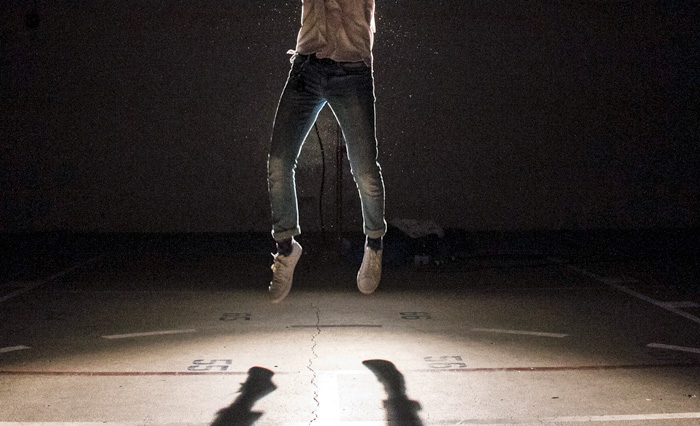 measuring jump height from hang time
variations: Vertical jump height can also be measured using a Vertec® or wall. Other test variations are to perform the test with no arm movement (one hand on hip, the other raised above the head) to isolate the leg muscles and reduce the effect of variations in coordination of the arm movements. The vertical jump test is usually performed with a counter-movement, that is, there is bending of the knees prior to the vertical jump. The test can also be performed as a squat jump, starting from the position of knees being bent, say at 90 degrees. The test can also be performed off one leg, with a single step into the jump, or with a run-up, depending on the relevance to the sport involved. For more details see vertical jump technique.
scoring: The jump height is usually recorded as a distance score, in cm or inches. See the vertical jump norm table to rate scores. For more information, see also a selection of vertical jump test results. It is also possible to convert jump height into a power or work score.
advantages: this test is simple and quick to perform. This jump timing mat device is very portable, compared to the Vertec®, though the laser system is more bulky and expensive. The vertical jump measurement when using this device is also not reliant on the subject timing their jump to touch something at the peak of the jump. Many timing mats can also be used for timing sprints and other uses. Using the timing mat you can perform the test without arm movement, as the arm is not required to reach up.
disadvantages: To be accurate, you must ensure that both feet land back on the mat with legs nearly fully extended, as landing with the legs bent can give incorrect larger scores. Without a mark on the wall to aim for and motivate the subject, measured jump height using this method is often lower than other methods. As the mat responds to the movement of weight on and off the mat, they are sometimes too sensitive and give erroneous results or are hard to stabilize before starting the test. This mats can be quite expensive.
comments: The jump height can be affected by how much you bend your knees before jumping, and the effective use of the arms. As with many tests, motivation can affect results - you should provide encouragement to the participant to achieve their maximal score.
Similar Tests
- Procedure for Vertical Jump Testing using the Vertec® or just a wall
- A simple way of testing Vertical Jump at home
- Procedure for testing Vertical Jump off one step or two feet, and with no arm movement.
- Vertical Jump in the water (for water polo players)
- A similar test of leg power is the standing long jump test
- Mid-Thigh Pull Test (IMTP) — an isometric leg strength test, the participant pulls against a static object.
Related Pages
- The NHL combine uses a force platform to calculate vertical jump height
- Vertical Jump Demonstration Videos
- Vertical Jump test results
- The Physics of the Vertical Jump
- About vertical jump techniques
- A discussion about the various vertical jump equipment available
- Apparatus for sale in the vertical jump store
- A history of the Sargent Test
- ChronoJump — for the measurement, management and statistics of jump time events.
- See the list of anaerobic tests for other fitness tests of leg power.
- The Vertical Jump test is part of the AFL draft and NBA draft testing procedures and used for the SPARQ rating system for many sports.
- Poll: Which equipment do you use to measure vertical jump?
- World Records for the Vertical Jump
 Any comments, suggestions, or corrections? Please let us know.
 Current Events