


Running Based Anaerobic Sprint Test (RAST)
The Running Based Anaerobic Sprint Test (RAST) was devised at the University of Wolverhampton in the UK, and involves six sprints over 35 meters with a 10 second recovery between each sprint, and provides measurements of peak power, average power and minimum power along with a fatigue index (Draper & Whyte, 1997).
purpose: this is a test of anaerobic power during running.
equipment required: scales, stopwatch, timing gates (optional), measuring tape, marker cones, at least 50 meter track.
pre-test: Explain the test procedures to the subject. Perform screening of health risks and obtain informed consent. Prepare forms and record basic information such as age, height, body weight, gender and test conditions. Measure and mark out the course. Perform a standard warm-up. See more details of pre-test procedures.
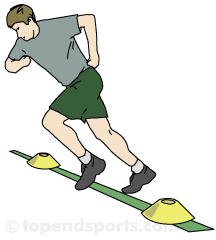
procedure: Weigh each subject prior to the test for use in calculations, followed by a warm-up. Set up cones at each end of 35 meters of running track. Two testers may be required, as one person is required to time each run of 35 meters, the other to time the 10 seconds recovery period. The subject stands at one end of the 35m track, and starts a maximal sprint on the command 'go'. Ensure the subject sprints maximally through the line each time. After 10 seconds, the next sprint starts from the opposite end of the 35 m track. Repeat this procedure until six sprints are completed.
 scoring: Record the time taken for each sprint to the nearest hundredth of a second (using timing gates provides greater accuracy). The sprint times along with body weight can be used to calculate maximal, minimal and average power outputs along with a fatigue index.
calculations: use the following formula to calculate the power for each sprint (weight=bodyweight of subject in kg, distance=35m, time=seconds to run 35m). From these values you can determine the maximum and minimum power, average power, relative power, and fatigue index.
Power = Weight × Distance ² ÷ Time ³
Peak Power = the highest power measurement
Relative Peak Power = peak power ÷ Weight
Average Power = the sum of all six power values ÷ 6
Fatigue Index = (maximum power – minimum power) ÷ total time for the 6 sprints
target population: This test is suitable for most multi-sprint sports such as basketball, football, hockey, rugby and soccer.
comments:
- This test was developed to provide a running based test to provide information like that from the Wingate 30 second cycle test. The total running time is close to 30 seconds, making the test comparable with the Wingate test.
- This test was developed by Nick Draper and Greg Whyte of the University of Wolverhampton UK. Professor Greg Whyte is EIS Director of Science and Research (and former University of Wolverhampton lecturer) and a former Olympic modern pentathlete, Professor Nick Draper is Chair of Sport and Exercise Science New Zealand and teaches at the University of Canterbury, Christchurch, New Zealand.
references:
- Draper, N. and Whyte, G (1997) Here's a new running based test of anaerobic performance for which you need only a stopwatch and a calculator. Peak Performance, 97, p. 3-5
- Zacharogiannis, E., Paradisis, G. and Tziortzis, S. (2004) An evaluation of tests of anaerobic power and capacity. Medicine & Science in Sports & Exercise 36 (suppl. 5), S116.
Similar Tests
- Phosphate recovery test — 7 x 7-second sprints.
- Sprint fatigue test — 10 x 30m sprints.
- FIFA interval test 1 — 6 x 40m sprints.
- Repeat Sprint Ability Test — 10 x 20m, starting every 20 seconds.
- Sprint recovery test — for AFL players, 6 x 30m sprints.
- Dal Monte repeat sprint test — 5 x 50 m (men) or 40 m (women), at intervals of 1 minute.
- Cycling Repeat Sprint Test — a cycle test of anaerobic capacity, involving 5 x 6 second efforts every 30 seconds.
Related Pages
- More about measuring power from running tests
- Warming up for sprint testing
- Other anaerobic capacity tests
- Recovery methods after exercise
 Any comments, suggestions, or corrections? Please let us know.
 Current Events