


Sprint Fatigue Test
A repeat sprint test of anaerobic capacity, involving ten 30m sprints performed every 30 seconds. See also the similar sprint recovery (6 x 30m sprints every 20 seconds) and phosphate recovery (7 x 7-second sprints with 23 seconds recovery) tests.
purpose: this is a test of anaerobic capacity, the ability to recover between sprints and produce the same level of power repeatedly.
equipment required: 2 stopwatches, measuring tape, marker cones, at least 50 meter track.
pre-test: Explain the test procedures to the subject. Perform screening of health risks and obtain informed consent. Prepare forms and record basic information such as age, height, body weight, gender, test conditions. Measure and mark out the test area. Perform an appropriate warm-up. See more details of pre-test procedures.
procedure: marker cones and lines are placed 30 meters apart to indicate the sprint distance. Two more cones are placed a further 10 meters along on each end. At the instructions of the timer, the subject places their foot at the starting line, then on 'go' two stopwatches are started simultaneously, and the subject sprints maximally for 30m, ensuring that they do not slow down before reaching the finish line. One stopwatch is used to time the sprint, the other continues to run. Record the time of the first sprint. The participants use the 10 meter cone to slow down and turn, and return to the 30m finishing point, which then becomes the next start line. The next sprint will be in the opposite direction. Each 30 meter sprint starts 30 seconds after the previous run started. This cycle continues until ten sprints are completed, starting at 30 sec, 1 min, 1.5 min, 2 min etc after the start of the first sprint.
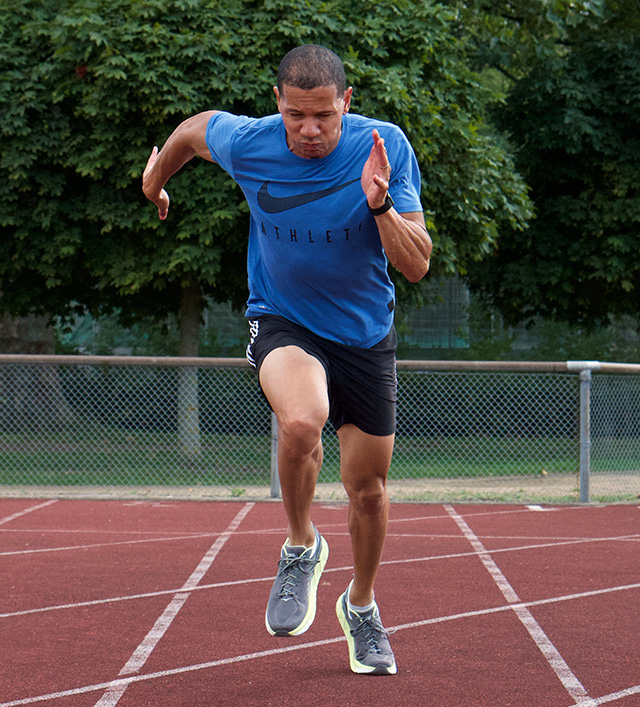 sprinting speed recovery test
scoring: The fatigue index is calculated by taking the average time of the first three trials and dividing it by the average time of the last three trials. This will give a value approximately between 75 and 95%. For example, if the times for the first three sprints were 6.9, 7.1, and 6.7 (average 6.9 seconds) and the last three times were 7.6, 8.2, and 7.9 (average 7.9 seconds), the fatigue index will be 6.9 ÷ 7.9 = 0.87 (Good)
Use this table to determine the rating:
| Rating | Fatigue Index |
|---|---|
| Excellent | > 89% |
| Good | 85-89 % |
| Average | 80-84% |
| Poor | < 80% |
target population: suitable for athletes involved in many multi-sprint sports such as basketball, hockey, rugby, soccer, AFL.
Similar Tests
- Sprint recovery test — for AFL players, 6 x 30m sprints.
- Phosphate recovery test — 7 x 7-second sprints.
- FIFA interval test 1 — 6 x 40m sprints.
- Repeat Sprint Ability Test — 10 x 20m, starting every 20 seconds.
- RAST — 6 x 35m sprints
- Cycling Repeat Sprint Test — a cycle test of anaerobic capacity, involving 5 x 6 second efforts every 30 seconds.
Related Pages
- Warming up for sprint testing
- Other anaerobic capacity tests
- Testing for intermittent sports
- Recovery methods after exercise
 Any comments, suggestions, or corrections? Please let us know.
 Current Events