Calf Girth Calculator
Quick Answer
This calf girth calculator helps athletes, coaches, and fitness enthusiasts measure and analyze calf circumference. Enter your measurements to calculate your calf-to-height ratio and compare to athletic norms.
- Calculates calf girth in both metric and imperial units
- Provides calf-to-height ratio for proportional analysis
- Compares results to sport-specific athletic populations
How to Measure Calf Girth
Calf girth measurement is a circumference measure taken at the widest point of the lower leg, providing valuable data about lower body musculature and adipose tissue distribution. This anthropometric measurement is commonly used by athletes, coaches, and sports scientists to track training adaptations and assess body composition changes.
Purpose: To measure the circumference of the calf as an indicator of underlying musculature and adipose tissue. When combined with skinfold measurements, girth measurements provide a clearer picture of changes in tissue composition and muscle-to-fat distribution.
Equipment Required: A flexible metal tape measure and a pen suitable for marking the skin. If using a plastic or cloth tape, check it regularly against a metal tape as these materials may stretch over time.
Pre-test Procedures: Explain the test procedures to the subject. Prepare forms and record basic information such as age, height, body weight, and gender. See more details of pre-test procedures.
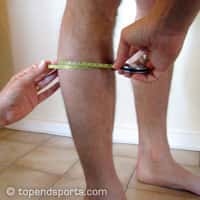
Proper tape placement for calf girth measurement
Procedure: This girth measurement is typically taken on the right side of the body. The subject stands erect with their weight evenly distributed on both feet and legs slightly apart. The measurement is taken at the level of the largest circumference of the calf. The maximal girth is not always obvious, and the tape may need to be moved up and down to find the point of maximum circumference. When recording, ensure the tape is not too tight or too loose, is lying flat on the skin, and is horizontal. It may help to have the subject stand on a box to make the measurement easier.
Reliability: Factors that may affect reliability include changes to the testing personnel, constant and even tension on the tape, and correct landmarking (finding the correct anatomical site for measurement).
Advantages: Low costs involved in the testing procedure, ease of self-testing, and no specialized equipment required beyond a tape measure.
Pro Tip: Clothing over the site should be removed if possible to ensure the measuring tape is positioned correctly and that the correct circumference is determined. For athletes monitoring training progress, measure at the same time of day for consistency.
Understanding Your Calf Girth Results
Interpreting calf girth measurements requires understanding both absolute values and proportional relationships. The calf-to-height ratio provides a normalized measure that accounts for overall body size, making it more useful for comparison across individuals of different heights.
| Classification | Male Calf Girth | Female Calf Girth | Calf-to-Height Ratio |
|---|---|---|---|
| Below Average | < 33 cm (13") | < 30 cm (12") | < 0.19 |
| Average | 33-38 cm (13-15") | 30-35 cm (12-14") | 0.19-0.22 |
| Above Average | 38-42 cm (15-16.5") | 35-38 cm (14-15") | 0.22-0.25 |
| Athletic | 42-46 cm (16.5-18") | 38-42 cm (15-16.5") | 0.25-0.28 |
| Elite Athletic | > 46 cm (18"+) | > 42 cm (16.5"+) | > 0.28 |
"Calf circumference is one of the most reliable anthropometric measures for assessing lower limb muscle mass. For athletes, monitoring calf girth alongside training load provides valuable insight into muscular adaptation and helps identify potential imbalances between limbs."— Robert J. Wood, PhD, Sports Scientist and Founder of Topend Sports
Sport-Specific Calf Development
Different sports place varying demands on calf musculature, leading to distinct patterns of calf development among athletes:
Cycling
Cyclists typically develop substantial calf muscle due to repetitive plantarflexion during pedaling. Track cyclists may have calf girths 15-20% above average due to explosive power requirements.
Sprinting
Sprinters require powerful calf muscles for explosive push-off. Elite sprinters often show calf-to-height ratios above 0.25, reflecting their need for maximum force production.
Weightlifting
Olympic weightlifters and powerlifters develop significant calf mass through heavy squatting movements and explosive triple extension during lifts.
Basketball
Basketball players require well-developed calves for jumping ability. The repetitive jumping and lateral movements contribute to calf hypertrophy.
Factors Affecting Calf Girth
Several factors influence calf circumference beyond training status:
- Genetics: Muscle fiber composition and insertion points significantly affect calf size potential
- Training history: Years of resistance training and sport-specific activity
- Body composition: Both muscle mass and subcutaneous fat contribute to girth measurements
- Hydration status: Fluid retention can temporarily increase measurements
- Time of day: Measurements may vary by 1-2% throughout the day due to fluid shifts
- Recent exercise: Post-exercise swelling can increase measurements temporarily
Training to Improve Calf Development
Athletes seeking to increase calf girth for performance or aesthetic purposes should consider the following training approaches:
| Training Goal | Exercise Selection | Sets × Reps | Frequency |
|---|---|---|---|
| Strength | Standing calf raises, seated calf raises | 4-6 × 4-8 | 2-3× per week |
| Hypertrophy | Varied calf raises, donkey calf raises | 3-4 × 8-15 | 2-3× per week |
| Endurance | Single-leg calf raises, jump rope | 3 × 15-25 | 3-4× per week |
| Power | Plyometric hops, depth jumps | 3-4 × 6-10 | 2× per week |
Asymmetry Assessment
Comparing calf girth between left and right legs can reveal important information about muscle imbalances that may affect performance or injury risk. An asymmetry greater than 5% between limbs warrants attention and may indicate:
- Previous injury affecting muscle development
- Unilateral sport demands (e.g., dominant leg in kicking sports)
- Compensatory patterns from other injuries
- Nerve or circulation issues requiring medical attention
Frequently Asked Questions
What is a good calf girth measurement for athletes?
Average calf girth for adult males ranges from 35-40 cm (14-16 inches) and for females 32-38 cm (12.5-15 inches). Athletes in sports requiring explosive leg power, such as sprinting, cycling, and weightlifting, typically have larger calf measurements due to increased muscle development. Elite athletes may exceed 45 cm for males and 40 cm for females.
How do I measure my calf girth accurately?
Stand erect with weight evenly distributed on both feet. Use a flexible measuring tape at the widest part of your calf muscle, typically about one-third down from the knee. Keep the tape horizontal and snug but not compressing the tissue. Measure both legs and note any asymmetry that may indicate muscle imbalances.
What is the calf-to-height ratio and why does it matter?
The calf-to-height ratio compares your calf circumference to your height, providing a proportional measure independent of overall body size. A ratio of 0.20-0.25 is typical for adults, with athletes often showing higher ratios due to muscular development. This ratio allows for meaningful comparison across individuals of different heights.
Can calf girth indicate health or fitness level?
Calf girth can be an indicator of lower body muscle mass and has been associated with physical function, particularly in older adults. Research suggests that adequate calf muscle mass is important for balance, mobility, and metabolic health. However, calf girth alone should not be used as a sole health indicator.
How often should I measure my calf girth?
For tracking training progress, measure monthly. Measure at the same time of day (preferably morning before training) for consistency. Record measurements from both legs to identify any asymmetry that may need addressing. Changes of 0.5 cm or more typically indicate meaningful adaptation.
Why might my left and right calf measurements be different?
Small differences (1-2%) between calves are normal due to limb dominance. Larger asymmetries may result from previous injuries, sport-specific demands, or compensatory movement patterns. If asymmetry exceeds 5%, consider consulting a sports medicine professional to evaluate for underlying issues.
Does calf size affect running performance?
Calf muscle development influences running economy and power output during push-off. However, larger calves also mean more mass to carry during running. Elite distance runners often have proportionally smaller calves than sprinters, as they prioritize efficiency over maximum power production.
Similar Tests
Related Pages
Girth Measurements Overview
General description of taking girth measurements and links to other girth testing sites.
View Girth Tests →Body Size Testing
Discussion about body size testing methods and their applications in sports science.
Learn More →MyoTape Measurement Tool
Using MyoTape for accurate and consistent girth measurements.
View Product →References
- Norton, K., & Olds, T. (2001). "Anthropometrica: A Textbook of Body Measurement for Sports and Health Courses." UNSW Press.
- Marfell-Jones, M.J., et al. (2006). "International Standards for Anthropometric Assessment." ISAK.
- American College of Sports Medicine. (2021). "ACSM's Guidelines for Exercise Testing and Prescription." 11th Edition.
- Heyward, V.H., & Wagner, D.R. (2004). "Applied Body Composition Assessment." Human Kinetics.
- Abe, T., et al. (2014). "Calf and thigh muscle cross-sectional areas and physical function in older adults." Medicine and Science in Sports and Exercise, 46(3), 413-419.
- Kuriyan, R. (2018). "Body composition techniques." Indian Journal of Medical Research, 148(5), 648-658.
- Wang, Z.M., et al. (2000). "The five-level model: a new approach to organizing body-composition research." American Journal of Clinical Nutrition, 56(1), 19-28.
Medical Disclaimer: This calculator provides estimates for educational and athletic training purposes only. Results should not replace professional medical advice. Always consult with a qualified healthcare provider or sports medicine professional before making health or training decisions based on these calculations. Individual results may vary based on factors not included in this calculation.
 Any comments, suggestions, or corrections? Please let us know.