Arm Relaxed Girth Calculator
Quick Answer
This calculator analyzes your relaxed arm girth measurement, comparing it to population data and athletic standards to determine your percentile ranking and muscular development category.
- Instantly converts between cm and inches
- Based on CDC NHANES anthropometric reference data
- Compares to sport-specific athletic standards
Girths are circumference measures at standard anatomical sites around the body. The relaxed arm girth measurement is a measure of the circumference of the upper arm when the biceps is relaxed. See the list of girth measurement locations.
Purpose: To measure the circumference of the arm, as a measure of the underlying musculature and adipose tissue. Girth measurements combined with skinfold measurements can give a clearer picture of changes in tissue composition and distribution of muscle and fat.
How to Measure Arm Relaxed Girth
Equipment required: flexible metal tape measure and pen suitable for marking the skin. If a plastic or cloth tape is used, it should be checked regularly against a metal tape as they may stretch over time.
Pre-test: Explain the test procedures to the subject. Prepare forms and record basic information such as age, height, body weight, gender. See more details of pre-test procedures.
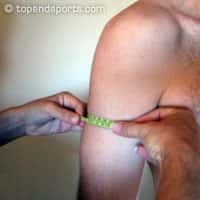
Procedure: First mark the site to be measured. This girth measurement is usually taken on the right side of the body. The arm is relaxed and hanging by the side, and the circumference is taken at the level of the mid-point between the acromion (boney point of shoulder) and the olecranon (boney point of elbow) processes. When recording, you need to make sure the tape is not too tight or too loose, is lying flat on the skin, and is horizontal.
Reliability: Factors that may affect reliability include changes to the testing personnel, constant and even tension on the tape, and correct landmarking (finding the correct anatomical site for measurement).
Advantages: Low costs involved in the testing procedure.
Comments: Clothing over the site should be removed if possible to make sure measuring tape is positioned correctly and that the correct circumference is determined.
Understanding Your Arm Girth Results
Arm girth measurements provide valuable insights into body composition and muscular development. The mid-upper arm circumference (MUAC) reflects the combined size of the biceps, triceps, and underlying bone, along with subcutaneous fat tissue.
Average Arm Circumference by Age and Gender
| Age Group | Males (cm) | Males (inches) | Females (cm) | Females (inches) |
|---|---|---|---|---|
| 20-29 | 32.3 | 12.7 | 30.0 | 11.8 |
| 30-39 | 33.0 | 13.0 | 31.5 | 12.4 |
| 40-49 | 33.3 | 13.1 | 32.0 | 12.6 |
| 50-59 | 33.2 | 13.1 | 32.8 | 12.9 |
| 60-69 | 32.8 | 12.9 | 32.2 | 12.7 |
| 70+ | 31.0 | 12.2 | 30.5 | 12.0 |
Source: CDC National Health and Nutrition Examination Survey (NHANES) data
Athletic Standards for Arm Girth
Athletes typically have larger arm circumferences than the general population due to increased muscle mass from training. Here are sport-specific benchmarks:
| Athletic Category | Male Range (cm) | Female Range (cm) |
|---|---|---|
| General Population (Average) | 30-34 | 28-32 |
| Recreational Athlete | 34-38 | 30-34 |
| Competitive Athlete | 38-42 | 32-36 |
| Elite Strength Athlete | 42-48 | 34-40 |
| Professional Bodybuilder | 48-55+ | 38-45+ |
The Science Behind Arm Girth Measurement
Mid-upper arm circumference (MUAC) has been extensively studied and validated as an indicator of body composition and nutritional status. Research published in the American Journal of Clinical Nutrition demonstrates that MUAC correlates strongly with total body muscle mass and can be used to track changes in lean tissue over time.
The measurement captures both the biceps brachii (anterior) and triceps brachii (posterior) muscles, along with the humerus bone and subcutaneous adipose tissue. For a more accurate assessment of muscle mass alone, arm girth can be combined with triceps skinfold thickness using the formula:
This derived measurement provides a more accurate estimate of arm muscle mass by mathematically removing the fat layer contribution.
Sport-Specific Applications
Different sports have varying optimal ranges for arm girth based on performance requirements:
Strength Sports
Powerlifting, weightlifting, and strongman athletes typically have the largest arm measurements (40-50+ cm) due to heavy resistance training targeting arm muscles.
Combat Sports
Boxers, wrestlers, and MMA fighters balance arm size with weight class requirements. Arm measurements vary significantly by weight division (32-45 cm).
Team Sports
Football, rugby, and basketball players typically range from 35-42 cm depending on position. Linemen and forwards tend toward higher measurements.
Endurance Sports
Runners, cyclists, and swimmers generally have smaller arm measurements (28-35 cm) as excess upper body mass can be detrimental to performance.
How to Improve Your Arm Measurements
If your goal is to increase arm girth for athletic or aesthetic purposes, consider these evidence-based strategies:
- Progressive Resistance Training: Focus on compound movements (rows, presses, pull-ups) and isolation exercises (curls, triceps extensions) with progressive overload.
- Adequate Protein Intake: Consume 1.6-2.2 g/kg body weight of protein daily to support muscle protein synthesis.
- Training Volume: Research suggests 10-20 sets per muscle group per week optimizes hypertrophy for most individuals.
- Recovery: Allow 48-72 hours between intense arm training sessions for optimal muscle repair and growth.
- Track Progress: Measure arm girth every 2-4 weeks at the same time of day to monitor development.
Frequently Asked Questions
What is a good relaxed arm girth measurement?
For adult males, the average relaxed arm girth is approximately 32-34 cm (12.6-13.4 inches). Values above 38 cm indicate above-average muscular development, while measurements exceeding 42 cm are typically seen in competitive strength athletes.
How do you measure arm girth correctly?
Stand with your arm relaxed at your side. Find the midpoint between your shoulder (acromion) and elbow (olecranon) processes. Wrap a flexible tape measure horizontally around the arm at this point, ensuring the tape is snug but not compressing the tissue. Record to the nearest millimeter.
What is the difference between relaxed and flexed arm girth?
Relaxed arm girth measures the arm in a neutral hanging position, while flexed arm girth is taken with the biceps contracted and elbow bent at approximately 90 degrees. Flexed measurements are typically 1-3 cm larger than relaxed measurements, depending on muscle development.
How often should I measure my arm girth for tracking progress?
For monitoring training progress, measure every 2-4 weeks. Take measurements at the same time of day, preferably in the morning before training, under consistent conditions. Record both arms and track the average over time.
Does arm circumference indicate muscle mass or fat?
Arm circumference reflects both muscle and subcutaneous fat tissue. To distinguish between them, combine girth measurements with triceps skinfold measurements. This allows calculation of arm muscle circumference, providing a more accurate estimate of lean tissue.
Why measure the relaxed arm instead of flexed?
Relaxed measurements provide more consistent and reproducible results since there's no variability in muscle contraction intensity. Clinical and research settings predominantly use relaxed measurements for standardization. Flexed measurements are useful for bodybuilding comparisons.
Can arm girth predict overall muscle mass?
Research shows moderate correlation between mid-upper arm circumference and total body muscle mass. However, arm girth alone cannot precisely predict whole-body composition. It serves as a useful screening tool and progress tracker when combined with other measurements.
References
- Fryar CD, Gu Q, Ogden CL, Flegal KM. (2016). "Anthropometric Reference Data for Children and Adults: United States, 2011-2014." National Center for Health Statistics, Vital Health Stat.
- Santos DA, Dawson JA, Matias CN, et al. (2014). "Reference Values for Body Composition and Anthropometric Measurements in Athletes." PLoS One; 9(5): e97846.
- Heymsfield SB, McManus C, Smith J, Stevens V, Nixon DW. (1982). "Anthropometric measurement of muscle mass: revised equations for calculating bone-free arm muscle area." Am J Clin Nutr; 36: 680-690.
- World Health Organization. (2007). "WHO Child Growth Standards: Methods and Development." Geneva: WHO.
- Frisancho AR. (1990). "Anthropometric Standards for the Assessment of Growth and Nutritional Status." Ann Arbor: University of Michigan Press.
Similar Tests
- See the similar flexed arm girth measurement
- Forearm Girth
Related Pages
- General description of taking girth measurements, and links to other girth measures
- A discussion about Body Size Testing.
- Using MyoTape for girth measurement.
- Other anthropometric tests
- Videos of Anthropometric Tests.
 Any comments, suggestions, or corrections? Please let us know.