Figure-of-Eight Agility Run Test Calculator
Quick Answer
This calculator instantly scores your figure-of-eight agility run test performance based on your completion time. Enter your fastest trial time to receive your performance category, percentile ranking, and personalized training recommendations.
- Calculates agility performance rating from Elite to Poor
- Based on ALPHA-FIT test protocol standards
- Provides sport-specific benchmarks and training guidance
The figure-of-eight agility test is a validated measure of agility and lower extremity muscular power that assesses an athlete's ability to maneuver around obstacles while running at maximum speed. This simple yet effective test involves sprinting around two cones placed 10 meters apart in a figure-8 pattern, making it ideal for field testing in various sports settings.
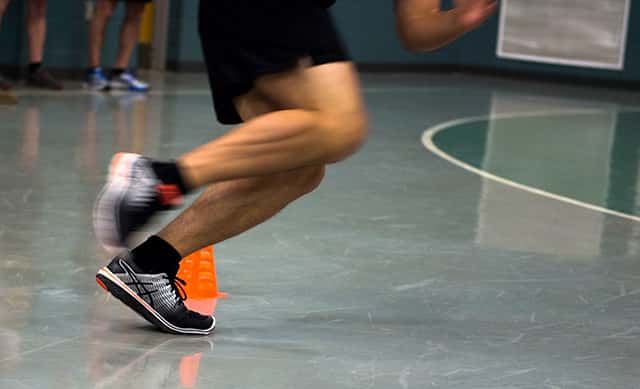
Agility Test: Demonstrating proper cone turning technique
Test Purpose and Applications
The figure-of-eight agility run test serves multiple purposes in athletic assessment. Its primary function is to measure an athlete's ability to change direction rapidly while maintaining speed and control. The test evaluates several key physical attributes including acceleration, deceleration, balance during turns, and lower body power output during direction changes.
This agility assessment is particularly valuable for sports requiring frequent directional changes such as soccer, basketball, tennis, rugby, and American football. Coaches and sports scientists use the test to establish baseline measurements, track training progress, identify athletes needing targeted agility work, and compare performance against sport-specific benchmarks.
Equipment and Setup Requirements
Essential Equipment
• Two marker cones
• Stopwatch or timing system
• Measuring tape (10 meters)
• Non-slip surface area
Course Setup
• Distance between cones: 10 meters
• Start/finish line beside first cone
• Clear running area on both sides
• Flat, dry surface required
Testing Conditions
• Indoor or outdoor setting
• Standardized footwear
• Adequate warm-up completed
• 2-3 minute rest between trials
Complete Test Procedure
Pre-test preparation: Explain the test procedures to the participant. Perform health risk screening and obtain informed consent. Record basic information including age, height, body weight, gender, and test conditions. Measure and mark out the course ensuring the 10-meter distance is accurate. Ensure participants complete an adequate warm-up including dynamic stretching and practice direction changes. See more details of pre-test procedures.
Test execution: Two cones are placed 10 meters apart with the start/finish line positioned next to one of the cones. The participant starts at the first cone in a ready position. On the command "go," the timer starts and the participant sprints to the second cone, runs around it (turning direction is typically left first), returns to the first cone, runs around it, and then crosses the start/finish line. The path creates a figure-8 pattern when viewed from above.
Trial protocol: One practice trial should be performed first to ensure the participant understands the course pattern. Following adequate recovery, two test trials with maximal effort are performed with 2-3 minutes rest between each trial. All turns should be made as tightly as possible while maintaining balance and speed.
Scoring: The stopwatch starts with the "go" command and stops when the participant crosses the start/finish line. Record times to the nearest 0.01 seconds. The fastest time of the two test trials is recorded as the official score. Times are then compared against normative data for interpretation.
Performance Standards and Normative Data
The following normative data tables provide performance benchmarks for the figure-of-eight agility test. These standards are derived from athletic population studies and the ALPHA-FIT test protocol research.
Male Performance Standards (seconds)
| Rating | 18-29 years | 30-39 years | 40-49 years | 50+ years |
|---|---|---|---|---|
| Elite | < 7.0 | < 7.5 | < 8.0 | < 9.0 |
| Excellent | 7.0 - 7.5 | 7.5 - 8.0 | 8.0 - 8.5 | 9.0 - 9.5 |
| Good | 7.5 - 8.5 | 8.0 - 9.0 | 8.5 - 9.5 | 9.5 - 10.5 |
| Average | 8.5 - 9.5 | 9.0 - 10.0 | 9.5 - 10.5 | 10.5 - 11.5 |
| Below Average | 9.5 - 10.5 | 10.0 - 11.0 | 10.5 - 11.5 | 11.5 - 12.5 |
| Poor | > 10.5 | > 11.0 | > 11.5 | > 12.5 |
Female Performance Standards (seconds)
| Rating | 18-29 years | 30-39 years | 40-49 years | 50+ years |
|---|---|---|---|---|
| Elite | < 8.0 | < 8.5 | < 9.0 | < 10.0 |
| Excellent | 8.0 - 8.5 | 8.5 - 9.0 | 9.0 - 9.5 | 10.0 - 10.5 |
| Good | 8.5 - 9.5 | 9.0 - 10.0 | 9.5 - 10.5 | 10.5 - 11.5 |
| Average | 9.5 - 10.5 | 10.0 - 11.0 | 10.5 - 11.5 | 11.5 - 12.5 |
| Below Average | 10.5 - 11.5 | 11.0 - 12.0 | 11.5 - 12.5 | 12.5 - 13.5 |
| Poor | > 11.5 | > 12.0 | > 12.5 | > 13.5 |
Sport-Specific Applications
Different sports have varying agility demands, and the figure-of-eight test can help identify sport-specific strengths and weaknesses.
Soccer and Football
Soccer players typically need elite agility scores to evade defenders and make rapid directional changes during dribbling. Midfielders and wingers often score better than goalkeepers and center-backs due to positional demands. Elite male soccer players typically complete the test in 7.0-7.5 seconds.
Basketball and Volleyball
Court sport athletes benefit from strong agility for defensive positioning and transition plays. Guards in basketball and outside hitters in volleyball typically demonstrate superior agility scores compared to centers and middle blockers.
Tennis and Racquet Sports
Tennis players require exceptional change-of-direction ability for court coverage. The figure-8 pattern closely mimics the lateral and forward-backward movements common in baseline rallies. Professional tennis players often achieve elite-level scores.
Combat Sports
Wrestlers, boxers, and MMA athletes use the test to assess footwork agility essential for both offensive and defensive movements. Lightweight athletes typically score better than heavyweights due to the power-to-weight ratio advantage.
How to Improve Your Figure-of-Eight Agility Score
Improving agility performance requires a comprehensive approach targeting multiple physical qualities.
Speed and Acceleration Training
Include short sprint intervals (10-20 meters) with emphasis on explosive starts. Resisted sprints using sleds or bands can improve acceleration power. Perform 6-10 repetitions with full recovery between sets.
Change of Direction Drills
Practice various cone drills including T-drills, pro agility shuttles, and ladder exercises. Focus on proper deceleration mechanics and efficient turning technique. The figure-8 drill itself can be used for training with variations in cone distance.
Lower Body Strength and Power
Develop leg strength through squats, lunges, and step-ups. Add plyometric exercises like box jumps, lateral bounds, and depth jumps to improve reactive power. Single-leg exercises address any bilateral strength imbalances.
Core Stability
A strong core enables faster direction changes by maintaining body control during turns. Include planks, anti-rotation exercises, and rotational movements in your training program.
Test Validity and Reliability
The figure-of-eight agility run test has been validated as part of the ALPHA-FIT test battery for adults aged 18-69 years. The test demonstrates good test-retest reliability (ICC > 0.85) when standardized protocols are followed. Studies have shown strong correlation with other agility measures including the Illinois Agility Test and T-Test.
Factors that may affect test reliability include surface conditions, footwear consistency, warm-up adequacy, and timing precision. Using electronic timing gates can improve measurement accuracy compared to manual stopwatch timing.
Advantages and Limitations
Advantages
• Simple setup with minimal equipment
• Quick administration time
• Suitable for large group testing
• Validated protocol (ALPHA-FIT)
• Sport-relevant movement patterns
Limitations
• Pre-planned route (no reactive component)
• Surface conditions affect results
• Manual timing introduces error
• Does not test all agility components
• Limited normative data availability
Frequently Asked Questions
What is a good time for the figure-of-eight agility test?
For adult males aged 18-29, a good time is between 7.5-8.5 seconds, with elite athletes completing it under 7.0 seconds. Adult females in the same age range should aim for 8.5-9.5 seconds, with elite performers under 8.0 seconds. Times naturally increase with age, so always compare against age-appropriate norms.
How is the figure-of-eight test different from other agility tests?
The figure-of-eight test specifically measures agility with two 180-degree turns around cones 10 meters apart. Unlike the Illinois test (multiple direction changes) or T-test (lateral movement focus), this test emphasizes curved running paths and tight turning ability. It is simpler to set up but tests different movement patterns.
Can I use this test for youth athletes?
Yes, the figure-of-eight test can be used with youth athletes aged 10 and above. However, adult normative data should not be applied directly to younger populations. Youth athletes will naturally improve as they develop physically through adolescence. Track individual progress over time rather than comparing against adult standards.
How often should I test my agility?
For most athletes, testing every 8-12 weeks provides meaningful data for tracking progress. Testing too frequently may not show significant changes due to the time needed for training adaptations. Key testing points include pre-season baseline, mid-season check, and post-season assessment.
Does turning direction (left vs right) affect results?
Most athletes show slight differences when turning to their dominant versus non-dominant side. The standard protocol specifies turning left first, but testing both directions can reveal bilateral asymmetries worth addressing in training. A difference greater than 0.5 seconds between directions may indicate an imbalance.
What factors most affect figure-of-eight performance?
Key factors include lower body power, acceleration ability, deceleration mechanics, turning technique, body composition, and footwear grip. Environmental factors like surface type, temperature, and footwear also play significant roles. Proper warm-up typically improves performance by 5-10%.
Is the figure-of-eight test valid for return-to-play decisions?
The test can be one component of return-to-play assessment, but should not be used in isolation. Athletes should achieve at least 90% of their pre-injury performance before clearance. Combine with sport-specific movement tests and medical clearance for comprehensive return-to-play decisions.
References
- Suni, J., Husu, P., & Rinne, M. (2009). Fitness for Health: The ALPHA-FIT Test Battery for Adults Aged 18–69. European Union, DG SANCO, and UKK Institute for Health Promotion Research.
- Ruiz, J.R., et al. (2011). Field-based fitness assessment in young people: the ALPHA health-related fitness test battery for children and adolescents. British Journal of Sports Medicine, 45(6), 518-524.
- Sheppard, J.M., & Young, W.B. (2006). Agility literature review: Classifications, training and testing. Journal of Sports Sciences, 24(9), 919-932.
- Young, W.B., James, R., & Montgomery, I. (2002). Is muscle power related to running speed with changes of direction? Journal of Sports Medicine and Physical Fitness, 42(3), 282-288.
- Nimphius, S., Callaghan, S.J., & Lockie, R.G. (2018). Change of direction and agility tests: Challenging our current measures of performance. Strength and Conditioning Journal, 40(1), 26-38.
- Haff, G.G., & Triplett, N.T. (2015). Essentials of Strength Training and Conditioning (4th ed.). Human Kinetics.
- Hoffman, J. (2006). Norms for Fitness, Performance, and Health. Human Kinetics.
The Test in Action
- This agility test is part of the ALPHA-FIT test protocol for adults.
- Used by sports science laboratories and athletic programs worldwide for baseline and progress monitoring.
- Commonly administered during pre-season fitness testing and return-to-play protocols.
Similar Tests
- Lane Agility Drill (basketball)
- AFL Agility Test
- Zig-Zag Test
- Illinois Agility Test
- Balsom Agility Run (soccer)
Related Pages
- Other agility fitness tests
- About the ALPHA-FIT test protocol for adults
 Any comments, suggestions, or corrections? Please let us know.