Russia at the Olympics
Russian athletes first competed at the Olympic Games in 1900, then in 1908 and 1912, competing as part of the Russian Empire. It was not until 1952 that they again appeared at the Olympic Games, this time as part of the team from the Soviet Union. After the break up of the USSR in 1991, Russian athletes competed as part of the Unified Team at the 1992 Games, then as Russia again in 1996 and ever since.
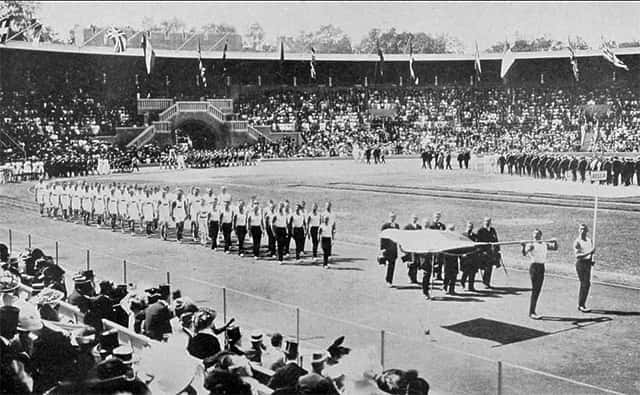 The Russian Empire team at the 1912 Olympic Games opening ceremony (from the Official Report)
Competing as the Soviet Union, the nation finished first overall in the medal tally in 1956, 1960, 1972, 1976 and 1980 and second in 1952, 1964 and 1968.
Competing as Russia
Russia remained a major Olympic power after 1996, finishing in the top four at every Summer Games up to Rio. They were second in 1996 and 2000, third in 2004 and 2008, and fourth in 2012 and 2016, before finishing fifth at the Tokyo Games of 2021, where the team competed under the ROC designation and won 71 medals.
Note that the placings for 2008 and 2012 in particular have shifted over the years as medals have been reallocated following retrospective drug testing of stored samples.
| Games | Gold | Silver | Bronze | Total |
|---|---|---|---|---|
| Summer Olympics | 147 | 125 | 150 | 422 |
| Winter Olympics | 45 | 39 | 34 | 118 |
| Combined | 192 | 164 | 184 | 540 |
These are the medals credited to Russia as a separate nation. They do not include the much larger hauls of the Russian Empire, the Soviet Union or the Unified Team, which are counted separately.
Notable Russian athletes include Evgeniya Kanaeva, the first gymnast to win the rhythmic individual all-around at two Olympics, in 2008 and 2012, and the women's rhythmic group, which won the group all-around at five successive Games from 2000 to 2016 before Bulgaria took the title in Tokyo.
Sanctions and Neutral Status
Russian track and field athletes were barred from the 2016 Rio Olympics by the sport's world governing body, then the IAAF and now World Athletics, following revelations of state-sponsored doping. In 2017 the IOC suspended the Russian Olympic Committee itself, and Russian competitors have not marched under their own flag at an Olympic Games since. They appeared as Olympic Athletes from Russia at the 2018 Winter Games, and as the ROC at Tokyo in 2021 and at the Beijing Winter Games of 2022, in each case without the Russian flag or anthem.
Following the invasion of Ukraine in 2022, the terms were tightened further. For Paris 2024 the IOC allowed a small number of athletes from Russia and Belarus to take part as Individual Neutral Athletes, under the abbreviation AIN. They had to pass a background check and be approved both by their international federation and by an IOC panel, could not enter team events, did not march in the opening ceremony, used a neutral flag and anthem, and did not appear in the medal table.
Thirty-two athletes competed under that banner in Paris, 15 of them Russian, and they won five medals between them. The only one won by a Russian was the women's doubles tennis silver taken by Mirra Andreeva and Diana Shnaider. The same arrangement applied at the Milano Cortina Winter Games in 2026, where 20 neutral athletes took part, 13 of them Russian, and the ski mountaineer Nikita Filippov won a silver in the men's sprint.
Trivia
- The Grand Duchy of Finland was part of the Russian Empire in 1908 and 1912, though their results are considered separately.
- Russia have hosted the Olympic Games twice, the Summer Games in Moscow in 1980 and the Winter Games in Sochi in 2014. Moscow 1980 was the first Olympics held in a communist country, and was marred by a US-led boycott that cut the number of participating countries.
- In 2000, Russian gymnast Alexei Nemov took home six medals, as he had done in Atlanta in 1996 four years earlier – twelve in all, though only four of them gold.
- The best all-time performing artistic swimmer at the Olympic Games is the Russian Svetlana Romashina who has won seven gold medals, in the team event in 2008 and in both the duet and the team in 2012, 2016 and 2021.
Related Pages
- Russia at the Winter Olympics
- Russia at the Paralympics
- Information about the Soviet Union at the Olympics
- More trivia from each Country at the Olympic Games
- Belarus at the Olympic Games
- 1980 Olympic Games in Moscow
- About Sport in Russia
 Any comments, suggestions, or corrections? Please let us know.