


10 & 30-second Tri-level anaerobic Tests
The Tri-Level fitness testing battery involves a 10-second, 30-second and aerobic sub-maximal cycle test. The first two, which are tests of anaerobic fitness, are described here. See the separate page for the Tri-level Aerobic Test.
equipment required: Repco front access cycle ergometer (which uses air resistance to modify workload), work monitor unit, stopwatch, weight scales to record participants mass.
pre-test: Explain the test procedures to the subject. Perform screening of health risks and obtain informed consent. Prepare forms and record basic information such as age, height, body weight, gender, test conditions. Calibrate the cycle ergometer. Adjust seat and handlebar height to suit the subject. Ensure that the participants are adequately warmed-up. See more details of pre-test procedures.
procedure: The subject is instructed to pedal as fast as possible for 10 or 30 seconds. The feet must the firmly strapped onto the pedal to enable maximal power output. Strong verbal encouragement will help the subject achieve their maximal score. For the 10 second test, you may want to give the athlete two attempts, with five minutes break between, and record the best effort. Latest model recording units can record power and work output every second, with older units work output can be recorded manually at selected time intervals.
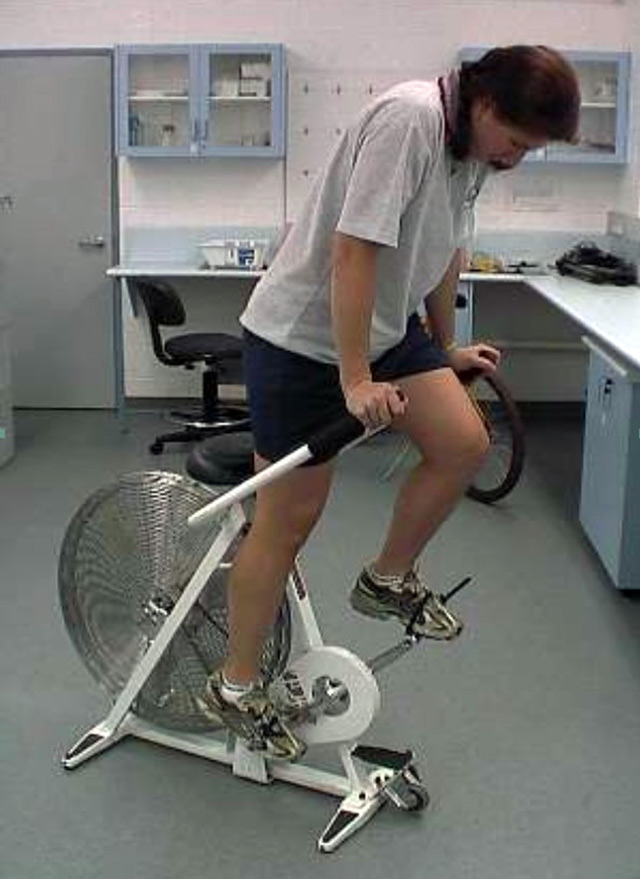 cycle ergometer test
scoring: The measurements that can be gained from the work monitor unit are total work (Alactic Work Index) and peak power (Alactic Power Index), and for the 30 second test (Lactic Work Index) a fatigue index can be calculated from the decline in power throughout the test. Peak power and total work scores can be divided by body weight for relative scores, and norm tables are available for these tests.
references:
- Minikin, B., 1990, Hints for interpreting the Tri-level profile of general fitness, in Sports Coach, Vol.13, No. 3, p21.
- Telford, R.D., Minikin, B.R., Hahn, A.G., & Hooper, L.A., 1989. A simple method for the assessment of general fitness: The Tri-level profile. Australian Journal of Science and Medicine in Sport, 21 (3): p6-9.
Similar Tests
- Wingate Cycle Test — a cycle test of anaerobic leg power, maximal effort over 30 seconds.
- Cycling Repeat Sprint Test — a cycle test of anaerobic capacity, involving 5 x 6 second efforts.
- 40 m cycle sprint — maximal cycling speed test.
- Tri-level Aerobic Test — cycle in one minute increments of 25 Watts until their heart rate reaches 75% of max.
Related Pages
- Fitness tests for cyclists
- Cycling Fitness Tests, assessments involving cycling exercise
- See the list of anaerobic tests for similar fitness tests.
- Comparison of Cycle Ergometers
- See also the similar Wingate Test of leg power.
- About Intermittent Sports Fitness Testing.
 Any comments, suggestions, or corrections? Please let us know.
 Current Events