


Sit and Reach Flexibility Test
The sit and reach test is a common measure of flexibility, and specifically it measures the flexibility of the lower back and hamstring muscles. This test is important as because tightness in this area is implicated in lumbar lordosis, forward pelvic tilt and lower back pain. This test was first described by Wells and Dillon (1952) and is now widely used as a general test of flexibility.
About Sit and Reach Test Variations
The sit and reach test measures flexibility by having a person sit with their legs straight and reaching forward as far as possible. The distance reached is recorded to assess flexibility, with longer reaches indicating greater flexibility. There are a few variations of the test. Many of the variations of this test involve the differences in how the measurement value is recorded.
The most logical measure how far the participant reaches forward is to use the level of the feet as level zero, so that any measure that does not reach the toes is negative, and any reach past the toes is positive (such as for PRT Sit and Reach for the Navy). However, using negative values is more difficult for statistical analysis, and for comparing results. The procedure for the Presidents Challenge version requires that the box is made with the scale moved so that 9 inches (23 cm) is at the level of the feet, so for example reaching two inches past the toes is recorded as 11 inches. The Eurofit manual suggests having 15cm at the level of the feet, and also 10 inches has been used (NHL combine testing).
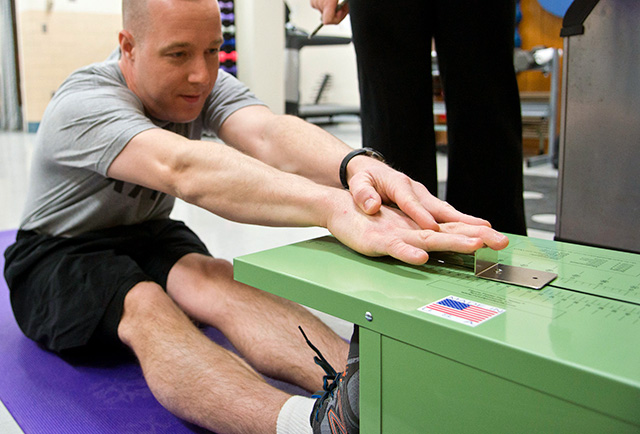 Sit and Reach Flexibility Test
A limitation of the traditional sit and reach procedure is that people with long arms and/or short legs would get a better result, while those with short arms and/or long legs are at a disadvantage. The modified sit and reach test controls for this, as the zero mark is adjusted for each individual, based on their sitting reach level.
The traditional sit and reach procedure also measures the combined flexibility of the legs. The Back-Saver Sit and Reach, as as used by Fitnessgram Program, tests one leg at a time. In the Chair Sit and Reach Test, designed for testing the elderly, the dominant leg is tested while the subject sits on a chair and leans forward.
If you do not have a specifically made sit and reach box, you can use any box, crate or step with a long ruler (make your own). You can follow the description of the Sit and Reach at home, a simple version that can be done with minimal equipment, or the V-Sit Flexibility Test, similar to the sit and reach though it uses a line on the ground instead of a box.
There are similar flexibility tests not performed while sitting. The Kraus-Weber Floor Touch Test, toe touch and Schober test all measure flexibility of the lower back and hamstrings, while standing and leaning forward.
Sit & Reach Test Procedure
The basic outline of the sit and reach test is described below. Some of the more popular variations are described in more detail above.
equipment required: sit and reach box (or alternatively a ruler can be used, and a step or box).
procedure: This test involves sitting on the floor with legs stretched out straight ahead. Shoes should be removed. The soles of the feet are placed flat against the box. Both knees should be locked and pressed flat to the floor - the tester may assist by holding them down. With the palms facing downwards, and the hands on top of each other or side by side, the subject reaches forward along the measuring line as far as possible. Ensure that the hands remain at the same level, not one reaching further forward than the other. After some practice reaches, the subject reaches out and holds that position for at least one-two seconds while the distance is recorded. Make sure there are no jerky movements. See also video demonstrations of the Sit and Reach Test.
scoring: The score is recorded to the nearest centimeter or half inch as the distance reached by the hand. Some test versions use the level of the feet as the zero mark, while others have the zero mark 9 inches before the feet. There is also the modified sit and reach test which adjusts the zero mark depending on the arm and leg length of the subject. There are some norms for the sit and reach test and also examples of some actual athlete results.
validity: This test only measures the flexibility of the lower back and hamstrings, and is a valid measure of this.
reliability: The reliability of this test will depend on the amount of warm-up that is allowed, and whether the same procedures are followed each time the test is conducted. Most sit and reach testing norms are based on no previous warm-up, though the best results will be achieved after a warm up or if the test is proceeded by a test such as the endurance test which can act as a warm up. If a warm up is used, it is important to have a standardized warm up and test order and repeat the same conditions for each time the test is conducted.
advantages: The sit and reach test is a common test of flexibility, and is an easy and quick test to perform. If using the standard testing procedure, there is a lot of published data to use for comparison.
disadvantages: Variations in arm, leg and trunk length can make comparisons between individuals misleading. This test is specific to the range of motion and muscles and joints of the lower back and hamstrings, and may not be relevant to other parts of the body.
References
- Wells, K.F. & Dillon, E.K. (1952). The sit and reach. A test of back and leg flexibility. Research Quarterly, 23. 115-118.
Similar Tests
- Sit and Reach Test variations:
- sit & reach — Presidents Challenge version.
- sit & reach — for the Navy Physical Readiness Test (PRT).
- sit & reach — simple version for fitness testing at home.
- sit & reach — backsaver version, testing each leg separately
- sit & reach — chair version
- Modified Sit and Reach
- V-Sit test — no box required
- Toe Touching Variations:
- Kraus-Weber Floor Touch Test — can the subject touch their toes for 10 seconds?
- Toe Touch — measure distance from fingertips to ground.
- Schober test — measures the flexibility of the lumbar spine based on the stretching of the skin over the lumbar spine while bending forwards.
- Stand & Reach — stand on a raised surface and bend forwards with straight legs. Measure how far past the toes the finger can reach.
Related Pages
- Sit and Reach Test Results and Normative Values
- Sit and reach boxes — see what is available
- Make your own Sit and Reach testing box, or Buy a sit and reach box
- Sit and Reach Test Videos and other Flexibility Test Videos
- Other flexibility tests
- Hamstring flexibility exercises on this list of stretches.
- Flexibility Store — items to measure flexibility.
 Any comments, suggestions, or corrections? Please let us know.
 Upcoming Events