


Quadrant Jump Test
This is a non-running type agility test, measuring the ability to move around in a small space with maximum speed, while maintaining balance and control (coordination). In the Quadrant Jump test, participants jump around.
See more Agility Tests.
purpose: to test whole body agility
equipment required: tape measure, chalk or tape for marking the ground, stopwatch
pre-test: Explain the test procedures to the subject. Perform screening of health risks and obtain informed consent. Prepare forms and record basic information such as age, height, body weight, gender and test conditions. Measure and mark out the floor cross pattern. Perform a standard warm-up. See more details of pre-test procedures.
test layout: A quadrant is marked out on the floor, as illustrated in the diagram (3 feet is about 90 cm). Mark the starting line and number each of the quadrants.
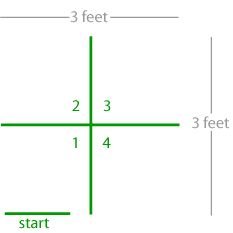 procedure: The subject stands with
both feet together at the starting line. On the command 'go', they jump ahead across the line into the first quadrant, then in sequence successively into quadrants 1, 2, 3, 4, 1, 2, etc. This pattern is continued as rapidly as possible for 10 seconds. After a rest repeat the trial.
procedure: The subject stands with
both feet together at the starting line. On the command 'go', they jump ahead across the line into the first quadrant, then in sequence successively into quadrants 1, 2, 3, 4, 1, 2, etc. This pattern is continued as rapidly as possible for 10 seconds. After a rest repeat the trial.
scoring: The average score from two, 10 second trials is the subject’s score. The participant's score is the number of correct jumps less a penalty deduction. One point is awarded each time the subject lands with both feet entirely within the correct quadrant during the 10 second trial, with a penalty of 0.5 point subtracted each time the subject touches a line and for each time the subject lands with one or both feet in an incorrect quadrant.
advantages: This is a simple agility test to perform, requiring limited equipment and space.
disadvantages: Only one person can perform the test at a time.
variations: Comparison of performing the test in the anticlockwise and clockwise directions may show if any imbalances exist between left and right movement skills.
reference: Johnson, B.L.; Nelson, J.K. IN: Kirby, R. F. (1991). Kirby's guide to fitness and motor performance tests. BenOak Pub. Co. Cape Girardeau, MO. Page(s) 59-60.
Similar Tests
- Hexagon agility test — involves jumping in and out of a hexagon shape as fast as possible.
- Hexagonal Obstacle Test — involves jumping over obstacles placed a hexagon shape, as fast as possible.
Related Pages
- Other agility tests
 Any comments, suggestions, or corrections? Please let us know.
 Current Events