


Balance Board Test
The Balance Board test is an agility and balance (equilibrium) test. The test requires participants to stand on a platform and try to keep the platform balanced for a period of 30 seconds. This is an important fitness capacity to measure in the elderly as poor balance can lead to falls and injuries.
purpose: to measure whole body balance
equipment required: A wooden balance platform measures measuring 50 x 50 x 1.5 cm, with a small 2 cm wide beam running lengthwise down the middle beneath it. Small stoppers are placed on the comers of the platform so that the board cannot tilt more than 18°. Contacts connected to a timer are placed on the underside of the platform, exactly in the middle of the left and right halves.
pre-test: Explain the test procedures to the subject. Perform screening of health risks and obtain informed consent. Prepare forms and record basic information such as age, height, body weight, gender, test conditions. Perform an appropriate warm-up. See more details of pre-test procedures.
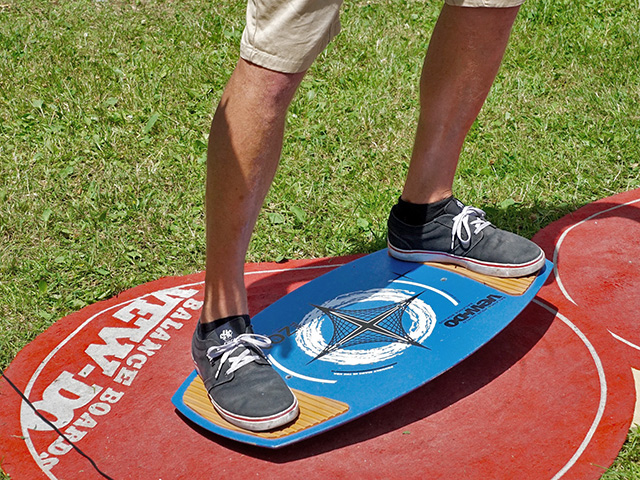 balance board
 procedure: The participant is instructed to stand on the platform with toes pointed outward (15°) and heels 15 cm apart. The participant must try to keep the platform balanced for a period of 30 seconds. The timer stops when the contacts touch the floor. After one practice trial the best score of three trials is recorded.
scoring: The score is the total time that neither contact touches the floor, expressed in counts (1 count = 0.3 s; 100 counts = 30). Thus the maximum score is 100 (for 30 seconds), and the higher scores indicate better performance.
target population: this test was designed specifically for the elderly population.
disadvantages: an apparatus specifically for this test needs to be obtained
reference: Koen A.P.Lemmink, Han Kemper, Mathieu H.G. de Greef, and Piet Rispens P, Stevens M, Reliability of the Groningen Fitness Test for the Elderly, Journal of Aging and Physical Activity, 2001, 9, 194-212
The Test in Action
- This test is part of the protocol for the Groningen Fitness Test for the Elderly.
Similar Tests
- Stork Balance Test — stand on the toes of one leg for as long as possible with the free leg resting on the inside of the opposite knee.
- One Leg Stand — the US sobriety test, stand with one foot off the ground for 30 seconds.
- Standing Balance Test — stand on one leg for as long as possible.
- Stick Lengthwise Test — balance on a stick for as long as possible, standing side-on on the balls of both feet.
Related Pages
- More about the Groningen Fitness Test for the Elderly
- A discussion about Fitness Testing for the Elderly
- Other Balance Tests
- balance testing
 Any comments, suggestions, or corrections? Please let us know.
 Current Events