


Fitness Tests for Hockey
(note: This information applies to field hockey, though it is not too dissimilar to ice hockey in its physical demands)
As with most team sports, there are many components of fitness that are important for success. Aerobic fitness is be one of the most important attributes of a successful hockey player, closely followed by anaerobic fitness and running speed and agility.
Further information and discussions on the components of fitness for hockey can be found here.
Aerobic Fitness
Aerobic fitness is a very important component of fitness for hockey. The shuttle run (beep) test is commonly used to for testing a hockey team, or the yo-yo test which is better suited for intermittent sports like hockey. You can find information on many other aerobic tests here.
Strength and Power
The vertical jump test can be performed to measure leg power. Maximal strength tests for specific exercises should be conducted. A handgrip strength test is also appropriate for hockey players. Strength (and power tests) should also be done to determine strength levels and to monitor strength changes in conjunction with training programs.
Speed
Maximum running speed and acceleration are very important in hockey. Sprint time over 40m, with a split time for the first 10m should be done.
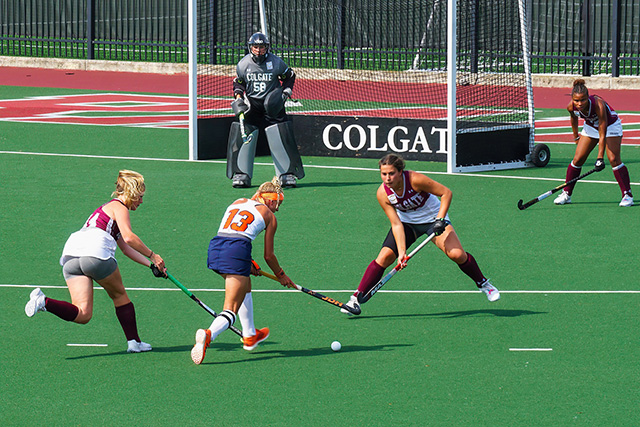 speed and agility are very important in hockey
Agility
The ability to quickly change direction is important for hockey. The 505 agility test measures the ability to change direction 180 degrees. A 90 degree turn test would also be suitable for hockey.
Flexibility
Good hamstring and lower back flexibility is important for hockey players to play the ball. Back injuries are common in this sport. The sit and reach test can be conducted to assess the lower back and hamstring flexibility.
Body Fat
Excess body fat would affect the hockey player's ability to move freely around the field, and the extra weight will increase fatigue. Body fat can be measured using the skinfold method. If this is not available, monitoring body weight changes would give an indication of body fat changes, assuming no change in muscle mass. See more about anthropometry for hockey.
SPECIAL CONSIDERATIONS
The Goal Keeper
The goalkeeper has very specific fitness demands. Tests for the goalkeeper should concentrate on explosive power and flexibility. Some type of reaction test can also be incorporated.
Related Pages
- Fitness Components for Field Hockey
- Also see the field hockey Rating Page
- More about anthropometry for hockey
- Poll about the fitness components for field hockey
- Hockey Physiology
- About Testing for Intermittent Sports
- Hockey Warm-ups
 Any comments, suggestions, or corrections? Please let us know.
 Current Events