


Athletics (Track & Field) at the Olympics
Athletics is one of five sports that have been contested at every summer Olympic Games since 1896 (the others are: Cycling, Fencing, Gymnastics and Swimming). Of the men's track and field events, 12 men’s have been contested at all Games – 100 m, 400 m, 800 m, 1,500 m, 110 m hurdles, marathon, high jump, pole vault, long jump, triple jump, shot put, and discus throw. Of the women's events, four events have been contested at all Olympic Games – 100 m, 4 x 100 m relay, high jump, and discus throw.
Track and Field Events at the Olympics
More About Some Events
- The 100m Olympic sprint champion is hailed the fastest man on earth. This event has been on all Olympic Games programs and has provided many highlights. See more about the Olympic 100m.
- The marathon was originally conceived as a race for the 1896 Olympics in Athens, commemorating the run of the soldier Pheidippides from a battlefield at the site of the town of Marathon. See more about the Olympic Marathon.
- The Decathlon has been included in the Olympic Games since 1912. The decathlon comprises 10 different events, with points are awarded for each event with the overall winner having the most points. See more about the Olympic Decathlon.
- The first time an athletics relay race was held was in 1908. It was a medley relay, consisting of 1600 meters being run by four athletes per team, the first two runners each ran 200 meters, the third runner ran 400m and the fourth ran 800m. The winning US team included African-American John Taylor, the first black athlete to have won a gold medal. The runners did not carry a baton as they do now, the transfers were by "touch".
Some Notable Olympic Athletes
- In 1920, Distance runner Paavo Nurmi won three medals for Finland. In 1924, Paavo Nurmi won five gold medals. In 1928, Nurmi picked up three more medals, including one gold. In 1932, Nurmi was barred from the Games, on grounds that on a trip to a German athletics meet he had claimed too much money in travel expenses. In total he won 9 gold medals and 3 silver, ranking him the greatest track and field athlete ever at the Olympic Games (based on medals won). See more on the Greatest T&F Athletes at the Olympics.
- In 1932, American Mildred "Babe" Didriksen won medals in high jumping (silver), 80m hurdles (gold) and the javelin (gold). She is the only athlete to ever medal in all three events.
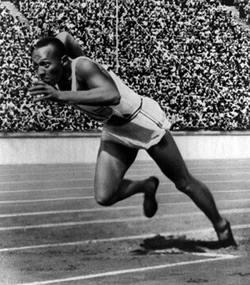
- A track and field star of the 1936 Games was Jesse Owens. The real name of the great USA sprinter was James Cleveland Owens. As a boy he was known as 'J.C.' because of his initials. That was until a new teacher mistook the sound of J. C., and began calling him 'Jesse'. The name stuck.
- In 1948, Dutch athlete Fanny Blankers-Koen won four gold medals, in the same events as Jesse Owens had twelve years earlier. She held the world records in the high jump and long jump, but did not compete in those, as rules prohibited women from competing in more than three individual events. Fanny was 30 years old and the mother
of 2 at the time.
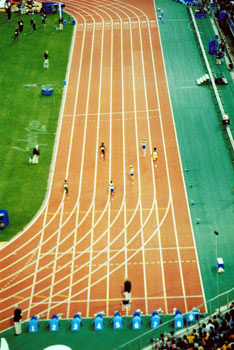
- The Olympic torchbearer for the 1956 Olympics was a virtually unknown 19 year old at the time he carried the torch into the stadium at Melbourne. Ron Clarke went on to become the world's finest distance runner in the 1960s.
- In Mexico City, 1968, Bob Beamon shattered the long-jump world record by more than 21 inches, Dick Fosbury revolutionized the high-jump with his back-first "Fosbury flop" technique, taking home the gold, and Al Oerter won the discus throw event a fourth time.
- In 1984, American Carl Lewis repeated Jesse Owens' 1936 feat, winning gold medals in the same four events. In 1992, Carl Lewis won two more gold medals, bringing his total to eight. In 1996, he got his ninth gold medal by winning the long jump.
- In 1988, Florence Griffith Joyner of the USA won four medals, three of them gold, in running events, while sister-in-law Jackie Joyner-Kersee won the long jump and heptathlon.
- In 2000, American Marion Jones won five track medals, three of them gold.
- In 2012, South African Oscar Pistorius (aka the 'Blade Runner') became the first double amputee to take part in both the Olympics and Paralympics. He competed in the Olympic Games 400m and the 4 x 400 m relay races.
- The latest addition to the Olympic Games athletics program is the 4x400m mixed relay, added for Tokyo 2020.
Other Trivia
- In the 1900 long jump event, American Myer Prinstein finished 2nd despite not even showing up for the finals. He did not want to participate in the finals on the Sunday due to his Christian beliefs, but his qualifying jumps from a previous day counted.
Related Pages
- See more information about the sport of Athletics.
- See more on the Greatest T&F Athletes at the Olympics.
- See also information about athletics at the Commonwealth Games.
- Athletics at the Paralympics
- Running events were part of the ancient Olympic Games, as was javelin, discus and jumping events as part of the pentathlon.
- List of Olympic Sports
 Any comments, suggestions, or corrections? Please let us know.
 Current Events