HRV Calculator - Heart Rate Variability Analysis
Quick Answer
This HRV calculator analyzes your heart rate variability (RMSSD) score and compares it to age and sex-matched athletic norms. Higher HRV generally indicates better cardiovascular fitness, recovery capacity, and autonomic nervous system balance.
- Calculates your percentile ranking among athletes of similar age
- Based on RMSSD time-domain analysis (the gold standard for athlete monitoring)
- Provides sport-specific recovery and training guidance
What is Heart Rate Variability (HRV)?
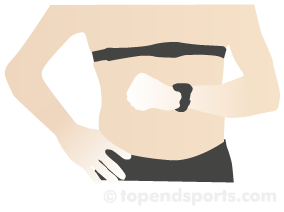 Heart Rate Variability (HRV) is a measure of the variation in time between each heartbeat, otherwise known as the R–R interval or inter-beat interval. Despite what you might assume, your heart doesn't beat at a perfectly consistent rhythm—there are subtle variations between each beat, measured in milliseconds. These variations are controlled by your autonomic nervous system (ANS), which regulates involuntary functions like heart rate, breathing, and digestion.
The time between each heartbeat is not consistent, it varies with every beat. Measuring how much it varies can be used to assess fitness and recovery in athletes. HRV has become one of the most valuable non-invasive tools for monitoring an athlete's readiness to train, recovery status, and overall cardiovascular health. The Polar Fitness Test uses HRV in its measurement.
For athletes, HRV provides a window into the balance between the sympathetic ("fight or flight") and parasympathetic ("rest and digest") branches of the nervous system. A higher HRV generally indicates that your body can effectively adapt to stress and recover from training, while consistently low HRV may signal accumulated fatigue, illness, or overtraining.
Understanding RMSSD and HRV Metrics
When tracking HRV, the most commonly used metric for athletic monitoring is RMSSD (Root Mean Square of Successive Differences). This time-domain measurement calculates the variation between consecutive heartbeats and is particularly sensitive to parasympathetic (vagal) nervous system activity—the branch responsible for recovery and relaxation.
RMSSD has several advantages for athlete monitoring:
- Short measurement time: Reliable readings can be obtained in just 1-2 minutes
- Less affected by breathing patterns: Unlike some frequency-domain measures, RMSSD is relatively stable regardless of breathing rate
- Consistent across positions: Valid measurements can be taken sitting, standing, or supine
- Widely validated: Extensive research supports its use for training monitoring in athletes
Most fitness trackers, smartwatches, and dedicated HRV apps report RMSSD values, typically ranging from 20-100ms in healthy adults. Elite endurance athletes may show values exceeding 100ms, while values consistently below 20ms may indicate impaired autonomic function or significant fatigue.
"RMSSD is the most reliable and practically applicable measure for day-to-day monitoring of athletes. The 7-day rolling average provides stable trend data that can guide training decisions with minimal day-to-day noise."— Plews et al., International Journal of Sports Physiology and Performance (2013)
HRV Normal Ranges by Age and Athletic Status
HRV naturally decreases with age due to reduced parasympathetic nervous system activity and cardiovascular changes. However, regular exercise can maintain HRV 20-30% above age-matched sedentary peers. The following table provides normative RMSSD values based on published research:
| Age Group | General Population (ms) | Recreational Athletes (ms) | Elite Athletes (ms) |
|---|---|---|---|
| 18-25 | 40-65 | 55-85 | 75-120+ |
| 26-35 | 35-55 | 45-75 | 65-100+ |
| 36-45 | 28-45 | 38-60 | 55-85 |
| 46-55 | 22-38 | 32-52 | 45-70 |
| 56-65 | 18-32 | 26-45 | 38-60 |
| 65+ | 15-28 | 22-38 | 32-50 |
Source: Compiled from Kubios Autonomic Aging dataset, Elite HRV population data, and Task Force guidelines. Values represent typical ranges; individual variation is significant.
How to Measure HRV for Training
Accurate HRV measurement requires consistent conditions. Follow these guidelines for reliable data that can guide your training decisions:
Equipment Required
Various equipment can be used to measure HRV, such as a heart rate monitor, smartphone HR app, or finger pulse sensors. Chest strap monitors provide the most accurate R-R interval data, while optical sensors on smartwatches and rings offer convenience with slightly reduced precision.
Measurement Protocol
Best results are achieved when the subject is at rest, with measurements taken over several minutes. Monitor your HRV daily, understand your baseline measurement, and monitor the changes over time. See more about resting heart rate measurement.
- Timing: Measure immediately upon waking, before getting out of bed or consuming anything
- Position: Remain in the same position each day (supine or seated)
- Duration: Allow 1 minute for stabilization, then record for 1-2 minutes minimum
- Equipment: Use a chest strap heart rate monitor for best accuracy, or a validated smartwatch/ring
- Environment: Avoid movement, talking, or environmental distractions during measurement
- Frequency: Measure daily for trend analysis; a minimum of 3-4 days per week provides useful data
Pro Tip: Track your 7-day rolling average rather than reacting to single-day readings. Day-to-day HRV can fluctuate by 20-30% due to factors like sleep quality, hydration, and stress. The weekly trend provides more actionable insights for training modification.
Using HRV for Training Guidance
HRV-guided training allows athletes to optimize performance by matching training intensity to recovery status. Research shows that athletes who adjust training based on HRV trends outperform those following fixed schedules, with studies reporting 5-10% greater improvements in performance markers.
Training Decision Framework
HRV Above Baseline (+5%)
Your body is well-recovered. Consider high-intensity sessions, heavy strength work, or longer endurance efforts.
HRV Near Baseline (±5%)
Proceed with planned training. Moderate intensity work is appropriate.
HRV Below Baseline (-10%)
Consider reducing intensity or volume. Active recovery, technique work, or rest may be more beneficial.
HRV Significantly Low (-20%+)
Prioritize recovery. This may indicate accumulated fatigue, illness onset, or other stressors requiring attention.
Sport-Specific HRV Applications
Different sports place varying demands on the autonomic nervous system, and HRV patterns can vary accordingly:
Endurance Sports (Running, Cycling, Triathlon, Swimming)
Endurance athletes typically show higher baseline HRV values due to enhanced vagal tone from aerobic training. Monitor for:
- Progressive HRV decline during heavy training blocks (normal and expected)
- HRV rebound during taper periods (indicates readiness to compete)
- Sustained low HRV with elevated resting HR (potential overtraining)
Strength and Power Sports (Weightlifting, Sprinting, Combat Sports)
High-intensity anaerobic training may show different HRV patterns:
- Acute HRV suppression 24-48 hours post-heavy training
- Weekly coefficient of variation (CV) may be more informative than absolute values
- Consider longer recovery periods when HRV remains suppressed beyond 48 hours
Team Sports (Soccer, Basketball, Rugby, Hockey)
Mixed-demand sports benefit from HRV monitoring to:
- Individualize training loads within team settings
- Identify athletes at risk of injury or illness
- Optimize squad rotation and match readiness
Factors That Affect HRV
Many lifestyle and physiological factors influence HRV readings. Understanding these helps interpret your results and optimize your autonomic health:
Factors That Increase HRV
- Quality sleep: Each additional hour of sleep adds approximately 3ms to RMSSD
- Aerobic fitness: Regular endurance training enhances parasympathetic activity
- Proper hydration: Even mild dehydration can reduce HRV
- Stress management: Meditation and breathing exercises improve vagal tone
- Healthy body composition: Lower visceral fat is associated with higher HRV
Factors That Decrease HRV
- Training fatigue: Accumulated training stress temporarily suppresses HRV
- Poor sleep: Interrupted or insufficient sleep significantly impacts recovery
- Alcohol consumption: Even moderate intake can reduce HRV for 24-48 hours
- Illness or infection: Immune activation shifts toward sympathetic dominance
- Psychological stress: Work, travel, and life stress affect autonomic balance
- Excessive caffeine: High doses may acutely reduce HRV (3-6 mg/kg)
HRV and Illness Prediction
Research on elite swimmers has shown that sustained HRV suppression (≥20% below baseline) can precede upper respiratory illness by 1-3 days. Athletes experiencing unexplained HRV drops should:
- Prioritize sleep and recovery
- Ensure adequate nutrition and hydration
- Consider reducing training load
- Monitor for early illness symptoms
How to Improve Your HRV
While genetic factors influence baseline HRV, lifestyle modifications can significantly impact your autonomic function:
- Optimize sleep: Aim for 7-9 hours of quality sleep in a cool, dark environment
- Train consistently: Regular aerobic exercise (3-5x/week) improves vagal tone over time
- Practice breathing exercises: 5-10 minutes of slow, deep breathing (6 breaths/minute) can acutely boost HRV by 15%
- Manage stress: Incorporate meditation, yoga, or other relaxation techniques
- Maintain healthy weight: Excess body fat, particularly visceral fat, is associated with reduced HRV
- Stay hydrated: Dehydration impairs cardiovascular function and HRV
- Limit alcohol: Avoid alcohol, especially in the evening
- Periodize training: Include regular recovery weeks to allow autonomic rebound
Frequently Asked Questions
What is a good HRV score for athletes?
A good HRV score depends on age, sex, and fitness level. For recreational athletes aged 25-35, RMSSD values of 45-75ms are typical, while elite endurance athletes may exceed 100ms. Rather than comparing to population averages, establish your personal baseline over 7-14 days and monitor trends relative to that baseline.
How often should I measure HRV?
For training optimization, measure HRV daily upon waking. If daily measurement isn't feasible, aim for at least 3-4 readings per week, taken on consistent days. This provides enough data points for meaningful trend analysis while remaining practical for most athletes.
Is nighttime HRV measurement better than morning?
Both approaches have merit. Morning measurements are convenient and capture your recovered state. Nighttime measurements (from sleep-tracking devices) reduce measurement burden but may show "parasympathetic saturation" effects in well-trained athletes, making them less sensitive to detecting training adaptations.
Can HRV predict overtraining?
HRV can help identify non-functional overreaching before it progresses to overtraining syndrome. Look for sustained HRV suppression (>7 days below baseline), increased day-to-day variability (coefficient of variation), and HRV patterns that don't respond to rest days. Combined with subjective wellness measures, HRV provides valuable early warning.
Why does my HRV fluctuate so much day to day?
Daily HRV variation of 10-20% is normal and reflects the dynamic nature of autonomic regulation. Factors like sleep quality, hydration, stress, and previous day's training all influence readings. This is why the 7-day rolling average is more useful than single readings—it smooths out daily noise while revealing meaningful trends.
Does HRV differ between men and women?
Research shows women tend to have slightly higher RMSSD values than men until approximately age 40-45, after which differences become negligible. Hormonal fluctuations during the menstrual cycle can also affect HRV in female athletes, with some studies showing reduced HRV during the luteal phase.
How accurate are smartwatch HRV measurements?
Modern smartwatches using photoplethysmography (PPG) provide reasonably accurate HRV measurements, though they may underestimate RMSSD by 6-11% compared to ECG-based chest straps. For trend monitoring and training decisions, this accuracy is generally sufficient. For research or clinical purposes, chest strap monitors remain the gold standard.
Medical Disclaimer: This calculator provides estimates for educational and athletic training purposes only. HRV measurements and recommendations should not replace professional medical advice. Low HRV may indicate various health conditions requiring medical evaluation. If you have concerns about your heart health or experience symptoms like chest pain, shortness of breath, or irregular heartbeat, consult a healthcare provider. Individual results may vary based on factors not included in this calculation.
References
- Task Force of the European Society of Cardiology. (1996). "Heart rate variability: Standards of measurement, physiological interpretation, and clinical use." Circulation, 93(5), 1043-1065.
- Plews, D.J., et al. (2013). "Training adaptation and heart rate variability in elite endurance athletes: Opening the door to effective monitoring." Sports Medicine, 43(9), 773-781.
- Buchheit, M. (2014). "Monitoring training status with HR measures: Do all roads lead to Rome?" Frontiers in Physiology, 5, 73.
- Tegegne, B.S., et al. (2020). "Reference values of heart rate variability from 10-second ECGs: The Lifelines Cohort Study." Scandinavian Journal of Medicine & Science in Sports, 30(3), 417-427.
- Hellard, P., et al. (2011). "Training-related risk of common illnesses in elite swimmers over a 4-year period." Medicine & Science in Sports & Exercise, 43(11), 2185-2194.
- Stone, J.D., et al. (2021). "Assessing the Accuracy of Popular Commercial Technologies That Measure Resting Heart Rate and Heart Rate Variability." Frontiers in Sports and Active Living, 3, 585870.
- Flatt, A.A. & Esco, M.R. (2015). "Smartphone-derived heart-rate variability and training load in a women's soccer team." International Journal of Sports Physiology and Performance, 10(8), 994-1000.
- Sammito, S., et al. (2024). "HRV biofeedback for stress reduction: A systematic review." Applied Psychophysiology and Biofeedback.
Similar Tests
Related Pages
- The Polar Fitness Test using HRV in its measurement.
- List of Health Fitness Tests
- See more endurance fitness tests
- Methods for measuring your heart rate
 Any comments, suggestions, or corrections? Please let us know.