Hip Girth Calculator
Quick Answer
This calculator converts hip girth measurements between metric and imperial units and calculates your waist-to-hip ratio (WHR) when waist measurements are provided. Results help athletes and coaches track body composition changes and assess health risk factors.
- Instantly converts between cm, inches, and mm
- Calculates WHR based on WHO standards
- Compares your measurements to population averages
Girths are circumference measures at standard anatomical sites around the body. The hip girth measurement is a measure of the circumference around the hips at the level of the greatest protrusion of the buttocks. See the list of girth measurement locations.
How to Measure Hip Girth Correctly
Purpose: To measure the circumference of the hip area as a measure of the underlying hip structure, musculature, and adipose tissue. When combined with the measure of abdominal girth in the Waist-Hip Ratio (WHR), this measurement has been shown to be related to the risk of coronary heart disease.
Equipment required: Flexible metal tape measure and pen suitable for marking the skin. If a plastic or cloth tape is used, it should be checked regularly against a metal tape as they may stretch over time.
Pre-test: Explain the test procedures to the subject. Prepare forms and record basic information such as age, height, body weight, and gender. See more details of pre-test procedures.
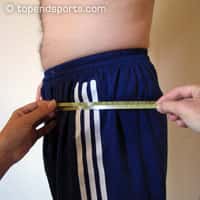 Procedure: The hip girth measurement is taken over minimal clothing, at the level of the greatest protrusion of the gluteal (buttock) muscles. The subject stands erect with their weight evenly distributed on both feet and legs slightly parted, making sure not to tense the gluteal muscles. When recording, you need to make sure the tape is not too tight or too loose, is lying flat and is horizontal. It may help to have the subject stand on a box to make the measurement easier.
Reliability: Factors that may affect reliability include changes to the testing personnel, constant and even tension on the tape, and correct landmarking (finding the correct anatomical site for measurement).
Advantages: Low costs involved in the testing procedure, ease of self-testing, and the measurement provides valuable data for body composition assessment.
Comments: Clothing over the site should be removed if possible to make sure that the measuring tape is positioned correctly and that the correct circumference is determined. Girth measurements combined with skinfold measurements can give a clearer picture of changes in tissue composition and distribution of muscle and fat. For this girth measurement, due to the location of the measure, care should be taken to maintain personal privacy of the subject, and sometimes it is appropriate to measure over their clothing. If so, this should be recorded with the results.
Average Hip Girth by Gender and Age
Understanding how your hip girth compares to population averages can help contextualize your measurements. The following table presents average hip circumferences based on NHANES anthropometric reference data:
| Age Group | Women (cm) | Women (inches) | Men (cm) | Men (inches) |
|---|---|---|---|---|
| 20-29 years | 98.2 | 38.7 | 97.4 | 38.3 |
| 30-39 years | 102.7 | 40.4 | 99.6 | 39.2 |
| 40-49 years | 104.0 | 40.9 | 100.6 | 39.6 |
| 50-59 years | 104.7 | 41.2 | 101.1 | 39.8 |
| 60-69 years | 103.9 | 40.9 | 100.6 | 39.6 |
| Overall Average | 102.2 | 40.2 | 99.6 | 39.2 |
Hip Girth for Athletes and Sports
Hip girth measurement plays an important role in athletic assessment and body composition monitoring across various sports. Athletes and coaches use hip measurements to track training adaptations, monitor off-season changes, and inform nutrition strategies.
Sport-Specific Considerations
Endurance Athletes (Marathon, Cycling, Triathlon): Endurance athletes typically have lower hip circumferences due to reduced adipose tissue and lean muscle mass. Monitoring hip girth changes can indicate shifts in body composition that may affect performance efficiency.
Power Athletes (Weightlifting, Sprinting, Combat Sports): Power athletes often have larger hip girths due to greater gluteal muscle development. Hip measurements help track hypertrophy progress and inform weight class decisions in combat sports.
Team Sport Athletes (Football, Rugby, Hockey): Position-specific requirements create variation in ideal hip measurements. Linemen in American football may have significantly larger hip circumferences than wide receivers, reflecting different physical demands.
Aesthetic Sports (Bodybuilding, Physique Competition): Hip girth is closely monitored relative to waist and shoulder measurements to achieve desired proportions. The waist-to-hip ratio is particularly important for competitive presentation.
Understanding the Waist-to-Hip Ratio (WHR)
The waist-to-hip ratio (WHR) is calculated by dividing waist circumference by hip circumference. This simple calculation provides insight into body fat distribution and associated health risks.
| Risk Level | Women (WHR) | Men (WHR) | Health Implications |
|---|---|---|---|
| Low Risk | ≤ 0.80 | ≤ 0.90 | Lower cardiovascular disease risk |
| Moderate Risk | 0.81 - 0.85 | 0.91 - 0.95 | Some increased health risk |
| High Risk | > 0.85 | > 0.95 | Increased risk of heart disease, diabetes |
According to the World Health Organization, abdominal obesity is defined as a waist-hip ratio above 0.90 for males and above 0.85 for females. Research shows that people with "apple-shaped" bodies (higher WHR) face more health risks than those with "pear-shaped" bodies who carry more weight around the hips.
Unit Conversion Reference
For quick reference when converting hip girth measurements:
| Centimeters (cm) | Inches (in) | Millimeters (mm) |
|---|---|---|
| 80 | 31.5 | 800 |
| 85 | 33.5 | 850 |
| 90 | 35.4 | 900 |
| 95 | 37.4 | 950 |
| 100 | 39.4 | 1000 |
| 105 | 41.3 | 1050 |
| 110 | 43.3 | 1100 |
| 115 | 45.3 | 1150 |
| 120 | 47.2 | 1200 |
Conversion formulas:
- Centimeters to inches: cm ÷ 2.54 = inches
- Inches to centimeters: inches × 2.54 = cm
- Centimeters to millimeters: cm × 10 = mm
Improving Your Waist-to-Hip Ratio
For athletes and fitness enthusiasts looking to optimize their body composition and WHR, consider these evidence-based strategies:
Cardiovascular Training: Regular aerobic exercise helps reduce visceral fat around the waist, improving WHR. High-intensity interval training (HIIT) has shown particular effectiveness for reducing abdominal fat while preserving muscle mass.
Resistance Training: Building gluteal and hip musculature through exercises like squats, hip thrusts, and deadlifts can increase hip circumference while reducing waist-to-hip ratio. Compound lower body exercises are especially effective for athletes.
Nutrition Strategies: A balanced diet with adequate protein supports muscle development while controlling caloric intake helps reduce excess adipose tissue. Athletes should focus on nutrient timing around training sessions.
Recovery and Sleep: Adequate sleep and recovery support hormonal balance, particularly cortisol regulation, which influences abdominal fat storage. Athletes should prioritize 7-9 hours of quality sleep.
Frequently Asked Questions
How do you measure hip girth correctly?
Hip girth is measured at the level of the greatest protrusion of the gluteal (buttock) muscles. Stand erect with weight evenly distributed on both feet and legs slightly parted. Use a flexible measuring tape held horizontally around the widest part of the hips, ensuring the tape is snug but not compressing the tissue.
What is the average hip circumference for women?
According to NHANES data, the average hip circumference for adult women is approximately 40.2 inches (102.2 cm). This varies by age, with women aged 40-49 having measurements around 40.9 inches (104 cm), while younger women aged 20-29 average 38.7 inches (98.2 cm).
What is the average hip girth for men?
The average hip circumference for adult men is approximately 39.2 inches (99.6 cm). Men show less variation across age groups compared to women, with measurements ranging from 38.3 to 39.8 inches throughout adulthood.
What is a healthy waist-to-hip ratio?
According to the World Health Organization, a healthy waist-to-hip ratio is below 0.90 for men and below 0.85 for women. Ratios above these thresholds indicate abdominal obesity and are associated with increased cardiovascular disease risk.
Why is hip girth measurement important for athletes?
Hip girth measurement helps athletes and coaches track changes in body composition, monitor training effects on muscle development, and assess fat distribution. Combined with waist measurements, it provides insight into health risk factors and can guide nutrition and training decisions for optimal performance.
How do I convert hip circumference from cm to inches?
To convert hip circumference from centimeters to inches, divide the centimeter measurement by 2.54. For example, 100 cm ÷ 2.54 = 39.4 inches. To convert from inches to centimeters, multiply by 2.54.
Should I measure hip girth over clothing?
For the most accurate results, hip girth should be measured over minimal clothing or directly on the skin. However, due to the location of the measurement, it may be appropriate to measure over light clothing for privacy. If measured over clothing, this should be noted and consistent for tracking changes over time.
References
- World Health Organization. (2011). "Waist Circumference and Waist-Hip Ratio: Report of a WHO Expert Consultation." Geneva.
- Welborn TA, Dhaliwal SS, Bennett SA. (2003). "Waist-hip ratio is the dominant risk factor predicting cardiovascular death in Australia." The Medical Journal of Australia; 179(11/12): 580-585.
- National Health and Nutrition Examination Survey (NHANES). Anthropometric Reference Data for Children and Adults: United States.
- Heitmann BL, Frederiksen P, Lissner L. (2004). "Hip circumference and cardiovascular morbidity and mortality in men and women." Obesity Research; 12(3): 482-487.
- Molarius A, Seidell JC, Sans S, et al. (1999). "Waist and hip circumferences, and waist-hip ratio in 19 populations of the WHO MONICA Project." International Journal of Obesity; 23(2): 116-125.
- Santos DA, Dawson JA, Matias CN, et al. (2014). "Reference values for body composition and anthropometric measurements in athletes." PLoS ONE; 9(5): e97846.
- American College of Sports Medicine. (2021). "ACSM's Guidelines for Exercise Testing and Prescription." 11th Edition.
Similar Tests
Related Pages
Waist-Hip Ratio Test
Complete guide to calculating and interpreting your waist-to-hip ratio for health assessment.
Learn More →Waist to Height Ratio
Another valuable body composition measure using waist circumference and height.
Learn More →Girth Measurements Overview
General description of taking girth measurements and links to other measurement sites.
Learn More →Body Size Testing
A discussion about body size testing methods and their applications in sports science.
Learn More →Anthropometry Tests
Complete guide to anthropometric testing methods for athletes and fitness assessment.
Learn More →Videos of Anthropometric Tests
Watch video demonstrations of proper anthropometric measurement techniques.
Watch Videos → Any comments, suggestions, or corrections? Please let us know.