PWC170 & PWC75% Calculator
Quick Answer
The PWC-170 calculator estimates your physical work capacity at a heart rate of 170 beats per minute using submaximal cycle ergometer data. This submaximal test provides a reliable measure of aerobic fitness without requiring maximal exertion.
- Calculates work capacity using linear extrapolation from 2 submaximal stages
- Based on the established heart rate-workload linear relationship
- Validated for cyclists, endurance athletes, and general fitness assessment
PWC stands for physical work capacity. There are two similar tests. PWC-170 estimates the working capacity at a heart rate of 170 beats per minute, while PWC-75% estimates the working capacity at 75% of maximum heart rate. The procedures are very similar for the two tests, below is described the method for the PWC170. For the PWC75% the heart rates aim for each stage may be different.
Test purpose: This test measures aerobic fitness.
Equipment required: Cycle ergometer, clock or stopwatch, heart rate monitor (optional).
Pre-test: Explain the test procedures to the subject. Perform screening of health risks and obtain informed consent. Prepare forms and record basic information such as age, height, body weight, gender and test conditions. Check and calibrate the equipment. Adjust the seat and handlebar height. Perform a standard warm-up. See more details of pre-test procedures.
Procedure: Athletes perform three consecutive workloads on a cycle ergometer. Begin by setting up subject on bike to ensure correct seat height (knee slightly bent at bottom of cycle). Place heart rate monitor on the subject. Check their exercise history to determine the starting workload (estimated to achieve a heart rate between 100-115). Start the test and measure heart rate each minute and continue for 3-4 minutes (until a steady heart rate is achieved). Continue the test for 2nd and 3rd workloads, set to achieve a HR between 115-130 and 130-145 beats per minute respectively.
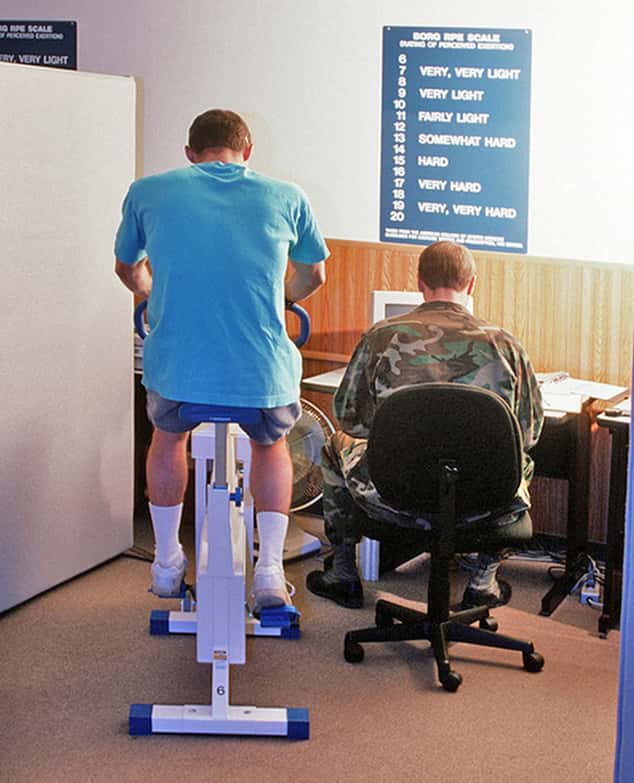 Monark cycling test
Scoring: Each steady-state heart rate and workload are graphed, with the line of best fit for the three points extrapolated to estimate the workload that would elicit a heart rate of 170 beats per minute (or 75% of maximum HR for the PWC-75% test). This workload value can then be compared to norms.
Advantages: Having the athletes seated during this test makes it appropriate for ECG monitoring.
Disadvantages:
- As the PWC test is performed on a cycle ergometer, the test favors cyclists.
- Determining the line of best fit and extrapolating to 170 bpm can be subjective and open to error.
Test versions: As well as the PWC 170 and 75%, other levels may also be used, such as PWC 130 for measuring elderly or other populations in which you do not wish to excessively elevate the heart rate.
Sport-Specific Applications
The PWC-170 test is particularly well-suited for cyclists and triathletes due to its use of cycle ergometry. Elite road cyclists typically achieve PWC-170 values of 250-350 watts, while recreational cyclists may score 150-200 watts. Team sport athletes including football, soccer, and basketball players use this test for preseason fitness screening, typically scoring between 180-250 watts depending on position.
How to Improve Your PWC-170 Score
Improving your physical work capacity requires consistent aerobic training. Key strategies include base aerobic training (3-5 sessions per week at 60-75% max HR), interval training (1-2 sessions per week), progressive overload, and sport-specific cycling work. Most athletes can expect improvements of 10-20% in PWC-170 scores after 8-12 weeks of structured training.
Frequently Asked Questions
What is a good PWC-170 score for athletes?
A good PWC-170 score varies by sport and fitness level. Elite endurance athletes typically achieve 250-350 watts, recreational athletes score 150-200 watts, and team sport athletes usually fall between 180-250 watts.
How often should I perform the PWC-170 test?
For training monitoring, perform the test every 6-8 weeks to track fitness changes. Ensure consistent test conditions each time for valid comparisons.
Can I use any cycle ergometer for the PWC-170 test?
While various ergometers can be used, mechanically-braked ergometers like the Monark 828E provide the most reliable results. The key is using the same ergometer for repeated tests.
What if my maximum heart rate is below 170 bpm?
If your predicted maximum heart rate is below 170 bpm (common for older athletes), use the PWC-75% or PWC-130 test instead. The calculator offers these alternative test modes.
How do I convert between watts and kgm/min?
To convert kgm/min to watts, divide by 6.12. To convert watts to kgm/min, multiply by 6.12. For example, 150 watts equals approximately 918 kgm/min.
Why did my results vary between tests?
Test variability can result from fatigue, hydration status, caffeine intake, environmental conditions, time of day, or not achieving true steady-state heart rates. Standardize all conditions between tests.
Is the PWC-170 test better than a VO2max test?
Neither is inherently better. VO2max tests provide the gold standard for maximal aerobic capacity but require maximal effort. PWC-170 estimates submaximal work capacity with lower risk. Both correlate reasonably well (r = 0.70-0.85).
References
- Wahlund, H. (1948). "Determination of physical working capacity." Acta Medica Scandinavica, 132(Suppl 215), 1-78.
- Sjöstrand, T. (1947). "Changes in the respiratory organs of workmen at an ore smelting works." Acta Medica Scandinavica, 128(Suppl 196), 687-699.
- Åstrand, P.O., & Ryhming, I. (1954). "A nomogram for calculation of aerobic capacity from pulse rate during submaximal work." Journal of Applied Physiology, 7(2), 218-221.
- Karpman, V.L., Belotserkovsky, Z.B., & Gudkov, I.A. (1988). "Testing in sports medicine." Moscow: FiS Publishers.
- American College of Sports Medicine. (2021). "ACSM's Guidelines for Exercise Testing and Prescription" (11th ed.). Wolters Kluwer.
- Noonan, V., & Dean, E. (2000). "Submaximal exercise testing: Clinical application and interpretation." Physical Therapy, 80(8), 782-807.
- Golding, L.A. (2000). "YMCA Fitness Testing and Assessment Manual" (4th ed.). Human Kinetics.
Similar Tests
Related Pages
- Fitness tests for cyclists
- Cycling Fitness Tests, assessments involving cycling exercise.
- Cycle Ergometers
- More information: measuring heart rate
- More aerobic fitness tests
 Any comments, suggestions, or corrections? Please let us know.