How Technology Is Transforming American Football
Technology can significantly help American football in many ways, such as by improving player safety, enhancing coaching strategies, assisting officiating with better accuracy, and boosting fan engagement through advanced stats and immersive experiences.
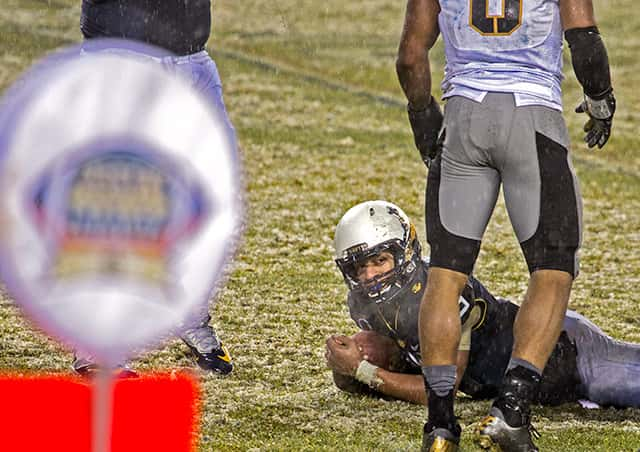 Is it a first down? Technology can be used to determine this
As the sporting world embraces AI and future technologies, we can expect, like in many other sports, American football to embrace new innovations that continue to shape the way the game is played, experienced, and enjoyed. In just the past few seasons the sport has swapped a 100-year-old measuring device for 8K cameras, put AI assistants on the sideline, and started using machine learning to predict injuries before they happen.
Technology and Player Safety
Technology is playing a major role in improving player safety in American football, where concussion remains a significant concern. Innovations like smart helmets equipped with impact sensors and advanced concussion protocols are helping to better protect players from serious injuries.
Better Helmets, Ranked by Data
Every year the NFL and the players' association put every available helmet model through laboratory crash testing that recreates the impacts most commonly seen in games. The results are published as a colour-coded poster — green for top-performing, yellow for not recommended, red for banned — so players can see exactly how their gear rates before they choose it.
The testing has driven a rapid arms race among manufacturers. Twelve new top-performing models arrived for the 2024 season and another seven for 2025, several of them developed through the league's $3 million Helmet Challenge. There are now also position-specific helmets, engineered separately for quarterbacks, offensive linemen and defensive linemen, because each position experiences a distinctly different pattern of head impacts. A quarterback is most likely to strike the back of the head on the turf, while linemen absorb many small frontal contacts on almost every snap.
The data suggests it matters: players wearing helmets outside the top-performing group have been found to suffer concussions at a rate roughly 30% higher than those in the best-rated models.
Guardian Caps and Impact Sensors
Guardian Caps — soft padded shells that strap over the outside of the helmet — have been mandatory in NFL contact practices for most position groups since 2022, and since 2024 players have been allowed to wear them in regular season games as well. The league reports meaningful reductions in impact force, although some independent researchers have questioned how much difference the caps make in real game conditions, so this remains an area to watch.
Instrumented mouthguards are another piece of the puzzle. Fitted with accelerometers and gyroscopes, they record the force, direction and location of head impacts and send the data to medical staff on the sideline. Rather than relying only on what the training staff happened to see, teams and researchers now have an objective record of what each player's head actually experienced.
AI and Injury Prediction
The most forward-looking safety project is the Digital Athlete, built by the NFL with Amazon Web Services. It combines player tracking data, video, equipment choices, playing surface and injury history to create a digital twin of each player, then runs simulations of thousands of scenarios to estimate injury risk. Teams use the output to adjust training loads, recovery plans and practice design for individual players.
Combined with rule changes such as the redesigned kickoff, this technology-led approach appears to be working. The 2024 season produced 182 concussions, the fewest since the league began tracking the statistic in 2015 and a 17% drop on the previous year.
Technology and Officiating
Technology is already helping referees make more accurate decisions, such as using instant replay systems and video reviews supported by AI to make the game fairer and reduce human error. Since 2021 the NFL's replay operation has run on a Hawk-Eye system that synchronises every camera angle in the stadium into a single platform, so a reviewing official can jump between views in seconds instead of waiting for a broadcast truck to queue them up.
The End of the Chain Gang
The most visible change came in 2025, when the NFL replaced chain measurements with the Hawk-Eye virtual measurement system. Six 8K cameras in every stadium optically track the ball, so once the officials have spotted it, the system reports the distance to the line to gain almost instantly and displays a virtual measurement on the stadium screens and broadcast.
It is worth being clear about what the cameras do and do not do. They do not decide where the ball should be placed — an official still makes that judgement by hand, as always. What the technology removes is the slow, imprecise second step of jogging the chains onto the field and eyeballing the result, which typically cost around 40 seconds per measurement. The chain crew still stands on the sideline as a visual reference and a backup if the system fails.
Human Judgement, Assisted
The league has been careful to keep officials in charge of judgement calls while letting technology handle the measurable ones. Replay assist can now correct clear and obvious errors on certain plays without a formal challenge, and from the 2026 season league officiating personnel are permitted to consult with the on-field crew when a disqualification for a flagrant act is being considered — a recognition that a second set of eyes with better camera angles can help get the biggest decisions right.
Technology on the Sideline
Coaching has quietly become one of the most technology-heavy parts of the game. Roughly 2,500 Copilot+ PCs are deployed across the league on game days, around 20 per sideline and 10 in each coaching booth, running the NFL's Sideline Viewing System. Instead of thumbing through printed still images, a coach can now filter plays instantly by down, distance, quarter or type of gain, and coaching booths run live dashboards that update personnel groupings and snap counts as the game unfolds.
Coach-to-player radio in the helmet, long a fixture in the NFL, arrived in college football in 2024 when the NCAA approved in-helmet communication and sideline tablets for FBS teams. That single change has done more than anything else to reduce the elaborate sideline sign-boards that college teams used to disguise their play calls.
Away from game day, virtual reality has become a genuine training tool rather than a novelty. Quarterbacks use VR systems to take mental repetitions at faster-than-real speed inside accurate recreations of the stadiums they are about to play in, working through progressions and defensive reads without the physical cost of live practice. Jayden Daniels, who uses one such system, has described it as a flight simulator for quarterbacks.
Technology in Scouting and the Draft
Player evaluation is being reshaped by computer vision. Software can now extract speed, acceleration and separation data straight from college game film, giving scouts objective athletic measurements for prospects who never ran at the combine, and for small-school players nobody had the budget to travel and watch. Front offices also use natural-language AI tools to query a decade or more of combine and scouting data in seconds.
Nobody in the league is pretending this replaces scouts. General managers tend to describe AI as an assistant that surfaces unbiased patterns a human might miss, with the final judgement still made by people who have watched the player.
Technology and the Fan Experience
Fans have been the quiet beneficiaries of all this data. RFID chips have been fitted in players' shoulder pads since 2014 and in the ball itself since 2017, feeding the Next Gen Stats platform that produces the speed, separation, completion probability and pressure rate numbers now shown routinely during broadcasts.
In 2026 the NFL opened much of that machinery to the public with NFL IQ, a hub on NFL.com that gives fans front-office style dashboards on roster needs, salary cap space, draft capital and prospect comparisons, later adding an AI chat interface so fans can simply ask questions of the data. Combined with stadium apps, multi-angle streaming and AI-generated highlight packages, the gap between what a general manager can see and what a fan at home can see has never been smaller.
What Comes Next
The next steps are already visible on the horizon: real-time health monitoring during games, AI that flags a player's elevated injury risk in the middle of a drive rather than the following week, fully automated ball spotting to complete what the virtual measurement system started, and smarter protective equipment tailored to individual head shapes and playing styles.
The tension running through all of it is the same one the NFL has navigated for a century — how much of the game's human judgement, and human theatre, should be handed to a machine. So far the league's answer has been to let technology handle what can be measured, and leave the rest to the officials, coaches and players.
Related Pages
- The Physics of Football
- Technology in Sports
- Technology in Specific Sports
- Football Fitness Testing
- Poll about the fitness components of football
- All About American Football
 Any comments, suggestions, or corrections? Please let us know.