Football Kicking Technique
Score At Least 5 More Points Per Game By Coaching Football Kicking Properly
Originally published September 2008. Reviewed and updated September 2026 — see what has changed since this article was written.
I'll bet you're frustrated that your team's football kicking skills are leaving at least five points on the field every game you coach. Think about it, how often have you been in a fourth and three situation on the opposition's fifteen yard line with no confidence in hitting the field goal?
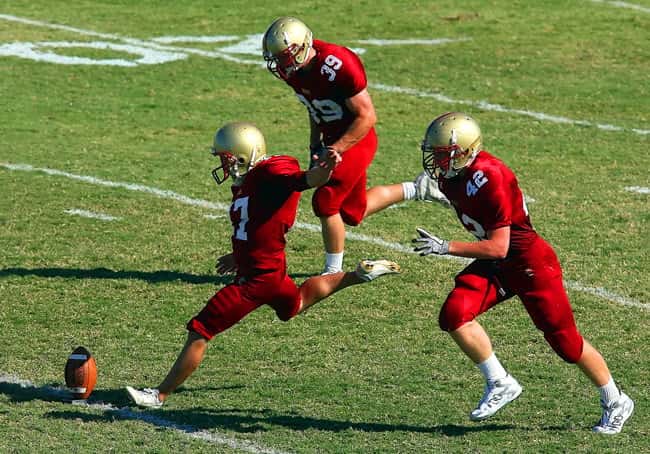 football kicking is an underrated skill
You go for it instead of trying the kick and don't make it. Instead of a three point lead, your opponent takes over and drives down for a touchdown. If you could improve your team's kicking skills to the point of making just one field goal and two extra points per game, what would those five points do for your football coaching record?
Let's discuss five simple tips for football kicking to help your kicker eliminate bad technique and have more success.
- Instill in your football kicker the need to invest consistent practice time on developing their kicking skills. This may sound obvious, but too many youth football teams spend so little time working on their kicking game, it's no wonder they can't get the football through the uprights.
- Here's another obvious one, but worth mentioning. Teach your kicker to kick with the side of the foot ("soccer style") as opposed to the "straight on" method. Your kicker will automatically become more accurate using this style of kicking.
- The plant foot is critical. Teach your kicker to place the plant foot alongside the ball, not behind it and not ahead of it. As contact is made with the ball, the bottom of the kicking shoe should be about parallel to the field.
- Pay close attention to the follow-through. Your kicker's head should stay down and remain focused on seeing the foot make contact with the bottom third of the football. Help your kicker avoid a common football kicking mistake by teaching them to keep their head down as long as possible on the follow-through. Make sure the follow-through is aimed straight toward the target.
- Lastly, many young football kickers have a tendency to alter their approach mechanics on longer field goal tries. Help them be aware of this and teach them to keep their approach consistent no matter the length of the attempted kick.
By applying these five simple tips to your team's football kicking skills, you can add at least five points to each game's total. Many football coaches seem willing to avoid working on the kicking aspect and leave these points on the field.
If you work on this aspect of your game and invest the time to study other finer points of successful football coaching, you'll quickly and easily begin to overtake those other coaches.
What Has Changed Since This Article Was Written
The five tips above have aged well — but the kicking game itself has moved on a long way since 2008. Three things are worth knowing if you are coaching kickers today.
- Soccer style is no longer a choice, it is the standard. Tip 2 was still worth arguing in youth football in 2008; today the straight-on style has all but disappeared from the game at every level. Mark Moseley, who retired after the 1986 season, was the last full-time straight-on kicker in the NFL. If your kicker is still kicking with the toe, the fix in tip 2 is the single biggest gain available to you.
- Accuracy and range have improved dramatically, because kicking is now coached as a specialty. NFL kickers made just 47.1% of their attempts from 50 yards and beyond in 2006, from only 40 attempts all season. By 2024 they were converting long-range kicks at close to 90% early in the year and setting single-week records for field goals made. Almost all of that gain comes from what tip 1 describes — year-round, deliberate practice, and dedicated coaching for the specialists rather than a few minutes tacked on to the end of team practice.
- Kickoffs are a coached skill again. The NFL made its "dynamic kickoff" permanent for the 2025 season and moved the spot after a touchback back to the 35-yard line, so simply booming the ball through the end zone now hands the opposition better field position. Directional kickoffs, hang time and dropping the ball into a target area are all worth practice time again — and the same thinking applies wherever your own competition's kickoff rules reward placement over distance.
One addition to the original five: practise the operation, not just the kick. A field goal is a snap, a hold and a kick inside roughly one and a third seconds, and most missed kicks at youth and high school level trace back to the snap or the hold rather than the kicker's leg. Rep the three together, with a rush, as often as you rep the kick on its own.
About The Author, Matt Zavadil
Matt and Dave used to run the website www.football-plays-and-drills.com (no longer online) and wrote the free coaching report, "5 Keys to Discovering the Successful Coach Inside You".
Related Pages
- The Longest Football Throw
- The Physics of Football
- Football Fitness Testing
- Poll about the fitness components for football
- All About American Football
Sources
- CBS Sports, NFL kickers off to historic start — long-range field goal accuracy, 2006 compared with 2024.
- NFL.com, Owners vote to make the dynamic kickoff permanent and move touchbacks to the 35-yard line.
 Any comments, suggestions, or corrections? Please let us know.