Netherlands at the Olympics
The Netherlands made its Olympic debut at the 1900 Summer Games in Paris, sending 34 athletes to compete in six sports. The only Summer Games it has missed since are St Louis in 1904, which almost no European nation attended, and Melbourne in 1956, which the Dutch boycotted in protest at the Soviet invasion of Hungary. At the Winter Games, where they first appeared in 1928, the only absence has been Lake Placid in 1932.
That debut in Paris brought six medals – one gold, two silver and three bronze. The gold came in the rowing, where the coxed pair from the Amsterdam club Minerva, François Brandt and Roelof Klein, won the final by two-tenths of a second. Minerva crews also took silver in the coxed four and bronze in the eight, the sailors Christoffel Hooijkaas, Henricus Smulders and Arie van der Velden were second in the 3–10 ton class, the swimmer Johannes Drost was third in the 200 metres backstroke, and the free pistol team of Antonius Bouwens, Solko van den Bergh, Dirk Boest Gips, Anthony Sweijs and Henrik Sillem took bronze as well.
Olympic Medals
| Games | Gold | Silver | Bronze | Total |
|---|---|---|---|---|
| Summer Olympics | 111 | 112 | 134 | 357 |
| Winter Olympics | 63 | 56 | 48 | 167 |
| Combined | 174 | 168 | 182 | 524 |
At the Summer Games the medals have come above all from cycling, swimming and rowing. At the Winter Games the pattern is far narrower: of the 167 Winter medals, some 146 have been won on the speed skating oval, long track and short track combined.
Antwerp and Amsterdam
After bronze-only returns in 1908 and 1912, the Netherlands won four gold medals at the 1920 Games in Antwerp – the men's archery team in the moving bird event, the cyclist Maurice Peeters in the 1,000 m sprint, the brothers Cornelis, Frans and Johan Hin in the 12-foot dinghy, and Joop Carp, Berend Carp and Petrus Wernink in the 6½ metre class. Two silver and five bronze medals took the tally to 11 and ninth place overall.
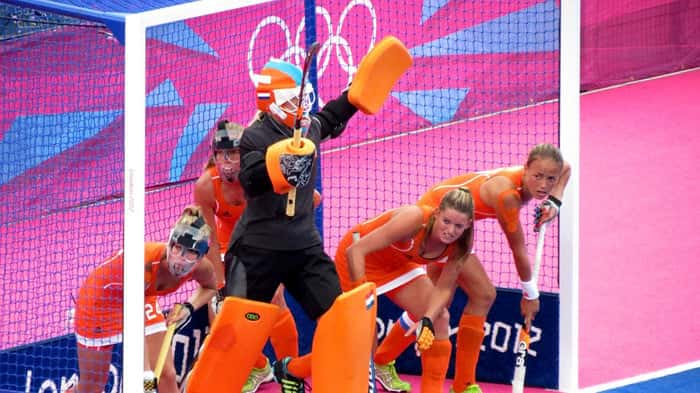 The dutch women's hockey team in London
In 1928 the Netherlands hosted the ninth Olympiad in Amsterdam, and from a team of 266 took six gold, nine silver and four bronze medals to finish eighth among the 46 competing nations. The champions included the boxer Bep van Klaveren, the swimmer Marie Braun, the tandem pair Bernhard Leene and Daan van Dijk, the horseman Charles Pahud de Mortanges in both the individual and team eventing, and the women's gymnastics team.
Winter Olympics
The Dutch first entered the Winter Games in 1928, missed the next edition in 1932, and have been at every one since. Their first Winter gold was a long time coming: it was won in 1964 at Innsbruck by the figure skater Sjoukje Dijkstra, who took the ladies' singles by a huge margin and who died in May 2024 at the age of 82.
From then on it was the speed skaters who took over. At Grenoble in 1968 Kees Verkerk won the men's 1500 metres, Carry Geijssen the women's 1000 and Ans Schut the women's 3000, and the Netherlands has been the leading skating nation at most Games since. Its biggest hauls were 24 medals at Sochi in 2014 and 20 at Milano Cortina in 2026.
The Modern Era
The Dutch won 25 medals at Sydney in 2000, including 12 gold, then 36 at Tokyo in 2021 – still their record total at a single Games – where Sifan Hassan won the 5000 and 10,000 metres and took bronze in the 1500.
Paris 2024 was better again at the top of the table. From 273 athletes in 26 sports the Netherlands won 15 gold, 7 silver and 12 bronze, 34 in all, for sixth place and a national record for golds at one Games. The track cyclist Harrie Lavreysen won three of them, in the team sprint, the sprint and the keirin; Hassan won the marathon in an Olympic record and added bronzes in the 5000 and 10,000 metres; Femke Bol won the mixed 4 x 400 metres relay and medalled twice more; and both the men's and the women's hockey teams took gold.
At Milano Cortina in 2026 the Netherlands finished third in the medal table, its best ever placing at a Winter Games, with 10 gold, 7 silver and 3 bronze. The 10 golds beat the previous national best of eight. Every one of the 20 medals came from skating: Femke Kok, Jutta Leerdam, Antoinette Rijpma-de Jong, Marijke Groenewoud and Jorrit Bergsma won on the long track, while Xandra Velzeboer and Jens van 't Wout took two short track titles apiece and the men added the 5000 metres relay.
Trivia
- The French boy who coxed the Dutch winning pair in the rowing at the 1900 Olympics has never been identified. Brandt and Klein pulled him out of the crowd in Paris because their own cox was too heavy, and he disappeared again after the photographs were taken. Estimates of his age range from about seven to thirteen, and if the lower figures are right he is the youngest Olympic champion of all time.
- The Netherlands took part in the equestrian events of the 1956 Games, held in Stockholm in June because of Australian quarantine rules, but did not go to the Melbourne Games later that year. Their single rider there, Alexis Pantchoulidzew, finished 28th in the individual eventing.
- The Netherlands Antilles was dissolved on 10 October 2010, becoming the countries of Curaçao and Sint Maarten and three special municipalities of the Netherlands. The IOC withdrew recognition of its Olympic committee in 2011, since a 1995 rule limits membership to sovereign states. Its athletes competed at London 2012 as independent athletes, and since then have represented either Aruba, which has had its own committee since 1986, or the Netherlands.
- Dutch athlete Jeroen Straathof competed at the Summer and Winter Olympics and the Paralympics. He was ninth in the 1500 metres as a speed skater at the 1994 Winter Olympics, before switching to cycling. At the 2000 Sydney Paralympics he was the pilot on the tandem with the visually impaired Jan Mulder, winning gold in the individual pursuit. He then rode in the Dutch team pursuit squad at the 2004 Athens Olympics, finishing fifth.
Related Pages
- Netherlands at the Winter Olympics
- List of all countries that have participated at the Olympic Games.
- Amsterdam Olympic Games 1928
- About sport in the Netherlands
 Any comments, suggestions, or corrections? Please let us know.